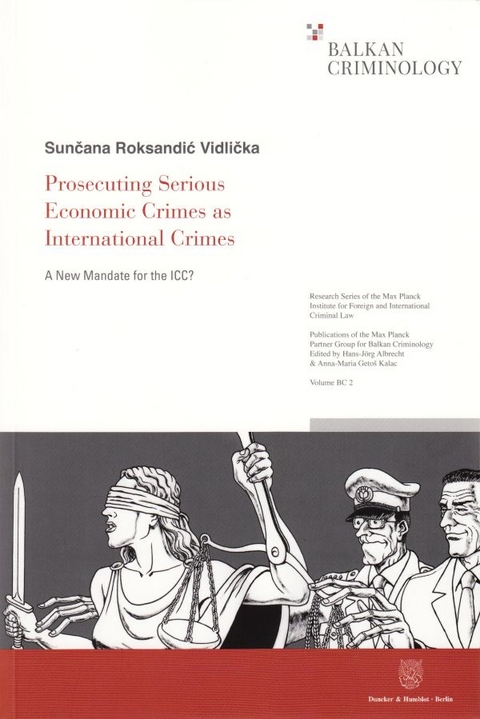
Prosecuting Serious Economic Crimes as International Crimes.
Duncker & Humblot (Verlag)
978-3-428-15199-8 (ISBN)
- Keine Verlagsinformationen verfügbar
- Artikel merken
Serious economic crimes and violations of economic, social and cultural rights have often been neglected in criminal proceedings and reports of truth commissions that have followed in the wake of economic transitions or conflicts. Although such economic crimes often result in a substantial loss of wealth to the overall economy and society of the country in question, they have not been widely nor effectively prosecuted. The Balkan region is no exception to this rule.
The study connects international criminal law with discourses of international human rights law, security studies, (supranational) criminology, political sciences, transitional justice and (economic) criminal law in order to find arguments as to why it is necessary to start prosecuting serious (transitional) economic offences as crimes under international law and why they should find their place in the ICC Statute. The research explains why Art. 7(1)(k) of the ICC Statute is the most plausible means to do so without violating the principle of legality.
»A very valuable scientific work on a highly innovative topic. [It] offers a new theoretic frame in which international economic crimes committed as crimes of the powerful by private corporate economic actors can be related to mechanisms to prevent and punish impunity, such as the ICC.« Prof. Dr. John A.E. Vervaele, Utrecht Law School, President of AIDP
»A serious and thought-provoking study. The topic is of great importance. I could not agree more with the conclusion that the time has come to consider some of the most serious, systematic and widespread economic crimes, breaching economic, social and cultural rights, as crimes under international law.« Prof. Dr. Ksenija Turkovic, Judge, European Court of Human Rights, Strasbourg
»A very courageous and intelligent piece of work.« Prof. Dr. Dr. h.c. Walter Perron, Albert Ludwigs University, Freiburg i.Br.
Sunčana Roksandić Vidlička was a doctorate candidate of the Criminology Department at Max Planck Institute of Foreign and International Criminal Law, writing her dissertation as Cotutelle de thèse between the University of Zagreb's Faculty of Law and Freiburg University's Faculty of Law. She teaches at the Zagreb Faculty of Law and is a member of the Max Planck Partner Group for Balkan Criminology. She is the Head of the Croatian Unit for the International Network of the UNESCO Chair in Bioethics and a member of the UNODC Anti-Corruption Academic Initiative. In 2017 she was a (co-)rapporteur for AIDP. She is the head of the Jean Monnet Project Advanced Seminar in EU Criminal Law and Policy. In 2011 she received the Annual Award for the best young scientist in social sciences by the Society of University Professors and other Scientists of the University of Zagreb. She has published in English, Croatian and German on issues which concern breaching and strengthening international human rights, primarily economic and social ones, by mechanisms of national and international criminal law.
Chapter 1: Introduction
Introduction – Research Questions and Methodological Approach – Transitional Justice Mechanisms – Difference between Violations of Economic and Social Rights and Perpetrating Economic Crimes as State-Corporate or Political White-Collar Crimes – The »Rechtsgut« of Serious International Economic Crimes – Why Pandora's Box Should be Opened – Challenges for the Future – The Content of this Study
Chapter 2: Need for a New Lens: Definition of Serious Economic Crimes of International Concern
Economic Crimes as Crimes of Globalization and a New World Order that Violate Economic, Social, and Cultural Rights – Definition of Economic and Financial Crimes – Introduction to Crimes of the Powerful – Guiding Narratives for (Transitional) Economic Offences as Core Crimes
Chapter 3: Typical Scenarios of Illicit Behaviour of Business Leaders during Armed Conflict and Transition
The Nuremberg Trials of Business Actors – Reasoning and Background for Topic Choice – Violations of Economic, Social, and Cultural Rights during Armed Conflict and Applicable Crimes – From van Anraat to Khulumani and Hernadi
Chapter 4: Transitional Justice
Introductory Remarks – Narratives of Transitional Justice and the Place for Economic Rights Violations – A Way Forward – Truth Commissions and Trials within the Transitional Justice Framework – European Court of Human Rights
Chapter 5: New Discourse of Human Security within an International Criminal Justice Agenda
Human and International Security – Rechtsgut and Constitutional Commitments
Chapter 6: Why and How Pandora's Box Should be Opened: The Importance of Invoking International Criminal Law for Combating Severe (Transitional) Economic Crimes
Initial Remarks – Core International Criminal Law and Transnational Criminal Law – Discourse of International Criminal Law and Globalization Processes – Voices of the Opposition – Why Would the ICC be Effective in Prosecuting Serious (Transitional) Economic Crimes? – Alien Tort Statute – Legal Challenges and Things to Consider – A Way Forward
Chapter 7: Conclusion: Expanding the Ratione Materiae Jurisdiction of the International Criminal Court: Which Offence(s) and where to Start?
Epilogue
Bibliography
| Erscheinungsdatum | 07.02.2018 |
|---|---|
| Reihe/Serie | Research Series of the Max Planck Institute for Foreign and International Criminal Law. Series BC: Publications of the Max Planck Partner Group for Balkan Criminology ; 2 |
| Zusatzinfo | XVIII, 529 S. |
| Verlagsort | Berlin |
| Sprache | englisch |
| Maße | 148 x 224 mm |
| Gewicht | 675 g |
| Themenwelt | Recht / Steuern ► EU / Internationales Recht |
| Recht / Steuern ► Öffentliches Recht ► Völkerrecht | |
| Recht / Steuern ► Strafrecht ► Kriminologie | |
| Schlagworte | Balkan Criminology • Economic crimes • Globalization • ICC |
| ISBN-10 | 3-428-15199-2 / 3428151992 |
| ISBN-13 | 978-3-428-15199-8 / 9783428151998 |
| Zustand | Neuware |
| Informationen gemäß Produktsicherheitsverordnung (GPSR) | |
| Haben Sie eine Frage zum Produkt? |
aus dem Bereich