


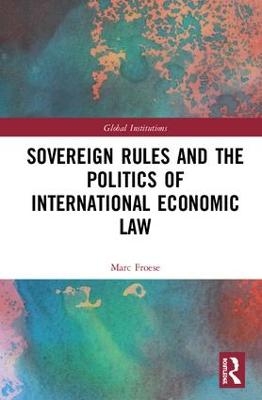
Sovereign Rules and the Politics of International Economic Law
Seiten
2018
Routledge (Verlag)
978-0-8153-6175-6 (ISBN)
Routledge (Verlag)
978-0-8153-6175-6 (ISBN)
This volume argues that the extensive development of international economic law makes it impossible to discuss international political economy and international law as if they were mutually exclusive processes, or even as if they were separate and mutually reinforcing.
How ought scholars and students to approach the rapidly expanding and highly multidisciplinary study of international economic law? Academics in the field of international political economy used to take for granted that they worked with the overarching concepts of rules and governance, while legal scholars analyzed treaties and doctrines. However, over the past twenty years formerly disparate fields of study have converged in a complex terrain, where academic researchers and governmental policy analysts use a pluralistic set of theoretical and methodological tools to study the ongoing development of international economic law.
This volume argues that the extensive development of international economic law makes it impossible to discuss international political economy and international law as if they were mutually exclusive processes, or even as if they were separate and mutually reinforcing. Rather, we must think of them as a deeply interconnected set of rapidly evolving activities. This is a paradigm shift in which we cease to think about an international system in which politics and law interact, and begin to think about an international system in which politics take place in a legal frame. Froese terms this a shift from politics and law, to the politics of international economic law.
This book does for political economy what others have already done for law – introduces political scientists, economists, and other practitioners of IPE, to the potential of engaging with legal theory and method; it will be of great interest to scholars in a range of areas including IPE, global governance, IR and international law.
How ought scholars and students to approach the rapidly expanding and highly multidisciplinary study of international economic law? Academics in the field of international political economy used to take for granted that they worked with the overarching concepts of rules and governance, while legal scholars analyzed treaties and doctrines. However, over the past twenty years formerly disparate fields of study have converged in a complex terrain, where academic researchers and governmental policy analysts use a pluralistic set of theoretical and methodological tools to study the ongoing development of international economic law.
This volume argues that the extensive development of international economic law makes it impossible to discuss international political economy and international law as if they were mutually exclusive processes, or even as if they were separate and mutually reinforcing. Rather, we must think of them as a deeply interconnected set of rapidly evolving activities. This is a paradigm shift in which we cease to think about an international system in which politics and law interact, and begin to think about an international system in which politics take place in a legal frame. Froese terms this a shift from politics and law, to the politics of international economic law.
This book does for political economy what others have already done for law – introduces political scientists, economists, and other practitioners of IPE, to the potential of engaging with legal theory and method; it will be of great interest to scholars in a range of areas including IPE, global governance, IR and international law.
Marc D. Froese is Professor of Political Science and Founding Director, International Studies Program at Burman University, Canada.
1. Introduction: Sovereign Rules 2. The Politics of International Economic Law 3. Legal Theory as Analytic Lens 4. Legal Development at the WTO 5. Regionalism and the Centralization of Trade Governance 6. Legal Development without Multilateral Coordination 7. Creating International Economic Law Beyond the State 8. Conclusion: Political Futures and the Changing Terrain of International Economic Law
| Erscheinungsdatum | 06.05.2018 |
|---|---|
| Reihe/Serie | Global Institutions |
| Zusatzinfo | 5 Tables, black and white; 20 Line drawings, black and white; 20 Illustrations, black and white |
| Verlagsort | New York |
| Sprache | englisch |
| Maße | 138 x 216 mm |
| Gewicht | 385 g |
| Themenwelt | Recht / Steuern ► EU / Internationales Recht |
| Sozialwissenschaften ► Politik / Verwaltung | |
| Wirtschaft | |
| ISBN-10 | 0-8153-6175-0 / 0815361750 |
| ISBN-13 | 978-0-8153-6175-6 / 9780815361756 |
| Zustand | Neuware |
| Informationen gemäß Produktsicherheitsverordnung (GPSR) | |
| Haben Sie eine Frage zum Produkt? |
Mehr entdecken
aus dem Bereich

aus dem Bereich
Textausgabe mit einer Einführung von Prof. em. Dr. Roland Bieber
Buch | Softcover (2024)
Nomos (Verlag)
CHF 27,85


