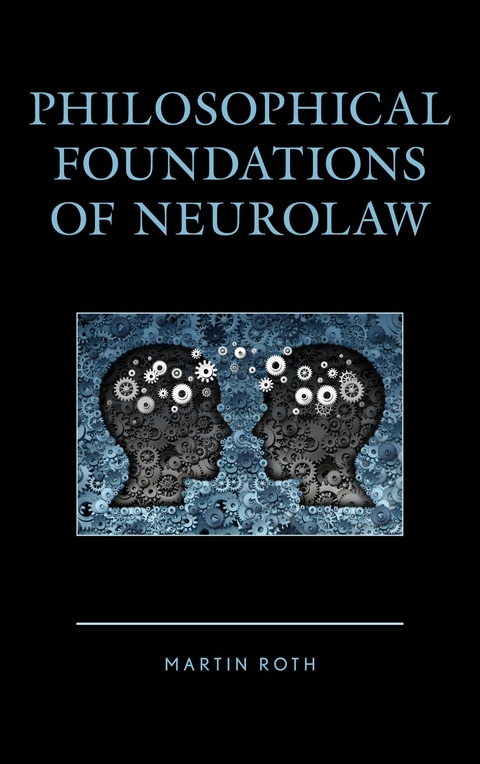
Philosophical Foundations of Neurolaw (eBook)
236 Seiten
Lexington Books (Verlag)
978-1-4985-3967-8 (ISBN)
As neuroscience continues to reveal the biological basis of human thought and behavior, what impact will this have on legal theory and practice? The emerging field of neurolaw seeks to address this question, but doing so adequately requires confronting difficult philosophical issues surrounding the nature of mind, free will, rationality, and responsibility. In The Philosophical Foundations of Neurolaw, Martin Roth claims that the central philosophical issue facing neurolaw is whether we can reconcile the conception of ourselves as free, rational, and responsible agents with the conception of ourselves as complex bio-chemical machines. Roth argues that we can reconcile these conceptions. To show this, Roth develops and defends an account of free will that identifies free will with the capacity to respond to rational demands, and he argues that this capacity is at the foundation of our thinking about responsibility. Roth also shows how the mind sciences can explain this capacity, thus revealing that a purely physical system can have the kind of free will that is relevant to responsible agency. Along the way, Roth critiques a number of arguments that purport to show that the kind of reconciliation provided is not possible. Roth concludes that though we should rethink our legal system in important ways, both in light of his account of free will and what neuroscience is poised to reveal, neuroscience does not threaten the law's core commitment to responsible agency.
Martin Roth is associate professor of philosophy at Drake University.
Chapter 1: Two ImagesChapter 2: Fusion ConfusionChapter 3: Spiderman, Doing Whatever a Spider CanChapter 4: What a Stupid I Am!Chapter 5: Dasein DesignChapter 6: Fusion FinalizedChapter 7: Bad BrainsChapter 8: fMRIs Are Watching YouChapter 9: Does the Legal System Have a Diminished Capacity?Appendix: Court Cases and Legal Doctrine
| Zusatzinfo | 3 Illustrations including: - 3 Halftones, Black & White including Black & White Photographs. |
|---|---|
| Verlagsort | Lanham |
| Sprache | englisch |
| Themenwelt | Geisteswissenschaften ► Philosophie ► Allgemeines / Lexika |
| Geisteswissenschaften ► Philosophie ► Ethik | |
| Geisteswissenschaften ► Philosophie ► Philosophie der Neuzeit | |
| Geisteswissenschaften ► Psychologie ► Biopsychologie / Neurowissenschaften | |
| Medizin / Pharmazie ► Gesundheitswesen | |
| Naturwissenschaften ► Biologie ► Humanbiologie | |
| Naturwissenschaften ► Biologie ► Zoologie | |
| Recht / Steuern ► EU / Internationales Recht | |
| Recht / Steuern ► Strafrecht | |
| Schlagworte | ADD • ADHD • Being • brain • brain scan • Compatibilism • criminal justice • Criminal Law • Dasein • Descartes • desert and punishment • diminished capacity • Dualism • Eagleman • euthyphro • fMRI • Free Will • Functionalism • Fusion • Legal philosophy • legal theory • leibniz • Materialism • Mental Health • Mind • M'Naghten Rule • moral responsibility • MRI • neuroatypical • neuro-imaging • Neurolaw • Neuroscience and law • Norms • Plato • predestination • predetermination • Psychology • Public Policy • Rationality • reactive attitudes • reason • Robert Kane • Socrates |
| ISBN-10 | 1-4985-3967-X / 149853967X |
| ISBN-13 | 978-1-4985-3967-8 / 9781498539678 |
| Informationen gemäß Produktsicherheitsverordnung (GPSR) | |
| Haben Sie eine Frage zum Produkt? |
 EPUB (Adobe DRM)
Kopierschutz: Adobe-DRM
Adobe-DRM ist ein Kopierschutz, der das eBook vor Mißbrauch schützen soll. Dabei wird das eBook bereits beim Download auf Ihre persönliche Adobe-ID autorisiert. Lesen können Sie das eBook dann nur auf den Geräten, welche ebenfalls auf Ihre Adobe-ID registriert sind.
Details zum Adobe-DRM
Dateiformat: EPUB (Electronic Publication)
EPUB ist ein offener Standard für eBooks und eignet sich besonders zur Darstellung von Belletristik und Sachbüchern. Der Fließtext wird dynamisch an die Display- und Schriftgröße angepasst. Auch für mobile Lesegeräte ist EPUB daher gut geeignet.
Systemvoraussetzungen:
PC/Mac: Mit einem PC oder Mac können Sie dieses eBook lesen. Sie benötigen eine
eReader: Dieses eBook kann mit (fast) allen eBook-Readern gelesen werden. Mit dem amazon-Kindle ist es aber nicht kompatibel.
Smartphone/Tablet: Egal ob Apple oder Android, dieses eBook können Sie lesen. Sie benötigen eine
Geräteliste und zusätzliche Hinweise
Buying eBooks from abroad
For tax law reasons we can sell eBooks just within Germany and Switzerland. Regrettably we cannot fulfill eBook-orders from other countries.
aus dem Bereich