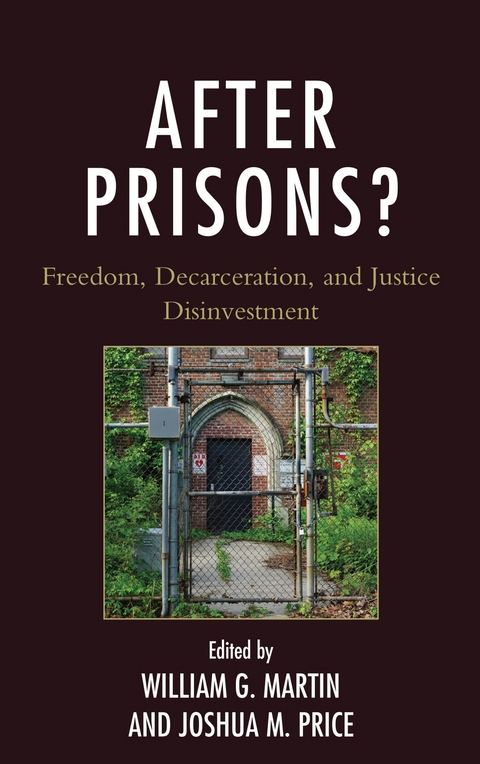
After Prisons? (eBook)
156 Seiten
Lexington Books (Verlag)
978-1-4985-3916-6 (ISBN)
As recently as five years ago mass incarceration was widely considered to be a central, permanent feature of the political and social landscape. The number of people in U.S. prisons is still without historic parallel anywhere in the world or in U.S. history. But in the last few years, the population has decreased, in some states by almost a third. A broad consensus is emerging to reduce prison rolls. Politicians have called for repealing the harshest sentencing laws of the war on drugs, abolishing mandatory minimums and closing correctional facilities. Does the decrease in the prison population herald the dismantling of mass incarceration? This book provides an answer. Drawing on original research from across New York State, the contributors argue that while massive decarceration is taking place, the outcome to date is not the one wished for by reformers, namely a more just system. While drug law reform is clearly upon us, for example, a moral panic about heroin addiction and phantom meth labs has recently reached a fever pitch. As the penitentiary population drops and prisons close, the number of people in jail has swelled. New intelligence-led policing, and the rise of a reentry industry together have led to more surveillance and less social justice. Together these developments lead to justice disinvestment as the state sheds direct responsibility for the criminal justice system to the private and non-profit sector, while it extends its reach through new forms of community-based supervision, surveillance and policing into poor neighborhoods and communities of color.Celebration may be premature, in other words. Having endowed a group that is already disproportionately poor and people of color with the stigma of criminality, the state has left the formerly incarcerated and their communities to their fate. The future we face appears to be neither emancipatory reform nor simply the continuation of past mass incarceration. The challenge of freedom, on a scale not seen since the Reconstruction, remains before us.
William G. Martin and Joshua M. Price are professors in the Sociology Department of the State University of New York at Binghamton.
Introduction: From Mass Imprisonment to Decarceration and Justice Disinvestment, William G. MartinChapter 1: The Prison Town Boom and Bust in the Empire State, William G. Martin, John Major Eason, and Luis R. Gonzalez Chapter 2: Media and the New War on Drugs: Governing through Meth, Kevin Revier, Chungse Jung, and William G. MartinChapter 3: From the Carceral Leviathan to the Police State: Policing Decarceration in New York State, Brendan McQuadeChapter 4: Serving Two Masters? Reentry Task Forces and Justice Disinvestment,Joshua M. PriceChapter 5: Is This What Decarceration Looks Like? Rising Jail Incarceration in Upstate New York, Andrew J. PragaczConclusion: A New Reconstruction?, Joshua M. Price and William G. Martin
| Erscheint lt. Verlag | 4.8.2016 |
|---|---|
| Co-Autor | John Major Eason, Luis R. Gonzalez, Chungse Jung, William G. Martin, Brendan McQuade, Andrew J. Pragacz, Joshua M. Price, Kevin Revier |
| Zusatzinfo | 16 Illustrations including: - 14 Black & White Illustrations; - 2 Tables. |
| Sprache | englisch |
| Themenwelt | Recht / Steuern ► Strafrecht ► Kriminologie |
| Sozialwissenschaften ► Pädagogik | |
| Schlagworte | criminal justice • Criminology • Decarceration • New York State • Penology • Prison system |
| ISBN-10 | 1-4985-3916-5 / 1498539165 |
| ISBN-13 | 978-1-4985-3916-6 / 9781498539166 |
| Informationen gemäß Produktsicherheitsverordnung (GPSR) | |
| Haben Sie eine Frage zum Produkt? |
 EPUB (Adobe DRM)
Kopierschutz: Adobe-DRM
Adobe-DRM ist ein Kopierschutz, der das eBook vor Mißbrauch schützen soll. Dabei wird das eBook bereits beim Download auf Ihre persönliche Adobe-ID autorisiert. Lesen können Sie das eBook dann nur auf den Geräten, welche ebenfalls auf Ihre Adobe-ID registriert sind.
Details zum Adobe-DRM
Dateiformat: EPUB (Electronic Publication)
EPUB ist ein offener Standard für eBooks und eignet sich besonders zur Darstellung von Belletristik und Sachbüchern. Der Fließtext wird dynamisch an die Display- und Schriftgröße angepasst. Auch für mobile Lesegeräte ist EPUB daher gut geeignet.
Systemvoraussetzungen:
PC/Mac: Mit einem PC oder Mac können Sie dieses eBook lesen. Sie benötigen eine
eReader: Dieses eBook kann mit (fast) allen eBook-Readern gelesen werden. Mit dem amazon-Kindle ist es aber nicht kompatibel.
Smartphone/Tablet: Egal ob Apple oder Android, dieses eBook können Sie lesen. Sie benötigen eine
Geräteliste und zusätzliche Hinweise
Buying eBooks from abroad
For tax law reasons we can sell eBooks just within Germany and Switzerland. Regrettably we cannot fulfill eBook-orders from other countries.
aus dem Bereich