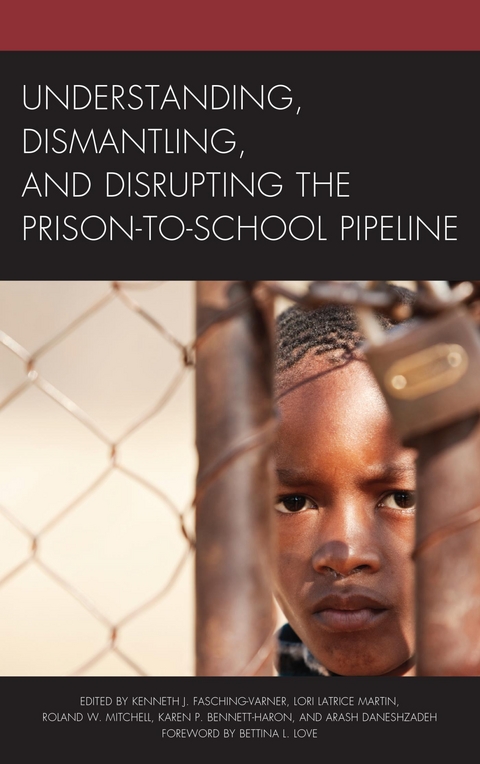
Understanding, Dismantling, and Disrupting the Prison-to-School Pipeline (eBook)
290 Seiten
Lexington Books (Verlag)
978-1-4985-3495-6 (ISBN)
This volume examines the school-to-prison pipeline, a concept that has received growing attention over the past 10-15 years in the United States. The "e;pipeline"e; refers to a number of interrelated concepts and activities that most often include the criminalization of students and student behavior, the police-like state found in many schools throughout the country, and the introduction of youth into the criminal justice system at an early age. The school-to-prison pipeline negatively and disproportionally affects communities of color throughout the United States, particularly in urban areas. Given the demographic composition of public schools in the United States, the nature of student performance in schools over the past 50 years, the manifestation of school-to-prison pipeline approaches pervasive throughout the country and the world, and the growing incarceration rates for youth, this volume explores this issue from the sociological, criminological, and educational perspectives. Understanding, Dismantling, and Disrupting the Prison-to-School Pipeline has contributions from scholars and practitioners who work in the fields of sociology, counseling, criminal justice, and who are working to dismantle the pipeline. While the academic conversation has consistently called the pipeline 'school-to-prison,' including the framing of many chapters in this book, the economic and market forces driving the prison-industrial complex urge us to consider reframing the pipeline as one working from 'prison-to-school.' This volume points toward the tensions between efforts to articulate values of democratic education and schooling against practices that criminalize youth and engage students in reductionist and legalistic manners.
Kenneth J. Fasching-Varner is the Shirley B. Barton Endowed Associate Professor of Education and director of the Higher Education Administration Program at Louisiana State University.Lori Latrice Martin is associate professor of sociology and African & African American studies at Louisiana State University.Roland Mitchell is the Jo Ellen Levy Yates Endowed Professor and associate dean of research engagement and graduate studies in the College of Human Sciences and Education at Louisiana State University.Hon. Karen P. Bennett-Haron serves as Justice of the Peace in Department 7 for the Las Vegas Justice Court, and is past Chief Justice of the court.Arash Daneshzadeh is a faculty member at the University of San Francisco School of Education, and director of Programs for Communities United for Restorative Youth Justice (CURYJ).
Foreword, Bettina L. LoveChapter 1. Free-Market Super Predators and the Neo-liberal Engineering of Crisis: Examining 21st Century Educational & Penal Realism, Kenneth J. Fasching-Varner, Lori L. Martin, Roland W. Mitchell, Karen P. Bennett-Haron, & Arash DaneshzadehChapter 2. Too Much, Too Little, But Never Too Late: Countering the Extremes in Gifted and Special Education for Black and Hispanic Students, Donna Y. Ford, Gilman W. Whiting, Ramon B. Goings, and Sheree N. AlexanderChapter 3. Pipeline in Crisis: A Call to Sociological and Criminological Studies Scholars to Dismantle the School-to-Prison Pipeline, Melinda Jackson, Tifanie Pulley, and Dari GreenChapter 4. “I got in trouble, but I really didn’t get caught:” The discursive construction of ‘Throwaway Youth’, Tracey M. Pyscher and Brian D. LozenskiChapter 5. Lyrical Interventions: Hip Hop, Counseling Education, and School-to-Prison, Arash Daneshzadeh and Ahmad WashingtonChapter 6. Crapitalism: Toward a Fantasyland in the Wal-Martization of America’s Education and Criminal Justice System, Dari Green, Melinda Jackson, and Tifanie PulleyChapter 7. Loving To Read…And Other Things of Which I Have Become Ashamed, Michael J. SeaberryChapter 8. Breaking the Pipeline: Using Restorative Justice to Lead the Way, Kerii Landry-ThomasChapter 9. In and of Itself a Risk Factor: Exclusionary Discipline and the School-to-Prison Pipeline, Russell J. Skiba, Mariella I. Arredondo, and Natasha T. WilliamsChapter 10. Unpacking Classroom Discipline Pedagogy: Intent vs. Impact, Tonya Walls, Janessa Schilmoeller, Irvin Guerrero, and Christine ClarkChapter 11. The Role of Teacher Educators in the School-To-Prison Pipeline: A Critical Look at Both a Traditional Teacher Education Program and an Alternative Certification Route Model, James L. Hollar and Jesslyn R. HollarChapter 12. Exiting the Pipeline: The Role of a Digital Literacy Acquisition Program within the Orleans Parish Prison Reentry Process, Gloria E. Jacobs, Elizabeth Withers, and Jill CastekChapter 13. Punishing Trauma: How Schools Contribute to the Carceral Continuum Through It’s Response to Traumatic Experiences, Devon Tyrone Wade and Kasim S. OrtizChapter 14. Still Gifted: Understanding the Role of Racialized Dis/ability in the School-to-Prison Pipeline, Kelsey M. JonesChapter 15. The Fight to Be Free: Exclusionary Discipline Practices and the School-to-Prison Pipeline, Runell KingChapter 16. The Criminalization of Blackness and the School-to-Prison Pipeline, Jahaan ChandlerChapter 17. Growing Teachers, Not Prisoners: The Potential for Grow Your Own Teacher Preparation Programs to Disrupt the School-to-Prison Pipeline, George Sirrakos Jr. and Tabetha Bernstein-Danis
| Erscheint lt. Verlag | 6.12.2016 |
|---|---|
| Co-Autor | Sheree N. Alexander, Irvin Guerrero, Jesslyn Hollar, Jim Hollar, Melinda Jackson, Gloria E. Jacobs, Michael E. Jennings, Kelsey M. Jones, Runell J. King, Kerii Landry-Thomas, Brian D. Lozenski, Mariella I. Arredondo, Kasim Ortiz, Tifanie W. Pulley, Tracey M. Pyscher, Janessa Schilmoller, Michael J. Seaberry, George Sirrakos, Russell J. Skiba, Devon Wade, Tonya Walls, Ahmad Washington, Tabetha Bernstein-Danis, Gilman W. Whiting, Natasha Williams, Elizabeth Withers, Jill Castek, Jahaan Chandler, Christine Clark, Donna Y. Ford, Ramon B. Goings, Dari Green |
| Zusatzinfo | 8 Illustrations including: - 4 Black & White Illustrations; - 4 Tables. |
| Sprache | englisch |
| Themenwelt | Recht / Steuern ► Strafrecht ► Kriminologie |
| Sozialwissenschaften ► Ethnologie | |
| Sozialwissenschaften ► Pädagogik ► Allgemeines / Lexika | |
| Sozialwissenschaften ► Pädagogik ► Bildungstheorie | |
| Sozialwissenschaften ► Soziologie | |
| Schlagworte | Courts • Criminology • Discipline • Economics • Education • Neoliberalism • Police • Prison • punish • school • School-to-Prison • Violence |
| ISBN-10 | 1-4985-3495-3 / 1498534953 |
| ISBN-13 | 978-1-4985-3495-6 / 9781498534956 |
| Informationen gemäß Produktsicherheitsverordnung (GPSR) | |
| Haben Sie eine Frage zum Produkt? |
 EPUB (Adobe DRM)
Kopierschutz: Adobe-DRM
Adobe-DRM ist ein Kopierschutz, der das eBook vor Mißbrauch schützen soll. Dabei wird das eBook bereits beim Download auf Ihre persönliche Adobe-ID autorisiert. Lesen können Sie das eBook dann nur auf den Geräten, welche ebenfalls auf Ihre Adobe-ID registriert sind.
Details zum Adobe-DRM
Dateiformat: EPUB (Electronic Publication)
EPUB ist ein offener Standard für eBooks und eignet sich besonders zur Darstellung von Belletristik und Sachbüchern. Der Fließtext wird dynamisch an die Display- und Schriftgröße angepasst. Auch für mobile Lesegeräte ist EPUB daher gut geeignet.
Systemvoraussetzungen:
PC/Mac: Mit einem PC oder Mac können Sie dieses eBook lesen. Sie benötigen eine
eReader: Dieses eBook kann mit (fast) allen eBook-Readern gelesen werden. Mit dem amazon-Kindle ist es aber nicht kompatibel.
Smartphone/Tablet: Egal ob Apple oder Android, dieses eBook können Sie lesen. Sie benötigen eine
Geräteliste und zusätzliche Hinweise
Buying eBooks from abroad
For tax law reasons we can sell eBooks just within Germany and Switzerland. Regrettably we cannot fulfill eBook-orders from other countries.
aus dem Bereich