


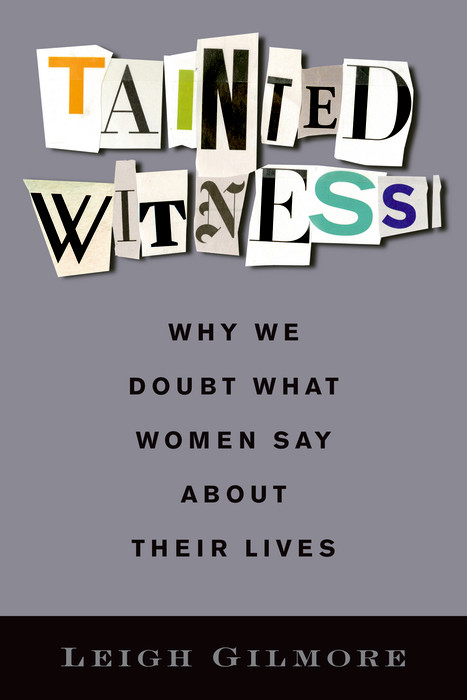
Tainted Witness (eBook)
Columbia University Press (Verlag)
978-0-231-54344-6 (ISBN)
Leigh Gilmore, Distinguished Visiting Professor of Women's and Gender Studies at Wellesley College, is the author of The Limits of Autobiography: Trauma and Testimony (2001) and Autobiographics: A Feminist Theory of Women's Self-Representation (1994) and coeditor of Autobiography and Postmodernism (1994). She has published articles in Feminist Studies, Signs, Women's Studies Quarterly, and Biography, among others, and in numerous collections. She was Dorothy Cruickshank Backstrand Chair of Gender and Women's Studies at Scripps College, professor of English at the Ohio State University, and has held visiting appointments at Brown University, Harvard Divinity School, Northeastern University, the University of California, Santa Cruz, and the University of California, Berkeley.
In 1991, Anita Hill's testimony during Clarence Thomas's Senate confirmation hearing brought the problem of sexual harassment to a public audience. Although widely believed by women, Hill was defamed by conservatives and Thomas was confirmed to the Supreme Court. The tainting of Hill and her testimony is part of a larger social history in which women find themselves caught up in a system that refuses to believe what they say. Hill's experience shows how a tainted witness is not who someone is, but what someone can become. Why are women so often considered unreliable witnesses to their own experiences? How are women discredited in legal courts and in courts of public opinion? Why is women's testimony so often mired in controversies fueled by histories of slavery and colonialism? How do new feminist witnesses enter testimonial networks and disrupt doubt? Tainted Witness examines how gender, race, and doubt stick to women witnesses as their testimony circulates in search of an adequate witness. Judgment falls unequally upon women who bear witness, as well-known conflicts about testimonial authority in the late twentieth and early twenty-first centuries reveal. Women's testimonial accounts demonstrate both the symbolic potency of women's bodies and speech in the public sphere and the relative lack of institutional security and control to which they can lay claim. Each testimonial act follows in the wake of a long and invidious association of race and gender with lying that can be found to this day within legal courts and everyday practices of judgment, defining these locations as willfully unknowing and hostile to complex accounts of harm. Bringing together feminist, literary, and legal frameworks, Leigh Gilmore provides provocative readings of what happens when women's testimony is discredited. She demonstrates how testimony crosses jurisdictions, publics, and the unsteady line between truth and fiction in search of justice.
Leigh Gilmore, Distinguished Visiting Professor of Women's and Gender Studies at Wellesley College, is the author of The Limits of Autobiography: Trauma and Testimony (2001) and Autobiographics: A Feminist Theory of Women's Self-Representation (1994) and coeditor of Autobiography and Postmodernism (1994). She has published articles in Feminist Studies, Signs, Women's Studies Quarterly, and Biography, among others, and in numerous collections. She was Dorothy Cruickshank Backstrand Chair of Gender and Women's Studies at Scripps College, professor of English at the Ohio State University, and has held visiting appointments at Brown University, Harvard Divinity School, Northeastern University, the University of California, Santa Cruz, and the University of California, Berkeley.
AcknowledgmentsIntroduction: Tainted Witness in Testimonial Networks1. Anita Hill, Clarence Thomas, and the Search for an Adequate Witness2. Jurisdictions and Testimonial Networks: Rigoberta Menchú3. Neoliberal Life Narrative: From Testimony to Self-Help4. Witness by Proxy: Girls in Humanitarian Storytelling5. Tainted Witness in Law and Literature: Nafissatou Diallo and Jamaica KincaidConclusion: Testimonial Publics—#BlackLivesMatter and Claudia Rankine's CitizenNotesBibliographyIndex
| Erscheint lt. Verlag | 6.3.2017 |
|---|---|
| Reihe/Serie | Gender and Culture Series | Gender and Culture Series |
| Verlagsort | New York |
| Sprache | englisch |
| Themenwelt | Geisteswissenschaften ► Sprach- / Literaturwissenschaft ► Anglistik / Amerikanistik |
| Geisteswissenschaften ► Sprach- / Literaturwissenschaft ► Literaturwissenschaft | |
| Recht / Steuern ► Allgemeines / Lexika | |
| Recht / Steuern ► EU / Internationales Recht | |
| Recht / Steuern ► Strafrecht ► Strafverfahrensrecht | |
| Sozialwissenschaften ► Politik / Verwaltung ► Politische Theorie | |
| Sozialwissenschaften ► Soziologie ► Allgemeines / Lexika | |
| Sozialwissenschaften ► Soziologie ► Gender Studies | |
| ISBN-10 | 0-231-54344-1 / 0231543441 |
| ISBN-13 | 978-0-231-54344-6 / 9780231543446 |
| Informationen gemäß Produktsicherheitsverordnung (GPSR) | |
| Haben Sie eine Frage zum Produkt? |
 PDF (Wasserzeichen)
Größe: 827 KB
DRM: Digitales Wasserzeichen
Dieses eBook enthält ein digitales Wasserzeichen und ist damit für Sie personalisiert. Bei einer missbräuchlichen Weitergabe des eBooks an Dritte ist eine Rückverfolgung an die Quelle möglich.
Dateiformat: PDF (Portable Document Format)
Mit einem festen Seitenlayout eignet sich die PDF besonders für Fachbücher mit Spalten, Tabellen und Abbildungen. Eine PDF kann auf fast allen Geräten angezeigt werden, ist aber für kleine Displays (Smartphone, eReader) nur eingeschränkt geeignet.
Systemvoraussetzungen:
PC/Mac: Mit einem PC oder Mac können Sie dieses eBook lesen. Sie benötigen dafür einen PDF-Viewer - z.B. den Adobe Reader oder Adobe Digital Editions.
eReader: Dieses eBook kann mit (fast) allen eBook-Readern gelesen werden. Mit dem amazon-Kindle ist es aber nicht kompatibel.
Smartphone/Tablet: Egal ob Apple oder Android, dieses eBook können Sie lesen. Sie benötigen dafür einen PDF-Viewer - z.B. die kostenlose Adobe Digital Editions-App.
Buying eBooks from abroad
For tax law reasons we can sell eBooks just within Germany and Switzerland. Regrettably we cannot fulfill eBook-orders from other countries.
 EPUB (Adobe DRM)
Kopierschutz: Adobe-DRM
Adobe-DRM ist ein Kopierschutz, der das eBook vor Mißbrauch schützen soll. Dabei wird das eBook bereits beim Download auf Ihre persönliche Adobe-ID autorisiert. Lesen können Sie das eBook dann nur auf den Geräten, welche ebenfalls auf Ihre Adobe-ID registriert sind.
Details zum Adobe-DRM
Dateiformat: EPUB (Electronic Publication)
EPUB ist ein offener Standard für eBooks und eignet sich besonders zur Darstellung von Belletristik und Sachbüchern. Der Fließtext wird dynamisch an die Display- und Schriftgröße angepasst. Auch für mobile Lesegeräte ist EPUB daher gut geeignet.
Systemvoraussetzungen:
PC/Mac: Mit einem PC oder Mac können Sie dieses eBook lesen. Sie benötigen eine
eReader: Dieses eBook kann mit (fast) allen eBook-Readern gelesen werden. Mit dem amazon-Kindle ist es aber nicht kompatibel.
Smartphone/Tablet: Egal ob Apple oder Android, dieses eBook können Sie lesen. Sie benötigen eine
Geräteliste und zusätzliche Hinweise
Buying eBooks from abroad
For tax law reasons we can sell eBooks just within Germany and Switzerland. Regrettably we cannot fulfill eBook-orders from other countries.
aus dem Bereich


