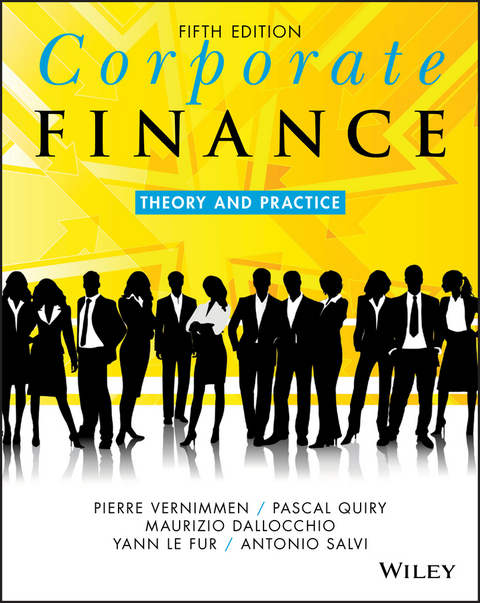
Corporate Finance (eBook)
John Wiley & Sons (Verlag)
978-1-119-42452-9 (ISBN)
The essential corporate finance text, updated with new data
Corporate Finance has long been a favourite among both students and professionals in the field for its unique blend of theory and practice with a truly global perspective. The fact that the authors are well-known academics and professionals in the world of mergers and acquisitions (M&A) and investment explains this popularity. This new Fifth Edition continues the tradition, offering a comprehensive tour of the field through scenario-based instruction that places concept and application in parallel. A new chapter has been added, devoted to the financial management of operating buildings that aims to answer questions such as, 'to own or to rent?' 'variable or fixed rents?' etc. The book's companion website features regularly updated statistics, graphs and charts, along with study aids including quizzes, case studies, articles, lecture notes and computer models, reflecting the author team's deep commitment to facilitating well-rounded knowledge of corporate finance topics. In addition, a monthly free newsletter keeps the readers updated on the latest developments in corporate finance as well as the book's Facebook page, which publishes a post daily.
Financial concepts can be quite complex, but a familiar setting eases understanding while immediate application promotes retention over simple memorisation. As comprehensive, relevant skills are the goal, this book blends academic and industry perspective with the latest regulatory and practical developments to provide a complete corporate finance education with real-world applicability.
- Blend theory and practice to gain a more relevant understanding of corporate finance concepts
- Explore the field from a truly European perspective for a more global knowledge base
- Learn essential concepts, tools and techniques by delving into real-world applications
- Access up-to-date data, plus quizzes, case studies, lecture notes and more
A good financial manager must be able to analyse a company's economic, financial and strategic situation, and then value it, all while mastering the conceptual underpinnings of all decisions involved. By emphasising the ways in which concepts impact and relate to real-world situations, Corporate Finance provides exceptional preparation for working productively and effectively in the field.
The essential corporate finance text, updated with new data Corporate Finance has long been a favourite among both students and professionals in the field for its unique blend of theory and practice with a truly global perspective. The fact that the authors are well-known academics and professionals in the world of mergers and acquisitions (M&A) and investment explains this popularity. This new Fifth Edition continues the tradition, offering a comprehensive tour of the field through scenario-based instruction that places concept and application in parallel. A new chapter has been added, devoted to the financial management of operating buildings that aims to answer questions such as, to own or to rent? variable or fixed rents? etc. The book s companion website features regularly updated statistics, graphs and charts, along with study aids including quizzes, case studies, articles, lecture notes and computer models, reflecting the author team s deep commitment to facilitating well-rounded knowledge of corporate finance topics. In addition, a monthly free newsletter keeps the readers updated on the latest developments in corporate finance as well as the book s Facebook page, which publishes a post daily. Financial concepts can be quite complex, but a familiar setting eases understanding while immediate application promotes retention over simple memorisation. As comprehensive, relevant skills are the goal, this book blends academic and industry perspective with the latest regulatory and practical developments to provide a complete corporate finance education with real-world applicability. Blend theory and practice to gain a more relevant understanding of corporate finance concepts Explore the field from a truly European perspective for a more global knowledge base Learn essential concepts, tools and techniques by delving into real-world applications Access up-to-date data, plus quizzes, case studies, lecture notes and more A good financial manager must be able to analyse a company s economic, financial and strategic situation, and then value it, all while mastering the conceptual underpinnings of all decisions involved. By emphasising the ways in which concepts impact and relate to real-world situations, Corporate Finance provides exceptional preparation for working productively and effectively in the field.
Pierre Vernimmen (deceased) Graduate of HEC and Harvard, was a founding member and first coordinator of the Finance Department at HEC, where he established himself as a leading academic in the field of corporate finance.?In 1973 he joined Paribas, initially as a private equity banker, moving onto the advisory business line (M&A, privatisations, financial restructurings) which he set up and managed from 1993 until his death in 1996. Pascal Quiry (Paris, France) is MD in the Corporate Finance department at BNP Paribas, and affiliate professor of finance at HEC.?He leads two 8-member teams which carry out company valuations and stock exchange transactions (takeover bids, exchange offers, demergers etc.). Pascal is board member of the French Finance Association and member of the American Finance Association. Yann Le Fur?(Paris, France) is a senior associate in the Paris Corporate Finance department of Schroder Salomon Smith Barney, and a lecturer at HEC. He co-manages a team of 5 professionals. Maurizio Dallocchio (Milan, Italy) former Dean of the leading Italian business school Bocconi (Milan) and Lehman Brothers Chair of Corporate Finance. He is also a board member of several listed and unlisted companies and is one of the most distinguished Italian authorities on finance. Antonio Salvi (Milan, Italy) is an Assistant Professor of Finance at Bocconi and the University of Venice where he teaches Corporate Finance. His areas of research cover cost of capital, structure of debt finance and corporate governance.
Preface viii
Frequently used symbols xii
1 What is Corporate finance? 1
Section 1 Financial Analysis? 15
Part One Fundamental Concepts in Financial Analysis 17
2 Cash Flow 19
3 Earnings 29
4 Capital Employed and Invested Capital 44
5 Walking Through from Earnings to Cash Flow 57
6 Getting to Grips with Consolidated Accounts 71
7 How to Cope with the Most Complex Points in Financial Accounts 88
Part Two Financial Analysis and Forecasting 115
8 How to Perform a Financial Analysis 117
9 Margin Analysis: Structure 141
10 Margin Analysis: Risks 164
11 Working Capital and Capital Expenditures 179
12 Financing 201
13 Return on Capital Employed and Return on Equity 216
14 Conclusion and Financial Analysis 235
Section II Investors and Markets 243
Part One Investment Decision Rules 245
15 The Financial Markets 247
16 The Time Value of Money and Net Present Value 267
17 The Internal Rate of Return 284
Part Two The Risk of Securities and the Required Rate of Return 297
18 Risk and Return 299
19 The Required Rate of Return 327
Part Three Financial Securities 345
20 Bonds 347
21 Other DEBT Products 369
22 Shares 384
23 Options 404
24 Hybrid Securities 425
25 Selling Securities 443
Section III Value 469
26 Value and Corporate Finance 471
27 Measuring Value Creation 490
28 Investment Criteria 508
29 The Cost of Capital 526
30 Risk and Investment Analysis 543
31 Valuation Techniques 555
Section IV Corporate Financial Policies 585
Part One Capital Structure Policies 587
32 Capital Structure and the Theory of Perfect Capital Markets 589
33 Capital Structure, Taxes and Organisation Theories 601
34 DEBT, Equity and Options Theory 618
35 Working Out Details: The Design of the Capital Structure 637
Part Two Equity Capital 657
36 Returning Cash to Shareholders 659
37 Distribution in Practice: Dividends and Share Buy-Backs 676
38 Share Issues 692
Part Three DEBT Capital 705
39 Implementing a DEBT Policy 707
Section V Financial Management 725
Part One Corporate Governance and Financial Engineering 727
40 Setting Up a Company or Financing Start-Ups 729
41 Choice of Corporate Structure 748
42 Initial Public Offerings (IPOs) 771
43 Corporate Governance 783
44 Taking Control of A Company 796
45 Mergers and Demergers 819
46 Leveraged Buyouts (LBOs) 836
47 Bankrupicy and Restructing 851
Part Two Managing Working Capital, Cash Flows, Financial Risks and Real Estate 863
48 Managing Working Capital 865
49 Cash Management 878
50 Managing Financial Risks 897
51 Managing Operational Real Estate 922
Epilogue - Finance and Strategy 935
Top 20 Largest Listed Companies 943
Contents 951
Index 961
Preface
This book aims to cover the full scope of corporate finance as it is practised today worldwide.
A way of thinking about finance
We are very pleased with the success of the first three editions of the book. It has encouraged us to retain the approach in order to explain corporate finance to students and professionals. There are four key features that distinguish this book from the many other corporate finance textbooks available on the market today:
- Our strong belief that financial analysis is part of corporate finance. Pierre Vernimmen, who was mentor and partner to some of us in the practice of corporate finance, understood very early on that a good financial manager must first be able to analyse a company’s economic, financial and strategic situation, and then value it, while at the same time mastering the conceptual underpinnings of all financial decisions.
- Corporate Finance is neither a theoretical textbook nor a practical workbook. It is a book in which theory and practice are constantly set off against each other, in the same way as in our daily practice as investors at Monestier Capital, DGPA and Natixis, as board members of several listed and unlisted companies, and as teachers at HEC Paris and Bocconi business schools.
- Emphasis is placed on concepts intended to give you an understanding of situations, rather than on techniques, which tend to shift and change over time. We confess to believing that the former will still be valid in 20 years’ time, whereas the latter will, for the most part, be long forgotten!
- Financial concepts are international, but they are much easier to grasp when they are set in a familiar context. We have tried to give examples and statistics from all around the world to illustrate the concepts.
The five sections
This book starts with an introductory chapter reiterating the idea that corporate financiers are the bridge between the economy and the realm of finance. Increasingly, they must play the role of marketing managers and negotiators. Their products are financial securities that represent rights to the firm’s cash flows. Their customers are bankers and investors. A good financial manager listens to customers and sells them good products at high prices. A good financial manager always thinks in terms of value rather than costs or earnings.
Section I goes over the basics of financial analysis, i.e. understanding the company based on a detailed analysis of its financial statements. We are amazed at the extent to which large numbers of investors neglected this approach during the latest stock-market euphoria. When share prices everywhere are rising, why stick to a rigorous approach? For one thing, to avoid being caught in the crash that inevitably follows.
The return to reason has also returned financial analysis to its rightful place as a cornerstone of economic decision-making. To perform financial analysis, you must first understand the firm’s basic financial mechanics (Chapters 2–5). Next you must master the basic techniques of accounting, including accounting principles, consolidation techniques and certain complexities (Chapters 6 and 7), based on international (IFRS) standards now mandatory in over 80 countries, including the EU (for listed companies), Australia, South Africa and accepted by the SEC for US listing. In order to make things easier for the newcomer to finance, we have structured the presentation of financial analysis itself around its guiding principle: in the long run, a company can survive only if it is solvent and creates value for its shareholders. To do so, it must generate wealth (Chapters 9 and 10), invest (Chapter 11), finance its investments (Chapter 12) and generate a sufficient return (Chapter 13). The illustrative financial analysis of the Italian appliance manufacturer Indesit will guide you throughout this section of the book.
Section II reviews the basic theoretical knowledge you will need to make an assessment of the value of the firm. Here again, the emphasis is on reasoning, which in many cases will become automatic (Chapters 15–19): efficient capital markets, the time value of money, the price of risk, volatility, arbitrage, return, portfolio theory, present value and future value, market risk, beta, etc. Then we review the major types of financial securities: equity, debt and options, for the purposes of valuation, along with the techniques for issuing and placing them (Chapters 20–25).
Section III is devoted to value, to its theoretical foundations and to its computation. Value is the focus of any financier, both its measure and the way it is shared. Over the medium term, creating value is, most of the time, the first aim of managers (Chapters 26–31).
In Section IV, “Corporate financial policies”, we analyse each financial decision in terms of:
- value in the context of the theory of efficient capital markets;
- balance of power between owners and managers, shareholders and debtholders (agency theory);
- communication (signal theory).
Such decisions include choosing a capital structure, investment decisions, cost of capital, dividend policy, share repurchases, capital increases, hybrid security issues, etc.
In this section, we draw your attention to today’s obsession with earnings per share, return on equity and other measures whose underlying basis we have a tendency to forget and which may, in some cases, be only distantly related to value creation. We have devoted considerable space to the use of options (as a technique or a type of reasoning) in each financial decision (Chapters 32–39).
When you start reading Section V, “Financial management”, you will be ready to examine and take the remaining decisions: how to create and finance a start-up, how to organise a company’s equity capital and its governance, buying and selling companies, mergers, demergers, LBOs, bankruptcy and restructuring (Chapters 40–47). Lastly, this section presents working capital management, cash management, the management of the firm’s financial risks and its operational real-estate assets (Chapters 48–51).
Last but not least, the epilogue addresses the question of the links between finance and strategy.
Suggestions for the reader
To make sure that you get the most out of your book, each chapter ends with a summary and a series of problems and questions (over 800 with the solutions provided). We’ve used the last page of the book to provide a crib sheet (the nearly 1000 pages of this book summarised on one page!). For those interested in exploring the topics in greater depth, there is an end-of-chapter bibliography and suggestions for further reading, covering fundamental research papers, articles in the press, published books and websites. A large number of graphs and tables (over 100!) have been included in the body of the text and these can be used for comparative analyses. Finally, there is a fully comprehensive index.
The masculine pronoun has been used throughout this book simply for convenience and brevity. This use is not intended to be discriminatory in any way.
An Internet site with huge and diversified content
www.vernimmen.com provides free access to tools (formulas, tables, statistics, lexicons, glossaries), resources that supplement the book (articles, prospectuses of financial transactions, financial figures for over 16 000 European, North American and emerging countries, listed companies, thesis topics, thematic links, a list of must-have books for your bookshelf, an Excel file providing detailed solutions to all of the problems set in the book), plus problems, case studies and quizzes for testing and improving your knowledge. There is a letterbox for your questions to the authors (we reply within 72 hours, unless, of course, you manage to stump us!). There are questions and answers and much more. The site has its own internal search engine, and new services are added regularly.
A teachers’ area provides teachers with free access to case studies, slides and an Instructor’s Manual, which gives advice and ideas on how to teach all of the topics discussed in the book.
A free monthly newsletter on corporate finance
Since (unfortunately) we can’t bring out a new edition of this book every month, we have set up the Vernimmen.com Newsletter, which is sent out free of charge to subscribers via the web. It contains:
- A conceptual look at a topical corporate finance problem (e.g. accounting for operating and capital leases, financially managing during a deflation phase).
- Statistics and tables that you are likely to find useful in the day-to-day practice of corporate finance (e.g. corporate income tax rates, debt ratios in LBOs).
- A critical review of a financial research paper with a concrete dimension (e.g. The real effect of corporate cash, why don’t US issuers demand European fees for their IPOs?).
- A question left on the vernimmen.com site by a visitor plus a response (e.g. Why do successful groups have such a low debt level? What is an assimilation clause?).
Subscribe to www.vernimmen.com and become one of the many readers of the Vernimmen.com...
| Erscheint lt. Verlag | 17.10.2017 |
|---|---|
| Sprache | englisch |
| Themenwelt | Recht / Steuern ► Wirtschaftsrecht |
| Wirtschaft ► Betriebswirtschaft / Management ► Finanzierung | |
| Schlagworte | Accounting • Australasian corporate finance • Corporate Finance • corporate finance applications • corporate finance case studies • corporate finance concepts • corporate finance essentials • corporate finance fundamentals • corporate finance graduate text • corporate finance introduction • corporate finance quizzes • corporate finance reference • corporate finance resources • corporate finance techniques • Corporate finance textbook • corporate finance theories • corporate finance topics • global corporate finance • learning corporate finance • practical corporate finance corporate finance skills • Rechnungswesen |
| ISBN-10 | 1-119-42452-6 / 1119424526 |
| ISBN-13 | 978-1-119-42452-9 / 9781119424529 |
| Informationen gemäß Produktsicherheitsverordnung (GPSR) | |
| Haben Sie eine Frage zum Produkt? |
 EPUB (Adobe DRM)
Kopierschutz: Adobe-DRM
Adobe-DRM ist ein Kopierschutz, der das eBook vor Mißbrauch schützen soll. Dabei wird das eBook bereits beim Download auf Ihre persönliche Adobe-ID autorisiert. Lesen können Sie das eBook dann nur auf den Geräten, welche ebenfalls auf Ihre Adobe-ID registriert sind.
Details zum Adobe-DRM
Dateiformat: EPUB (Electronic Publication)
EPUB ist ein offener Standard für eBooks und eignet sich besonders zur Darstellung von Belletristik und Sachbüchern. Der Fließtext wird dynamisch an die Display- und Schriftgröße angepasst. Auch für mobile Lesegeräte ist EPUB daher gut geeignet.
Systemvoraussetzungen:
PC/Mac: Mit einem PC oder Mac können Sie dieses eBook lesen. Sie benötigen eine
eReader: Dieses eBook kann mit (fast) allen eBook-Readern gelesen werden. Mit dem amazon-Kindle ist es aber nicht kompatibel.
Smartphone/Tablet: Egal ob Apple oder Android, dieses eBook können Sie lesen. Sie benötigen eine
Geräteliste und zusätzliche Hinweise
Buying eBooks from abroad
For tax law reasons we can sell eBooks just within Germany and Switzerland. Regrettably we cannot fulfill eBook-orders from other countries.
aus dem Bereich