


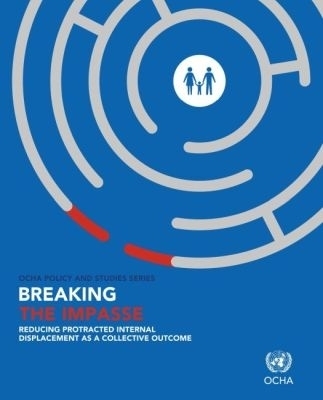
Breaking the Impasse
Reducing Protracted Internal Displacement As a Collective Outcome
Seiten
2017
United Nations (Verlag)
978-92-1-132046-6 (ISBN)
United Nations (Verlag)
978-92-1-132046-6 (ISBN)
- Titel z.Zt. nicht lieferbar
- Portofrei ab CHF 40
- Auch auf Rechnung
- Artikel merken
This OCHA-commissioned study offers a better understanding of protracted internal displacement and related challenges. The study finds that addressing protracted internal displacement is not a purely humanitarian concern, but rather a key development and political challenge.
The global number of internally displaced persons (IDPs) has reached an all-time high, as an increasing number of IDPs remain displaced for years or even decades. Tens of millions of IDPs are dependent on humanitarian assistance or live far below the poverty line in substandard housing without security of tenure, and with no or only limited access to basic services, education and health care. With durable solutions out of reach and facing barriers to leading self-sufficient lives, they are “left behind” despite the promises of the Sustainable Development Goals. In light of these alarming trends and the need for more effective response strategies, this OCHA-commissioned study offers a better understanding of protracted internal displacement and related challenges. The study finds that addressing protracted internal displacement is not a purely humanitarian concern, but rather a key development and political challenge, with humanitarian and, depending on the context, human rights, peace and security, and disaster risk reduction actors at all levels each having a distinct role to play. The study recommends that stakeholders focus on clear and measurable collective outcomes and the reduction of vulnerabilities of IDPs and host communities over time. This approach implicitly recognizes that IDPs should not have to wait until a conflict is fully resolved or all impacts of a disaster have ceased before they can begin rebuilding their lives and move towards self-sufficiency. Through this new approach, millions of IDPs and host communities could secure better access to livelihood opportunities, adequate housing with security of tenure and basic services. The study features five case studies: Colombia, the Democratic Republic of the Congo (DRC), the Philippines, Somalia and Ukraine.
The global number of internally displaced persons (IDPs) has reached an all-time high, as an increasing number of IDPs remain displaced for years or even decades. Tens of millions of IDPs are dependent on humanitarian assistance or live far below the poverty line in substandard housing without security of tenure, and with no or only limited access to basic services, education and health care. With durable solutions out of reach and facing barriers to leading self-sufficient lives, they are “left behind” despite the promises of the Sustainable Development Goals. In light of these alarming trends and the need for more effective response strategies, this OCHA-commissioned study offers a better understanding of protracted internal displacement and related challenges. The study finds that addressing protracted internal displacement is not a purely humanitarian concern, but rather a key development and political challenge, with humanitarian and, depending on the context, human rights, peace and security, and disaster risk reduction actors at all levels each having a distinct role to play. The study recommends that stakeholders focus on clear and measurable collective outcomes and the reduction of vulnerabilities of IDPs and host communities over time. This approach implicitly recognizes that IDPs should not have to wait until a conflict is fully resolved or all impacts of a disaster have ceased before they can begin rebuilding their lives and move towards self-sufficiency. Through this new approach, millions of IDPs and host communities could secure better access to livelihood opportunities, adequate housing with security of tenure and basic services. The study features five case studies: Colombia, the Democratic Republic of the Congo (DRC), the Philippines, Somalia and Ukraine.
United Nations Publications is the official publisher for the UN and it produces over 400 titles each year. The range of subjects covered are as varied as the issues being tackled by the UN as it works for a better world for all. Since the first printing of the UN Charter, this publishing unit has been providing valued information to those in government, academia and business
| Erscheinungsdatum | 03.11.2017 |
|---|---|
| Reihe/Serie | OCHA Policy and Studies Series |
| Verlagsort | New York |
| Sprache | englisch |
| Maße | 208 x 256 mm |
| Gewicht | 535 g |
| Themenwelt | Recht / Steuern ► EU / Internationales Recht |
| Recht / Steuern ► Öffentliches Recht ► Völkerrecht | |
| Sozialwissenschaften ► Politik / Verwaltung | |
| Sozialwissenschaften ► Soziologie | |
| ISBN-10 | 92-1-132046-1 / 9211320461 |
| ISBN-13 | 978-92-1-132046-6 / 9789211320466 |
| Zustand | Neuware |
| Informationen gemäß Produktsicherheitsverordnung (GPSR) | |
| Haben Sie eine Frage zum Produkt? |
Mehr entdecken
aus dem Bereich
aus dem Bereich
Die Rechtsprechung des Gerichtshofs der Europäischen Union, deutscher …
Buch | Softcover (2025)
Nomos (Verlag)
CHF 53,50


