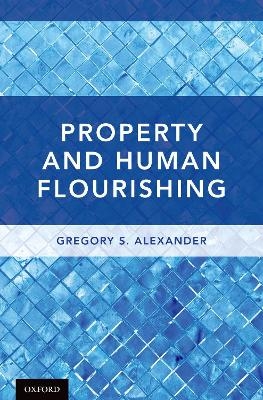
Property and Human Flourishing
Oxford University Press Inc (Verlag)
978-0-19-086074-5 (ISBN)
Rather than identifying any single moral value, this book argues that human flourishing, understood as morally pluralistic and objective, is property's moral foundation. The book goes on to develop a theory that connects ownership and human flourishing with obligations. Owners have obligations to members of the communities that enabled the owners to live flourishing lives by cultivating in their community members certain capabilities that are essential to leading a well-lived life. These obligations are rooted in the interdependence that exists between owners and their community members, and inherent in the human condition.
Obligations have always been inherent in ownership. Owners are not free to inflict nuisances upon their neighbors, for example, by operating piggeries in residential neighborhoods. The human flourishing theory explains why owners at times have obligations that enable their fellow community members to develop certain necessary capabilities, such as health care and security. This is why, for example, farm owners may be required to allow providers of health care and legal assistance to enter their property to assist employees who are migrant workers.
Moving from the abstract and theoretical to the practical, this book considers implications for a wide variety of property issues of importance both in the literature and in modern society. These include questions such as: When is a government's expropriation of property legitimated for the reason it is for public use? May the owner of a historic or architecturally significant house destroy it without restriction? Do institutions that owned African slaves or otherwise profited from the slave trade owe any obligations to members of the African-American community? What insights may be gained from the human flourishing concept into resolving current housing problems like homelessness, eviction, and mortgage foreclosure?
Gregory S. Alexander is the A. Robert Noll Professor of Law at Cornell Law School. He is a nationally renowned expert in property law, and he has taught at Cornell since 1985. Alexander has been a Fellow at the Center for Advanced Study in the Behavioral Sciences, in Palo Alto, California, and at the Max-Planck-Institute for Comparative and International Law, in Hamburg and Heidelberg, Germany. Professor Alexander is a prolific and recognized writer, the winner of the American Publishers Association's 1997 Best Book of the Year in Law award for his work, Commodity and Propriety. His previous Oxford book is Property and Community (edited with Eduardo M. Peñalver) 2010.
Preface
Acknowledgments
Part I: Human Flourishing
Chapter One: Flourishing and Welfare
Part II: Ownership
Chapter Two: Ownership and Obligations
Chapter Three: Community and Communities
Part III: Obligations
Chapter Four: Intergenerational Communities
Chapter Five: The Complexities of Land Reparations
Chapter Six: The Right to Exclude
Chapter Seven: Expropriations and Eminent Domain
Chapter Eight: Of Buildings, Art, and Sperm: The Right to Destroy and the Duty to Preserve
Chapter Nine: Race and Property
Chapter Ten: Homelessness and Other Systemic Housing Problems
Bibliography
Index
| Erscheinungsdatum | 16.04.2018 |
|---|---|
| Verlagsort | New York |
| Sprache | englisch |
| Maße | 236 x 163 mm |
| Gewicht | 635 g |
| Themenwelt | Recht / Steuern ► Allgemeines / Lexika |
| Recht / Steuern ► EU / Internationales Recht | |
| ISBN-10 | 0-19-086074-X / 019086074X |
| ISBN-13 | 978-0-19-086074-5 / 9780190860745 |
| Zustand | Neuware |
| Informationen gemäß Produktsicherheitsverordnung (GPSR) | |
| Haben Sie eine Frage zum Produkt? |
aus dem Bereich