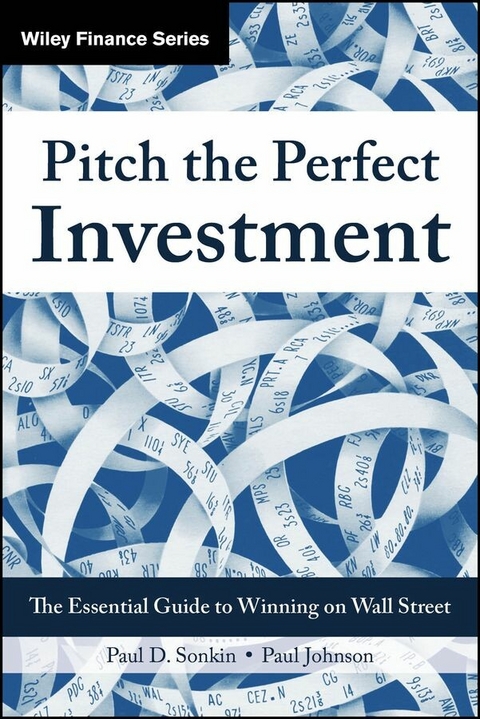
Pitch the Perfect Investment (eBook)
John Wiley & Sons (Verlag)
978-1-119-28097-2 (ISBN)
Pitch the Perfect Investment combines investment analysis with persuasion and sales to teach you the 'soft skill' so crucial to success in the financial markets. Written by the leading authorities in investment pitching, this book shows you how to develop and exploit the essential, career-advancing skill of pitching value-creating ideas to win over clients and investors. You'll gain world-class insight into search strategy, data collection and research, securities analysis, and risk assessment and management to help you uncover the perfect opportunity; you'll then strengthen your critical thinking skills and draw on psychology, argumentation, and informal logic to craft the perfect pitch to showcase your perfect idea. The ability to effectively pitch an investment is essential to securing a job on Wall Street, where it immediately becomes a fundamental part of day-to-day business. This book gives you in-depth training along with access to complete online ancillaries and case studies so you can master the little skill that makes a big difference.
It doesn't matter how great your investment ideas are if you can't convince anyone to actually invest. Ideas must come to fruition to be truly great, and this book gives you the tools and understanding you need to get it done.
- Persuade potential investors, clients, executives, and employers
- Source, analyze, value, and pitch your ideas for stocks and acquisitions
- Get hired, make money, expand your company, and win business
- Craft the perfect investment into the perfect pitch
Money managers, analysts, bankers, executives, salespeople, students, and individual investors alike stand to gain massively by employing the techniques discussed here. If you're serious about success and ready to start moving up, Pitch the Perfect Investment shows you how to make it happen.
PAUL D. SONKIN is an analyst and portfolio manager at Gabelli Funds and previously spent 14 years at the helm of The Hummingbird Value Fund. For 16 years he was an adjunct professor at Columbia Business School and is coauthor of Value Investing: From Graham to Buffett and Beyond.
PAUL JOHNSON runs Nicusa Investment Advisors and is an Adjunct Professor at Columbia Business School and the Gabelli School of Business at Fordham University. He is a contributing annotator to The Most Important Thing Illuminated (by Howard Marks), co-author of The Gorilla Game, and a contributing author to Columbia Business School: A Century of Ideas.
Learn the overlooked skill that is essential to Wall Street success Pitch the Perfect Investment combines investment analysis with persuasion and sales to teach you the "e;soft skill"e; so crucial to success in the financial markets. Written by the leading authorities in investment pitching, this book shows you how to develop and exploit the essential, career-advancing skill of pitching value-creating ideas to win over clients and investors. You'll gain world-class insight into search strategy, data collection and research, securities analysis, and risk assessment and management to help you uncover the perfect opportunity; you'll then strengthen your critical thinking skills and draw on psychology, argumentation, and informal logic to craft the perfect pitch to showcase your perfect idea. The ability to effectively pitch an investment is essential to securing a job on Wall Street, where it immediately becomes a fundamental part of day-to-day business. This book gives you in-depth training along with access to complete online ancillaries and case studies so you can master the little skill that makes a big difference. It doesn't matter how great your investment ideas are if you can't convince anyone to actually invest. Ideas must come to fruition to be truly great, and this book gives you the tools and understanding you need to get it done. Persuade potential investors, clients, executives, and employers Source, analyze, value, and pitch your ideas for stocks and acquisitions Get hired, make money, expand your company, and win business Craft the perfect investment into the perfect pitch Money managers, analysts, bankers, executives, salespeople, students, and individual investors alike stand to gain massively by employing the techniques discussed here. If you're serious about success and ready to start moving up, Pitch the Perfect Investment shows you how to make it happen.
PAUL D. SONKIN is an analyst and portfolio manager at Gabelli Funds and previously spent 14 years at the helm of The Hummingbird Value Fund. For 16 years he was an adjunct professor at Columbia Business School and is coauthor of Value Investing: From Graham to Buffett and Beyond. PAUL JOHNSON runs Nicusa Investment Advisors and is an Adjunct Professor at Columbia Business School and the Gabelli School of Busi- ness at Fordham University. He is a contributing annotator to The Most Important Thing Illuminated (by Howard Marks), co-author of The Gorilla Game, and a contributing author to Columbia Business School: A Century of Ideas.
Preface ix
Introduction 1
Part I The Perfect Investment 23
Chapter 1 How to Value an Asset 25
Chapter 2 How to Value a Business 43
Chapter 3 How to Evaluate Competitive Advantage and Value Growth 71
Chapter 4 How to Think About a Security's Intrinsic Value 127
Chapter 5 How to Think About Market Efficiency 145
Chapter 6 How to Think About the Wisdom of Crowds 171
Chapter 7 How to Think About Behavioral Finance 223
Chapter 8 How to Add Value Through Research 267
Chapter 9 How to Assess Risk 299
Part II the Perfect Pitch 337
Chapter 10 How to Select a Security 339
Chapter 11 How to Organize the Content of the Message 371
Chapter 12 How to Deliver the Message 395
Acknowledgments 431
Art Acknowledgments 435
About the Authors 439
Index 441
Preface
A picture is not thought out and settled beforehand. While it is being done it changes as one’s thoughts change. And when it is finished, it still goes on changing, according to the state of mind of whoever is looking at it. A picture lives a life like a living creature, undergoing the changes imposed on us by our life from day to day. This is natural enough, as the picture lives only through the man who is looking at it.
—Pablo Picasso1
The quote by Picasso captures how we feel about this book, as our thoughts changed considerably over the three years it took us to write it. In the many conversations we had with our patient acquisition editor, Bill Falloon, once again explaining why the book was going to miss yet another deadline, we reassured him, “You are going to get a much different, but better book than you initially signed up for.”
Now that the book is finally finished, we are excited to see what happens as our creation is “released into the wild.” Like Picasso’s picture, our book will take on a life of its own as the concepts we present are assessed and scrutinized, adopted by some and refuted by others. We know that certain of our ideas will undergo changes as our readers either build upon or discard and replace them through the process of creative destruction. In the words of Paul Samuelson, “Inexact sciences . . . advance funeral by funeral.”2 We welcome both. It is our desire to educate and stretch people’s minds in the fields of security analysis and fundamental investing. We hope that, like Picasso’s pictures, the book lives a long life through those who are looking at it.
As Paul S. is fond of saying, “Being listed as a co-author and writing a book are two completely different things.” While we both have been listed as co-authors before, this is the first book that we have actually written. We both had wanted to write a book for years, but life kept intervening and we never found the time to pursue the idea. During the summer of 2013, with significant prodding from his friend Alejandra, Paul S. finally decided to write a book.
Like so many events in life, the spark of this collaboration was random. On Friday, October 4, 2013, just after the conclusion of the 23rd annual Graham & Dodd Breakfast at the Pierre Hotel in New York City, Paul S. and Paul J. were talking when Paul S. mentioned that he was planning to write a book. Paul J. asked, “What is the title of your book?” Paul S. replied, “The Perfect Pitch.” Paul J. responded, “Funny. I had always planned on writing a book called The Perfect Investment.” We began emailing each other after returning to our offices later that morning and quickly discovered that our books were complementary. While Paul S. was fascinated with the role pitching played in getting an investment idea adopted, Paul J. was focused on finding the right idea to pitch. It became increasingly clear that the two books were different sides of the same coin and obvious that we should combine efforts to write a single book together.
In addition to our complementary views, we had known each other for almost 20 years, had similar approaches to investing, and a lot of mutual respect. Besides, we thought it would be fun to work together. The book began to take shape over the next several weeks as we fleshed out the proposal for our publisher and settled on the title Pitch the Perfect Investment.
The gestation of our friendship began in September 1994 when Paul S., then a student at Columbia Business School, took Paul J.’s Security Analysis class. Paul S. and about 20 other students loved Paul J.’s content and teaching style so much that they persuaded him to teach a second class the following semester. When Paul S. approached Paul J. about teaching this class, Paul J. said, “I already taught you all the material I have.” Paul S. responded, “That’s okay, just teach the same stuff again.” Of course, Paul J. created new material and the class was a smashing success.
Over the following summer, Paul S. offered to help Paul J. with his Security Analysis class and became his teaching assistant in the fall of 1995. Then, in the spring of 1996, Paul S. became an adjunct professor and taught at Columbia Business School for the next 16 years, eventually teaching over 450 students. As of the writing of this book, Paul J. has been an adjunct professor for 25 years and has taught over 40 investment courses to more than 2,000 students.
For Paul S., the journey to writing this book began when he started working as a research analyst for legendary microcap value investor Chuck Royce after graduating in May 1995. On his first day at work, he found out abruptly that he was not adequately prepared for the job. While he felt that he had a pretty good handle on the mechanics of the research process, he was unequipped to present the information in a way that would persuade a portfolio manager to follow his recommendation. He quickly discovered that many of his classmates were in a similar position. Paul S. remembers a call from one of his former classmates, who told him, “It’s my first day on the job and my boss came over to say hello, and see how I was settling in, then threw an annual report on my desk, said ‘tell me what you think,’ leaving before I had a chance to ask him anything. What do I do now?”
To address that deficiency, when Paul S. taught his first class, Advanced Seminar in Fundamental Research Techniques, in the spring of 1996, his goal was to teach students the essential skills they would need to do their job as a securities analyst. He told his students on the first day of class, “You go to Apex Technical School to learn how to weld. This class will teach you how to be a research analyst. It’s a vocational class that will teach you how to do the job.” Paul structured his lectures originally to teach fundamental research techniques, with the course culminating in a final project where each student gave a 20-minute presentation on a stock they had worked on during the term. The presentations were painfully boring, and to Paul, who was diagnosed with attention deficit disorder at the age of five, the experience of sitting through them was simply unbearable. Because of his impatience, he interrupted students after a minute or two into their presentation and started peppering them with questions.
As a result of this experience, Paul completely inverted the structure of the course. The final project remained a presentation, but research was now performed to support the pitch, not the other way around. Paul figured that if the students could support and defend their pitch, then it indicated that they had done an appropriate amount of research. This exercise cemented Paul’s belief that the pitch is the backbone of any good investment recommendation.
There was a parallel influence for Paul structuring his class this way. In the fall of 1995, Paul audited Pat Duff’s Advanced Security Analysis course,3 in which students were assigned an industry and required to pitch stocks from that industry to guest portfolio managers Duff invited to class. These portfolio managers, like legendary investor Dick Gilder, would mercilessly punch holes in the students’ presentations. Paul adopted this structure in his Security Analysis class the next time he taught the course. Then, in the spring of 1999, Paul conceived the idea of melding Duff’s class with Bruce Greenwald’s Value Investing class4 to create a new course, which he titled Advanced Seminar in Applied Value Investing and then taught for the next 13 years. The new course focused on having the students pitch investment ideas with a value discipline. Applied Value Investing is one of the most popular courses at Columbia Business School, with multiple sections taught each semester.
Paul J.’s journey was different. Paul became an adjunct professor at Columbia Business School in the fall of 1992 on the recommendation of Charlie Wolf, with whom Paul worked at Credit Suisse First Boston. Charlie had been a tenured professor at Columbia since 1966, teaching courses on debt markets and credit instruments. Roger Murray, who began teaching Security Analysis at Columbia when Benjamin Graham retired in 1956, had himself retired in 1978. After several years without offering a course in security analysis, the Business School asked Charlie to take over teaching the class. At the age of 51, to learn more about how an equity analyst did his job, Charlie took a sabbatical year off from teaching to work as a rookie analyst at First Boston Corp. (which was eventually acquired by Credit Suisse). Charlie began his Wall Street career writing research reports on a small technology company called Apple Computer. He was so enthralled with being a Wall Street analyst that he gave up his tenure and never returned to academia. Charlie agreed with the school to teach security analysis as an adjunct professor, usually in the fall term, and to recruit other Wall Street analysts to teach the same course in the spring. Charlie was unable to teach the course in the fall of 1992 and walked across the hall to Paul’s office to see if he had any interest in teaching the course for him. The conversation took place in early August and the fall term was scheduled to start only four weeks later. Although Paul was amenable to the idea of teaching someday, he was concerned that he would not have...
| Erscheint lt. Verlag | 24.8.2017 |
|---|---|
| Sprache | englisch |
| Themenwelt | Recht / Steuern ► Wirtschaftsrecht |
| Wirtschaft ► Betriebswirtschaft / Management ► Finanzierung | |
| Schlagworte | argumentation skills • client relations • Finance & Investments • Finance & Investments Special Topics • Finanz- u. Anlagewesen • Finanzwesen • fundamental investment skills • GAMCO Investors, Inc. • Investment Analysis • Investment pitching • investment research • investment sales • Investor Relations • investor skills • Nicusa Capital Partners • Persuasion • pitching psychology • pitching techniques • preparing a pitch • presenting ideas • principles of investment pitching • principles of persuasion • selling ideas • Spezialthemen Finanz- u. Anlagewesen • Wall Street skills |
| ISBN-10 | 1-119-28097-4 / 1119280974 |
| ISBN-13 | 978-1-119-28097-2 / 9781119280972 |
| Informationen gemäß Produktsicherheitsverordnung (GPSR) | |
| Haben Sie eine Frage zum Produkt? |
 EPUB (Adobe DRM)
Kopierschutz: Adobe-DRM
Adobe-DRM ist ein Kopierschutz, der das eBook vor Mißbrauch schützen soll. Dabei wird das eBook bereits beim Download auf Ihre persönliche Adobe-ID autorisiert. Lesen können Sie das eBook dann nur auf den Geräten, welche ebenfalls auf Ihre Adobe-ID registriert sind.
Details zum Adobe-DRM
Dateiformat: EPUB (Electronic Publication)
EPUB ist ein offener Standard für eBooks und eignet sich besonders zur Darstellung von Belletristik und Sachbüchern. Der Fließtext wird dynamisch an die Display- und Schriftgröße angepasst. Auch für mobile Lesegeräte ist EPUB daher gut geeignet.
Systemvoraussetzungen:
PC/Mac: Mit einem PC oder Mac können Sie dieses eBook lesen. Sie benötigen eine
eReader: Dieses eBook kann mit (fast) allen eBook-Readern gelesen werden. Mit dem amazon-Kindle ist es aber nicht kompatibel.
Smartphone/Tablet: Egal ob Apple oder Android, dieses eBook können Sie lesen. Sie benötigen eine
Geräteliste und zusätzliche Hinweise
Buying eBooks from abroad
For tax law reasons we can sell eBooks just within Germany and Switzerland. Regrettably we cannot fulfill eBook-orders from other countries.
aus dem Bereich