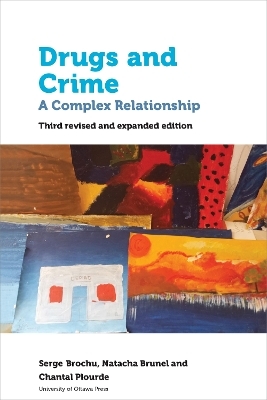
Drugs and Crime
University of Ottawa Press (Verlag)
978-0-7766-2632-1 (ISBN)
- Lieferbar (Termin unbekannt)
- Portofrei ab CHF 40
- Auch auf Rechnung
- Artikel merken
Discussing illegal drugs without taking into account its criminal context is a difficult proposition. Certain questions come back repeatedly: Does doing drugs really lead to delinquency? Do some drugs have criminal properties? Why would a drug addict turn to crime? What are the best methods of intervention in dealing with individuals who have serious drug habits?
The third edition of Drogue et criminalité : Une relation complexe (Les Presses de l’Université de Montréal), translated here for the first time in English, presents an overview of the complex relationship between drugs and crime, avoids cursory affirmations to the effect that psychoactive substance use necessarily leads to crime. It also sheds light on the political and legislative contexts tied to drugs and offers an exceptional synthesis of the research literature of the past 20 years. The authors also discuss the increased attention to illegal drug users and people with addictions and describe the different supports that are available to them.
Published in English.
Serge Brochu, Ph.D. Psychology, is Full Professor at Université de Montréal’s École de criminologie, Honorary President of the International Society for Criminology, and President of the Association des intervenants en dépendance du Québec (AIDQ). He is a researcher at the Groupe de recherche et intervention sur les substances psychoactives-Québec (RISQ) and at the Centre international de criminologie comparée (CICC). He is also the scientific director of the Institut universitaire sur les dépendances (IUD).
List of Figures and Tables
Acknowledgments
INTRODUCTION
Illegal Psychoactive Substances in Canada
Drug Use and Criminal Behaviour
CHAPTER 1
Links Between Drugs and Crime in Facts and Figures
Youth
Adults
Justice-involved Individuals
Drugs in Prison
Substance-dependent Individuals
CHAPTER 2
Drugs: A Detailed Criminogenic Profile
Selected Important Definitions
Intoxication and Criminal Behaviour
Cannabinoids
Stimulants
Cocaine
Amphetamine-type Stimulants
Benzodiazepines
Heroin and Other Opioids
Hallucinogens
Drug Interactions
Victimization While Under the Influence of a
Psychoactive Substance
The Role of Intoxication
Dependence and Criminal Behaviour
How Users Support Their Habit
Crime as an Income-generating Activity
Acquisitive Crime
Trafficking
Other Lucrative Criminal Activities
Links Between Dependence and Criminal Activity
CHAPTER 3
The Legal and Political Landscape
The Road to Repression
Globalization of Trade
Prohibition
The War on Drugs
Action Against Drug Producers
Action Against Drug Importers and Distributors
Action Against Users
Europe
The Netherlands
Portugal
The Americas
The United States
Uruguay
Canada
Different Concepts and Approaches
Normalizing the Relationship With Users
CHAPTER 4
Proximal and Distal Models: A Static Conceptualization
Proximal Elements
Goldstein’s Tripartite Model
The Psychopharmacological Model
The Economic-Compulsive Model
The Systemic Model
Non–Mutually Exclusive Types of Crime
The Inverse Proximal Model
Distal Elements
CHAPTER 5
Trajectories: A Dynamic Conceptualization
The Evolving Drug–Crime Relationship
Deviant Trajectories
Experimentation and Occasional Use
Frequent Use
Regular Use
Addiction
Factors That Influence the Progression and Maintenance
of Deviant Trajectories
The Substance Itself
Income
Environment
Traumatic Events
Reduction, Cessation, and Interruption
Peer Pressure
Internal Pressure
Organizational Pressure
Deviant Environment Pressures
Women’s Distinctive Trajectory
CHAPTER 6
Deviant Lifestyles: An Integrated Conceptualization
The Integrative Model
Risk Factors
Deviant Lifestyles
Degrees of Permeation
Stages of Progression
CHAPTER 7
Treating Addicts in the Criminal Justice System
Access to Treatment
Punishment or Rehabilitation?
"Nothing Works”
The Punitive Post-Martinson Era
“What Works?”
Treating Drug Dependence in Offenders
Drug Courts
Post-sentencing Treatment
Cognitive-Behavioural Programs
Therapeutic Communities and Boot Camps
Peer Support and Twelve-Step Groups
Methadone Maintenance Programs
Motivational Interviewing
Co-occurring Mental Health and Substance Use Disorders
Ingredients for Treatment Success
Screening and Assessment
Personalized Plans
Relapse Prevention
Motivation
Judicial Pressure
The Therapeutic Relationship
Adequate Treatment Duration
Aftercare
Extension of Social Control
The Real Client
Boundaries and Bridges
Conclusion
The Drug–Crime Relationship
Who?
Why?
What?
How Can Society Intervene?
Implementing Appropriate Policies
Providing Suitable Care
References
Authors and Translator
| Erscheinungsdatum | 12.04.2018 |
|---|---|
| Reihe/Serie | Health and Society |
| Übersetzer | Julie da Silva |
| Sprache | englisch |
| Maße | 152 x 229 mm |
| Gewicht | 329 g |
| Themenwelt | Recht / Steuern ► Strafrecht ► Kriminologie |
| Sozialwissenschaften ► Soziologie | |
| ISBN-10 | 0-7766-2632-9 / 0776626329 |
| ISBN-13 | 978-0-7766-2632-1 / 9780776626321 |
| Zustand | Neuware |
| Informationen gemäß Produktsicherheitsverordnung (GPSR) | |
| Haben Sie eine Frage zum Produkt? |
aus dem Bereich