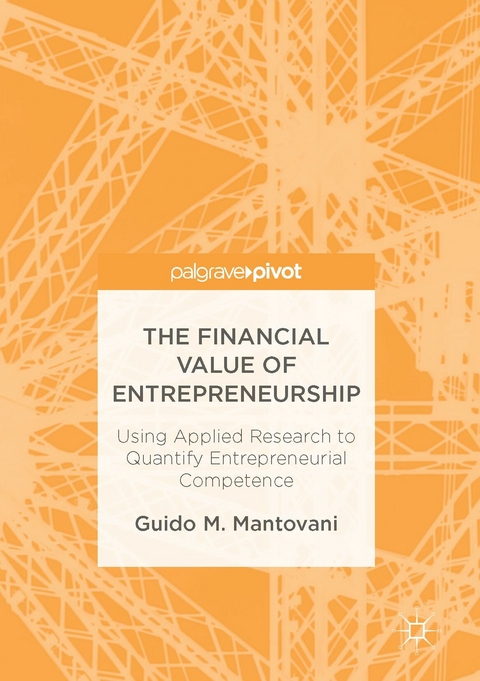
The Financial Value of Entrepreneurship (eBook)
158 Seiten
Palgrave Macmillan US (Verlag)
978-1-137-36537-8 (ISBN)
Guido M. Mantovani is Professor of Corporate Finance at Ca' Foscari University's Treviso and Venice campuses in Italy, and President of the HERMES Universities network in Strasbourg, France. He has published in Italy and internationally on topics of contingent-claim finance, corporate risk management, and information risks. More recently, his research efforts have focused on entrepreneurial finance, the financial valuation of human capital, and the integrated rating of small and medium enterprises.
This Palgrave Pivot examines the essence of competence value in corporate and small business finance, offering empirical evidence to better understand financial practices within entrepreneurial settings. Mantovani suggests an innovative methodology to detect the financial value of entrepreneurial capabilities. He shows how the concept of competence value and T-ratio, its measurement tool, are necessary to arrange sound entrepreneurial finance deals. This book opens with an analysis of how entrepreneurial skills contribute to the economics of entrepreneurial business, and then provides a financial background to estimate the competence value even when the financial markets fail to do so. The book goes on to introduce the idea of an entrepreneurial life-cycle made of stages based on the transformation of human skills into competitive hallmarks. Applications across a large sample of companies and Mantovani's concluding suggestions about the financial practice make this bookessential to both academics and executives.
Guido M. Mantovani is Professor of Corporate Finance at Ca' Foscari University's Treviso and Venice campuses in Italy, and President of the HERMES Universities network in Strasbourg, France. He has published in Italy and internationally on topics of contingent-claim finance, corporate risk management, and information risks. More recently, his research efforts have focused on entrepreneurial finance, the financial valuation of human capital, and the integrated rating of small and medium enterprises.
The Financial Value of Entrepreneurship 3
Foreword 6
Acknowledgments and remarks added by the author to the Foreword 8
Contents 10
List of Figures 11
List of Tables 12
1 The Root: Why Competence has Value 14
1 The Economics of Knowledge and the Value of Skills 17
2 Entrepreneurial Skill as a Productive Factor in Business Economics 22
3 The Cycle of Skill Contributions to Firm Performance 29
4 Goodwill vs. Competence Value and Competence Value vs. Intangible Assets 35
2 Contributions of Skills to Entrepreneurial (and Small Business) Economics 38
1 The Entrepreneurial Lifecycle and the Growth of Firms 39
2 The Expected Productivity of Competence, the Going Concern Firm and the Governance Tools to Increase Competence Productivity 40
3 The E-seed Phase: Subordinate Returns to Innovate 43
4 The E-pullulating Phase: Subordinate Maturity to Create a Corporation 45
5 The E-completing Phase: Subordinate Tradability to Create Market Value 47
3 In Search of Competence Value in an Incomplete Financial Market Context 49
1 Value Creation vs. Value Emersion 49
2 Market Price, Fair Value and Hidden Value 56
Why market incompleteness can explain more of entrepreneurial finance than market inefficiency 56
3 Incomplete Markets and the (Hidden) Value of Entrepreneurial Skills 58
4 Risk Aversion in Incomplete Markets 64
5 Certainty Equivalents and Financial Market Equilibrium: Lintner’s CAPM 67
6 Valuing Capital Assets, Intangible Assets and Competence Assets 75
7 Value Estimation Techniques Across E-phases 82
Note 85
4 The Return-To-Risk Profile of Investing in a Competence-Driven Business 86
1 The Return-To-Risk Profile of the Emerged (W1) Value 87
2 The Return-To-Risk Profile of the Hidden (W2) Value 88
3 The Level of Risk Aversion Required to Invest in Hidden Value 93
4 The Determinants of the Return-To-Risk Persistence of Firm Performance 97
5 The Governance Puzzle of Letting Value Emerge 110
5 How to Measure the Competence Value (from the Q Ratio to the T Ratio) 118
1 Computing the Q Ratio, the Potential Q Ratio and the T Ratio in Practice 121
2 An Empirical Application of the T Ratio (the Case of the Venetian Area) 122
3 Computing the T Ratio 123
6 Funding the Competence Life Cycle to Create Value and Allow It to Emerge 132
1 The Equity Capital Contribution to Competence Value Emersion 134
2 The Debt Capital Contribution to Competence Value Emersion 137
3 The Financial Intermediaries that Allow Value Emergence 138
4 Competence Value and Debt-Maturity Decisions 139
7 The Next Step: From Asset-Backed to Competence-Driven Financial Practices 146
1 We Need more Competence-Driven Finance! 148
2 We Chiefly Have Asset-backed Finance! 156
3 Entrepreneurial Finance Differs from Corporate Finance 160
Bibliography 162
Index 168
| Erscheint lt. Verlag | 16.6.2017 |
|---|---|
| Zusatzinfo | XVI, 158 p. 9 illus. |
| Verlagsort | New York |
| Sprache | englisch |
| Themenwelt | Recht / Steuern ► Wirtschaftsrecht |
| Wirtschaft ► Betriebswirtschaft / Management ► Finanzierung | |
| Wirtschaft ► Betriebswirtschaft / Management ► Unternehmensführung / Management | |
| Schlagworte | behavioral risk • Competition • Competitive • completing stage • confident equivalent • debt and equity financing • debt maturity • endogenous risk • entrepreneurial business • incomplete financial markets • market shortfall • Performance Persistence • persistence of performance • pullulating stage • q-ratio • return threshold • risk tolerance • seed stage • skill accumulation • skills as a productive factor |
| ISBN-10 | 1-137-36537-4 / 1137365374 |
| ISBN-13 | 978-1-137-36537-8 / 9781137365378 |
| Informationen gemäß Produktsicherheitsverordnung (GPSR) | |
| Haben Sie eine Frage zum Produkt? |
 PDF (Wasserzeichen)
DRM: Digitales Wasserzeichen
Dieses eBook enthält ein digitales Wasserzeichen und ist damit für Sie personalisiert. Bei einer missbräuchlichen Weitergabe des eBooks an Dritte ist eine Rückverfolgung an die Quelle möglich.
Dateiformat: PDF (Portable Document Format)
Mit einem festen Seitenlayout eignet sich die PDF besonders für Fachbücher mit Spalten, Tabellen und Abbildungen. Eine PDF kann auf fast allen Geräten angezeigt werden, ist aber für kleine Displays (Smartphone, eReader) nur eingeschränkt geeignet.
Systemvoraussetzungen:
PC/Mac: Mit einem PC oder Mac können Sie dieses eBook lesen. Sie benötigen dafür einen PDF-Viewer - z.B. den Adobe Reader oder Adobe Digital Editions.
eReader: Dieses eBook kann mit (fast) allen eBook-Readern gelesen werden. Mit dem amazon-Kindle ist es aber nicht kompatibel.
Smartphone/Tablet: Egal ob Apple oder Android, dieses eBook können Sie lesen. Sie benötigen dafür einen PDF-Viewer - z.B. die kostenlose Adobe Digital Editions-App.
Buying eBooks from abroad
For tax law reasons we can sell eBooks just within Germany and Switzerland. Regrettably we cannot fulfill eBook-orders from other countries.
aus dem Bereich