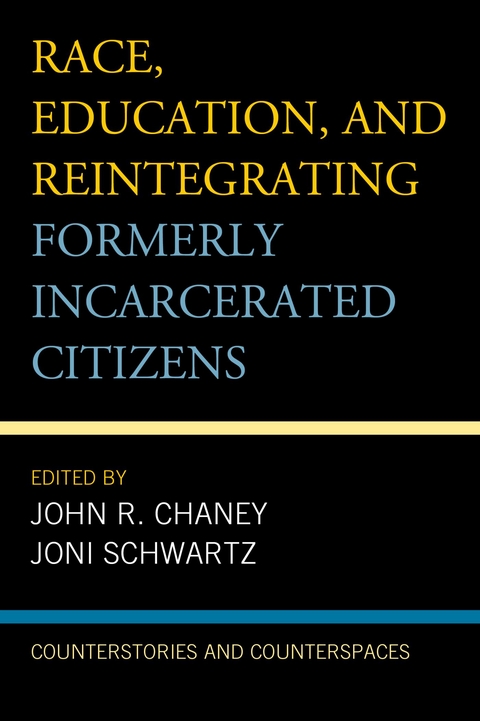
Race, Education, and Reintegrating Formerly Incarcerated Citizens (eBook)
212 Seiten
Lexington Books (Verlag)
978-1-4985-4091-9 (ISBN)
This timely, readable text offers an authoritative and balanced analysis of how racially driven policies in America impact post release education as a leading pathway to social reintegration. Compelling research findings from an assemblage of college faculty, seasoned administrators, and criminal justice professionals are interwoven with first-person narratives from formerly incarcerated individuals. This book takes full advantage of its interdisciplinary mixture of voices and positionality to build its argument upon a three-part framework from Critical Race Theory (CRT). It convincingly utilizes the tools of academic research, counterstories, and counterspaces to make a persuasive case that the intersection of race, the criminal justice system, and education represent one of the greatest civil rights issues of our time. Part 1, "e;Context, Critical Race Theory and College Re-Entry,"e; explores the historical and current dynamics of these uniquely American intersections while linking Critical Race Theory with the field of re-entry and offering serious analysis of post incarceration and education initiatives. Interest convergence, white privilege, and writing from returning citizens as a way of "e;coming to voice"e; are also explored in this section.Part 2, "e;Counterstories,"e; offers case, comparative case, and phenomenological studies that include embedded quotations with first-person narratives contributed from formerly incarcerated students and graduates. This section also includes an honest and gripping analytic auto-ethnography from the book's co-editor who readily reveals his experiences as both a faculty member and formerly incarcerated individual. Other highlighted topics include the issues of stigma, overcoming obstacles in the classroom, and the unique problems for returning citizens when acclimating to college culture. Combining qualitative research and descriptions of successful programs Part 3,"e;Counterspaces,"e; explores the dynamics of creating places within programs and classrooms that support physical, emotional, spiritual, and intellectual engagement for and with the formerly incarcerated through learner-centered, culturally sensitive, and racially explicit pedagogy. This book is designed to be a most welcome addition to any serious academic discussion focusing upon institutionalized racism and education's use as a tool in reversing the mass incarceration of people of color in America.
John R. Chaney is full time criminal justice faculty member at City University of New York’s (CUNY) LaGuardia Community College and reentry consultant for community-based organizations.Joni Schwartz is associate professor at City University of New York’s (CUNY) LaGuardia Community College, social activist scholar, and founder of three adult education centers in New York City.
Foreword, Elliott DawesAcknowledgmentsIntroduction, John R. Chaney and Joni SchwartzPart 1: Context, Critical Race Theory, and College Re-EntryChapter 1: Schooling for Prison: Incarceration for Poverty, Michael HolzmanChapter 2: Education Outside of the Box, Cory FeldmanChapter 3: Do I want to be a 30 Percenter or 70 Percenter?: Black Cultural Privilege, Tony GaskewChapter 4: No Dismantling with the Master’s Tools: The Problem of Privilege in Criminal Justice Education, Colleen P. ErenChapter 5: Writing into Being and Post Incarceration, Joni SchwartzPart 2: CounterstoriesChapter 6: On the Other Side: The Reengagement of Formerly Incarcerated Students, Michael Baston and Brian MillerChapter 7: Mentoring: Compassion without Condescension, Joshua Halberstam and Tiheba BainChapter 8: Short-Term to Long Term Incarceration and Educational Re-Engagement: A Comparative Case Study, Dwayne Simpson, Davon T. Harris, and John R. ChaneyChapter 9: A New Normal: Young Men of Color: Trauma & Engagement in Learning, Carlyle Van Thompson and Paul J. SchwartzChapter 10: Epiphany of a Prodigal Son: An Autoethnography, John R. ChaneyPart 3: CounterspacesChapter 11: Returning to School after Incarceration: Policy, Prisoners and the Classroom, Brian Miller, Joserichsen Mondesir, Timothy Stater, and Joni SchwartzChapter 12: Infinite Space and Common Ground: The Humble Wisdom of Scholar-Allies, Norman Conti and Elaine FrantzChapter 13: A College Initiative Success Story, Terrance Coffie and John R. ChaneyChapter 14: High School Equivalency as Counterspace, Joni SchwartzChapter 15: Creating Counterspaces in College: LaGuardia Community College’s Correctional Education Initiative, Jane MacKillop
| Reihe/Serie | Critical Perspectives on Race, Crime, and Justice |
|---|---|
| Co-Autor | Elaine Frantz, Tony Gaskew, Joshua Halberstam, Davon T. Harris, Michael Holzman, Jane MacKillop, Brian Miller, Joserichsen Mondesir, Joni Schwartz, Paul J. Schwartz, Tiheba Bain, Dwayne Simpson, Timothy Stater, Carlyle Van Thompson, Michael Baston, Michael Carey, John R. Chaney, Terrance Coffie, Norman Conti, Colleen P. Eren, Cory Feldman |
| Vorwort | Elliott Dawes |
| Zusatzinfo | 1 Illustrations including: - 1 Black & White Illustrations. |
| Sprache | englisch |
| Themenwelt | Recht / Steuern ► Strafrecht ► Kriminologie |
| Sozialwissenschaften ► Ethnologie | |
| Sozialwissenschaften ► Pädagogik | |
| Sozialwissenschaften ► Soziologie | |
| Schlagworte | Counter-spaces • Counter-stories and education • Criminology • critical race theory • Mass Incarceration and education • Post-incarceration education • Prison re-entry • Prison to college • Racism and Incarceration • Recidivism and education • reentry education • white privilege |
| ISBN-10 | 1-4985-4091-0 / 1498540910 |
| ISBN-13 | 978-1-4985-4091-9 / 9781498540919 |
| Informationen gemäß Produktsicherheitsverordnung (GPSR) | |
| Haben Sie eine Frage zum Produkt? |
 EPUB (Adobe DRM)
Kopierschutz: Adobe-DRM
Adobe-DRM ist ein Kopierschutz, der das eBook vor Mißbrauch schützen soll. Dabei wird das eBook bereits beim Download auf Ihre persönliche Adobe-ID autorisiert. Lesen können Sie das eBook dann nur auf den Geräten, welche ebenfalls auf Ihre Adobe-ID registriert sind.
Details zum Adobe-DRM
Dateiformat: EPUB (Electronic Publication)
EPUB ist ein offener Standard für eBooks und eignet sich besonders zur Darstellung von Belletristik und Sachbüchern. Der Fließtext wird dynamisch an die Display- und Schriftgröße angepasst. Auch für mobile Lesegeräte ist EPUB daher gut geeignet.
Systemvoraussetzungen:
PC/Mac: Mit einem PC oder Mac können Sie dieses eBook lesen. Sie benötigen eine
eReader: Dieses eBook kann mit (fast) allen eBook-Readern gelesen werden. Mit dem amazon-Kindle ist es aber nicht kompatibel.
Smartphone/Tablet: Egal ob Apple oder Android, dieses eBook können Sie lesen. Sie benötigen eine
Geräteliste und zusätzliche Hinweise
Buying eBooks from abroad
For tax law reasons we can sell eBooks just within Germany and Switzerland. Regrettably we cannot fulfill eBook-orders from other countries.
aus dem Bereich