


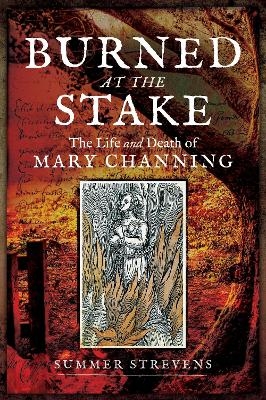
Burned at the Stake
The Life and Death of Mary Channing
Seiten
2017
Pen & Sword History (Verlag)
978-1-4738-9872-1 (ISBN)
Pen & Sword History (Verlag)
978-1-4738-9872-1 (ISBN)
- Keine Verlagsinformationen verfügbar
- Artikel merken
The first comprehensive re-telling of Mary Channing's life and death since the sensationalised publication chronicling her criminality and dramatic demise appeared in print in 1706.
In 1706 19-year-old Mary Channing was convicted of poisoning her husband and became the last woman to be burned at the stake in Dorset. Despite her impressive attempts to defend herself, the jury had taken only half an hour to find her guilty. Yet on pronouncement of the death sentence, Mary 'pleaded her belly' and thus postponed her execution until after she had given birth to her child in gaol. When the day finally arrived, her execution was made into something of a county fair, with 10,000 spectators gathering to view the barbaric ordeal upon the floor of Dorchester's ancient Roman amphitheatre, Maumbury Rings. Although the law extended an act of clemency allowing for Mary to be strangled to death before the fires were lit, there is evidence to suggest that she was, in fact, still alive when consigned to the flames. After the gory spectacle was complete, it was said not one of those 10,000 people ever cared particularly for hot roast after that.
More than 300 years after her dramatic demise, Mary s fate still holds a macabre fascination, as it did for Thomas Hardy, who recorded some of the grislier details of her execution in his notebooks and used her as the inspiration for his poem, 'The Mock Wife'. Yet while Mary Channing has been granted a kind of grim celebrity, as well as an established place in the annals of female murderers, a measure of compelling sympathy for her case is nonetheless another lasting aspect of her legacy.
In 1706 19-year-old Mary Channing was convicted of poisoning her husband and became the last woman to be burned at the stake in Dorset. Despite her impressive attempts to defend herself, the jury had taken only half an hour to find her guilty. Yet on pronouncement of the death sentence, Mary 'pleaded her belly' and thus postponed her execution until after she had given birth to her child in gaol. When the day finally arrived, her execution was made into something of a county fair, with 10,000 spectators gathering to view the barbaric ordeal upon the floor of Dorchester's ancient Roman amphitheatre, Maumbury Rings. Although the law extended an act of clemency allowing for Mary to be strangled to death before the fires were lit, there is evidence to suggest that she was, in fact, still alive when consigned to the flames. After the gory spectacle was complete, it was said not one of those 10,000 people ever cared particularly for hot roast after that.
More than 300 years after her dramatic demise, Mary s fate still holds a macabre fascination, as it did for Thomas Hardy, who recorded some of the grislier details of her execution in his notebooks and used her as the inspiration for his poem, 'The Mock Wife'. Yet while Mary Channing has been granted a kind of grim celebrity, as well as an established place in the annals of female murderers, a measure of compelling sympathy for her case is nonetheless another lasting aspect of her legacy.
Born in London, Summer Strevens now lives and writes in Dorset. Capitalising on a life-long passion for historical research, Summer has embraced writing as a full time occupation. As well as penning feature articles of regional historical interest, her published books include The Yorkshire Witch: the Life & Trial of Mary Bateman, Haunted Yorkshire Dales, York Murder & Crime, The Birth of the Chocolate City: Life in Georgian York, The A-Z of Curiosities of the Yorkshire Dales, Fashionably Fatal and Before They Were Fiction.
| Erscheinungsdatum | 17.02.2018 |
|---|---|
| Zusatzinfo | 32 illustartions |
| Verlagsort | Barnsley |
| Sprache | englisch |
| Maße | 156 x 234 mm |
| Themenwelt | Literatur ► Biografien / Erfahrungsberichte |
| Geschichte ► Teilgebiete der Geschichte ► Kulturgeschichte | |
| Recht / Steuern ► Strafrecht ► Kriminologie | |
| ISBN-10 | 1-4738-9872-2 / 1473898722 |
| ISBN-13 | 978-1-4738-9872-1 / 9781473898721 |
| Zustand | Neuware |
| Informationen gemäß Produktsicherheitsverordnung (GPSR) | |
| Haben Sie eine Frage zum Produkt? |
Mehr entdecken
aus dem Bereich



aus dem Bereich
Die Revolution des Gemeinen Mannes
Buch | Softcover (2024)
C.H.Beck (Verlag)
CHF 16,80
Eine Geschichte des Geschmacks
Buch | Hardcover (2025)
C.H.Beck (Verlag)
CHF 49,95


