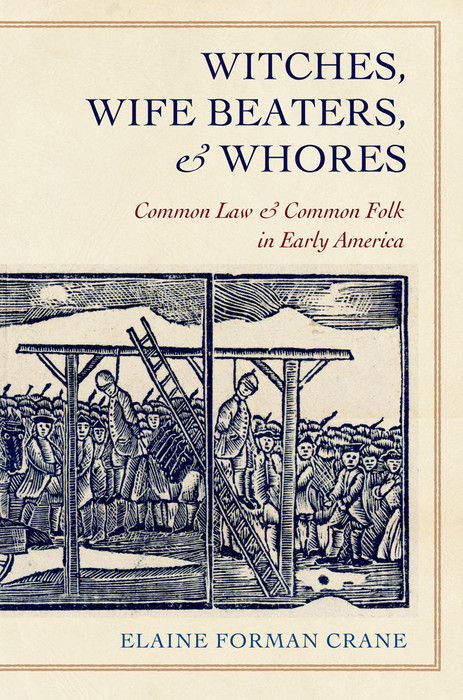
Witches, Wife Beaters, and Whores (eBook)
288 Seiten
Cornell University Press (Verlag)
978-0-8014-6273-3 (ISBN)
The early American legal system permeated the lives of colonists and reflected their sense of what was right and wrong, honorable and dishonorable, moral and immoral. In a compelling book full of the extraordinary stories of ordinary people, Elaine Forman Crane reveals the ways in which early Americans clashed with or conformed to the social norms established by the law. As trials throughout the country reveal, alleged malefactors such as witches, wife beaters, and whores, as well as debtors, rapists, and fornicators, were as much a part of the social landscape as farmers, merchants, and ministers. Ordinary people 'made' law by establishing and enforcing informal rules of conduct. Codified by a handshake or over a mug of ale, such agreements became custom and custom became 'law.' Furthermore, by submitting to formal laws initiated from above, common folk legitimized a government that depended on popular consent to rule with authority.
In this book we meet Marretie Joris, a New Amsterdam entrepreneur who sues Gabriel de Haes for calling her a whore; peer cautiously at Christian Stevenson, a Bermudian witch as bad 'as any in the world;' and learn that Hannah Dyre feared to be alone with her husband-and subsequently died after a beating. We travel with Comfort Taylor as she crosses Narragansett Bay with Cuff, an enslaved ferry captain, whom she accuses of attempted rape, and watch as Samuel Banister pulls the trigger of a gun that kills the sheriff's deputy who tried to evict Banister from his home. And finally, we consider the promiscuous Marylanders Thomas Harris and Ann Goldsborough, who parented four illegitimate children, ran afoul of inheritance laws, and resolved matters only with the assistance of a ghost. Through the six trials she skillfully reconstructs here, Crane offers a surprising new look at how early American society defined and punished aberrant behavior, even as it defined itself through its legal system.
CraneElaine Forman:
Elaine Forman Crane is the author of Witches, Wife Beaters, and Whores: Common Law and Common Folk in Early America and Killed Strangely: The Death of Rebecca Cornell.
The early American legal system permeated the lives of colonists and reflected their sense of what was right and wrong, honorable and dishonorable, moral and immoral. In a compelling book full of the extraordinary stories of ordinary people, Elaine Forman Crane reveals the ways in which early Americans clashed with or conformed to the social norms established by the law. As trials throughout the country reveal, alleged malefactors such as witches, wife beaters, and whores, as well as debtors, rapists, and fornicators, were as much a part of the social landscape as farmers, merchants, and ministers. Ordinary people made law by establishing and enforcing informal rules of conduct. Codified by a handshake or over a mug of ale, such agreements became custom and custom became law. Furthermore, by submitting to formal laws initiated from above, common folk legitimized a government that depended on popular consent to rule with authority. In this book we meet Marretie Joris, a New Amsterdam entrepreneur who sues Gabriel de Haes for calling her a whore; peer cautiously at Christian Stevenson, a Bermudian witch as bad as any in the world; and learn that Hannah Dyre feared to be alone with her husband-and subsequently died after a beating. We travel with Comfort Taylor as she crosses Narragansett Bay with Cuff, an enslaved ferry captain, whom she accuses of attempted rape, and watch as Samuel Banister pulls the trigger of a gun that kills the sheriff's deputy who tried to evict Banister from his home. And finally, we consider the promiscuous Marylanders Thomas Harris and Ann Goldsborough, who parented four illegitimate children, ran afoul of inheritance laws, and resolved matters only with the assistance of a ghost. Through the six trials she skillfully reconstructs here, Crane offers a surprising new look at how early American society defined and punished aberrant behavior, even as it defined itself through its legal system.
| Erscheint lt. Verlag | 15.10.2011 |
|---|---|
| Sprache | englisch |
| Themenwelt | Geschichte ► Allgemeine Geschichte ► Neuzeit (bis 1918) |
| Geisteswissenschaften ► Geschichte ► Regional- / Ländergeschichte | |
| Geschichte ► Teilgebiete der Geschichte ► Kulturgeschichte | |
| Geschichte ► Teilgebiete der Geschichte ► Militärgeschichte | |
| Recht / Steuern ► Allgemeines / Lexika | |
| Recht / Steuern ► EU / Internationales Recht | |
| Recht / Steuern ► Rechtsgeschichte | |
| ISBN-10 | 0-8014-6273-8 / 0801462738 |
| ISBN-13 | 978-0-8014-6273-3 / 9780801462733 |
| Informationen gemäß Produktsicherheitsverordnung (GPSR) | |
| Haben Sie eine Frage zum Produkt? |
 PDF (Adobe DRM)
Kopierschutz: Adobe-DRM
Adobe-DRM ist ein Kopierschutz, der das eBook vor Mißbrauch schützen soll. Dabei wird das eBook bereits beim Download auf Ihre persönliche Adobe-ID autorisiert. Lesen können Sie das eBook dann nur auf den Geräten, welche ebenfalls auf Ihre Adobe-ID registriert sind.
Details zum Adobe-DRM
Dateiformat: PDF (Portable Document Format)
Mit einem festen Seitenlayout eignet sich die PDF besonders für Fachbücher mit Spalten, Tabellen und Abbildungen. Eine PDF kann auf fast allen Geräten angezeigt werden, ist aber für kleine Displays (Smartphone, eReader) nur eingeschränkt geeignet.
Systemvoraussetzungen:
PC/Mac: Mit einem PC oder Mac können Sie dieses eBook lesen. Sie benötigen eine
eReader: Dieses eBook kann mit (fast) allen eBook-Readern gelesen werden. Mit dem amazon-Kindle ist es aber nicht kompatibel.
Smartphone/Tablet: Egal ob Apple oder Android, dieses eBook können Sie lesen. Sie benötigen eine
Geräteliste und zusätzliche Hinweise
Buying eBooks from abroad
For tax law reasons we can sell eBooks just within Germany and Switzerland. Regrettably we cannot fulfill eBook-orders from other countries.
aus dem Bereich