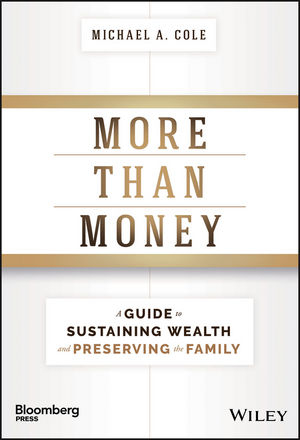
More Than Money (eBook)
192 Seiten
Wiley (Verlag)
978-1-119-26480-4 (ISBN)
A new, more comprehensive approach to long-term family wealth management
More Than Money provides a high-level, integrated approach to preserving both financial resources and family harmony, Research has shown a failure rate of 70 percent in long-term multigenerational wealth management, and contrary to popular assumption, only five percent of that failure is due to bad investment, poor tax planning, or inadequate performance by legal and financial advisors, The number-one reason family wealth management fails is the family itself; poor communication, lack of trust, divergent visions, and a failure to prepare succeeding generations will tear down the resources the family has worked so hard to build, Traditional wealth management cannot fix this, Instead, this book offers a fresh approach that integrates strategic and tactical wealth management to align the family's assets with the family members, With helpful tools and advice drawn from a real-world understanding of family complexities, you'll improve your ability to preserve your family's resources over multiple generations,
With an expert's perspective on the real forces behind successful family wealth management, this book provides a clear model and a practical roadmap for long-term financial preservation,
- Develop a shared family vision and mission
- Improve communication and trust among members
- Merge strategic and tactical planning
- Ensure the longevity of your family's wealth
The wealth management sphere tends to focus on taxes, investments, banking, and estate planning, but little thought is given to the people themselves-this overlooks the fact that individual family members are the most critical factor in multigenerational wealth management, and fails to provide solutions, More Than Money merges traditional strategies with family dynamics, communication, governance, and preparation to help your resources last for generations to come,
MICHAEL A, COLE is the CEO of Cresset Family Office, an unparalleled subsidiary of Cresset Capital, LLC, He and his team provide ultra-high-networth clients with a unique and highly refined suite of wealth management services combining traditional wealth management offerings, access to distinctive, high quality private investments and cutting-edge family office services, Prior to starting Cresset Family Office he was president and founder of Ascent Private Capital Management of U,S, Bank, which was awarded Best Multi-Family Office ($5 billion to $15 billion AUM / AUA) by Family Wealth Report under his tenure, This award is bestowed on the best overall firm in the category, Family Wealth Report also awarded Ascent for Outstanding Contribution to Wealth Management Thought Leadership,
A new, more comprehensive approach to long-term family wealth management More Than Money provides a high-level, integrated approach to preserving both financial resources and family harmony. Research has shown a failure rate of 70 percent in long-term multigenerational wealth management, and contrary to popular assumption, only five percent of that failure is due to bad investment, poor tax planning, or inadequate performance by legal and financial advisors. The number-one reason family wealth management fails is the family itself; poor communication, lack of trust, divergent visions, and a failure to prepare succeeding generations will tear down the resources the family has worked so hard to build. Traditional wealth management cannot fix this. Instead, this book offers a fresh approach that integrates strategic and tactical wealth management to align the family s assets with the family members. With helpful tools and advice drawn from a real-world understanding of family complexities, you ll improve your ability to preserve your family s resources over multiple generations. With an expert s perspective on the real forces behind successful family wealth management, this book provides a clear model and a practical roadmap for long-term financial preservation. Develop a shared family vision and mission Improve communication and trust among members Merge strategic and tactical planning Ensure the longevity of your family s wealth The wealth management sphere tends to focus on taxes, investments, banking, and estate planning, but little thought is given to the people themselves this overlooks the fact that individual family members are the most critical factor in multigenerational wealth management, and fails to provide solutions. More Than Money merges traditional strategies with family dynamics, communication, governance, and preparation to help your resources last for generations to come.
CHAPTER 2
Wealth Is More Than Money
In the introduction to his transformational guidebook Family Wealth: Keeping It in the Family, James Hughes mentions that a family's wealth “consists primarily of its human capital (defined as all the individuals who make up the family) and its intellectual capital (defined as everything each individual family member knows), and secondarily of its financial capital.”1 Later in the book, he mentions a fourth type of capital: social capital, which I define as the networks of people of means who use their wealth and influence for the benefit of society.
If, in fact, human, intellectual, and social capital make up 75 percent of a family's actual wealth, giving 90 percent of the family's and advisors' attention to only 25 percent of the assets doesn't make a lot of sense. Yet this is the way traditional wealth managers and those they advise tend to view their roles.
Hughes makes exactly this point. In his view, a family that loses its wealth usually does so because of too great a concentration on financial capital and too little attention paid to the other types of capital the family possesses. Hughes goes on to say that “a family's financial capital is a tool to support the growth of the family's human and intellectual capital.”2 In other words, money is simply a means to a more important and meaningful end. Money, rightly considered, can empower an entire family, but if there is too much emphasis on balance sheets and not enough on family relationships, talents, roles, and strategic planning, the family can be enfeebled as its wealth trickles away.
Families who focus strictly on their financial assets usually do not sustain wealth over time and enjoy the fruits of their labor. They frequently have deep‐rooted resentments about the uses of money, as well as relationship challenges, values clashes, and arguments about the place of money in their personal value systems. As a result, the wealth may disappear by the third generation, even if it is well‐managed and invested.
The Rockefellers: An Emphasis on Wealth‐Building and Philanthropy
If the Vanderbilt clan is the exemplar of wealth planning run amok, then the Rockefeller family is the other side of the coin. Although the Rockefellers no longer stand at the top of the heap of America's richest families, they still control more than $11 billion, settling in at #22 on the 2015 Forbes list of America's wealthiest families.
John D. Rockefeller, although probably no more ruthless than the other titans of his era—Vanderbilt, Carnegie, and Morgan, for example—could be savagely competitive, but buried within him was also a strand of philanthropy that grew as his assets expanded. An article in Philanthropy Roundtable highlights Rockefeller's charitable bent.
The article mentions that a few days after the sixteen‐year‐old Rockefeller landed his first job, he bought a ledger in which he accounted for virtually every cent of income and outgo. What is noticeable is that even when he was working for pennies each day, he already was sharing his resources. “‘When I was only making a dollar a day,’ Rockefeller later recalled, ‘I was giving [away] five, ten, or twenty‐five cents.’”3
As Rockefeller's wealth increased, so did his charitable donations. By 1865, he was giving away more than $1,000 annually. Not surprisingly, Rockefeller was inundated with requests for money. “At breakfast, he made it a habit to say grace and then open review of requests for charity . . . asking his children to further investigate promising appeals,”4 thus setting the stage for their understanding of the need both for making money and making an impact; this understanding has continued into the succeeding generations.
Because of his immense fortune, Rockefeller's philanthropy, much of which was orchestrated and shepherded by his son, John D. Rockefeller Jr., was virtually boundless, from his founding of the University of Chicago to the Rockefeller Institute for Medical Research (now Rockefeller University) to the General Education Board to funding for Morehouse College and Spelman College (which was named for his wife, Laura Spelman Rockefeller). The contributions of the various organizations he funded are staggering to contemplate: a vaccine for yellow fever; prevention and cure of hookworm diseases; and support of sixty‐four Nobel Prize winners in the fields of chemistry and medicine, to mention only a few. By the time of his death at age 97, Rockefeller had given away approximately $540 million and had changed countless lives forever.
In his adulthood, John D. Rockefeller Jr. also gave more than $500 million to conservation causes, historic preservation, art, and religious—primarily Baptist—institutions. He was the driving force behind New York's Rockefeller Center. Through the establishment of the Rockefeller Brothers Fund (which also included their sister by 1954), the family contin ued the legacy of philanthropy, making grants to “organizations working to expand knowledge, clarify values and critical choices, nurture creative expression, and shape public policy.”5 Some of the trustees of the fund today are fourth and fifth generations of the Rockefeller family.
Not surprisingly, with the family's emphasis on public service, some of the third generation of Rockefellers found their way onto a larger stage—the political arena. Nelson Rockefeller served four terms as governor of New York and three years as vice president of the United States under Gerald Ford. His brother Winthrop was governor of Arkansas from 1967 to 1971.
In the minds of many, David Rockefeller was the embodiment of the Chase Manhattan Bank and later the Chase Manhattan Corporation. Beginning his affiliation with Chase Manhattan in 1946, he became chairman of the board of directors of Chase Manhattan Bank, NA, in March 1969 and CEO of Chase Manhattan Corporation in May of that year. He wielded immense influence in both corporate and international affairs.
Laurance Rockefeller carried on his father's work in conservation and was also an early venture capitalist. According to the Washington Post, “[he] also was a chief advocate for investing family money in new, often bold enterprises. Particularly fascinated by aviation, he poured money into new projects so they would not be snuffed out by a merger because of a lack of financing.”6 He was awarded the Presidential Medal of Freedom, the nation's highest civilian honor, for his unparalleled work in conservation.
John D. Rockefeller III, the eldest of the third generation, was active in the establishment of Lincoln Center in New York. He chaired the Rockefeller Foundation but used his own money to found the Population Council, an organization that dealt with world overpopulation issues; he later was appointed by President Richard Nixon to the Commission on Population Growth and the American Future. He was also an extensive collector of Asian art, which he bequeathed to the Asia Society, an organization he founded.
The only female among the third generation, Abigail (Babs) Rockefeller was a benefactor of note. The organizations that benefited from her philanthropy included Memorial Sloan‐Kettering Cancer Center, the Metropolitan Museum of Art, the Museum of Modern Art (which was founded by her mother), the Population Council, the American Red Cross, and many more.
The fourth generation was represented in part by John D. “Jay” Rockefeller IV, son of John D. III. He was first elected governor of West Virginia in 1977, and in 1985 moved on to the U.S. Senate, where he served for thirty years.
In the nineteenth century, John D. Rockefeller amassed a fortune and became arguably the richest man in history. He saw around corners, seizing opportunities and acting aggressively in his own behalf, all the while giving away vast sums for the betterment of humankind. During that period, he was also the target of harsh criticism for some of his methods and actions, including monopolistic practices that were outlawed by the Sherman Antitrust Act. However, as the current head of the family, the centenarian David Rockefeller said, “Grandfather never breathed a sigh of remorse to my father, his grandchildren or anyone else. He believed Standard Oil benefited society.”7
Thus, the Rockefeller slant on wealth certainly does not eschew continuing to acquire assets and to manage them for growth through Rockefeller & Co., which “serve[s] members of the Rockefeller family as they pursue their investment goals and further their heritage of public service and philanthropic endeavors.”8 However, the accumulation of wealth still is coupled with the family's agenda of “promoting the well‐being of humanity around the world”9 by making substantial grants to organizations that help the family realize their desire to do good. Today, a fifth generation of leaders is being groomed to take leadership of the family enterprise.
To cite only one example, in 2013, thirty‐seven‐year‐old Justin Rockefeller, one of Jay Rockefeller's sons and a trustee of the Rockefeller Brothers Fund, co‐founded (along with other social entrepreneurs and venture capitalists) The ImPact, a nonprofit NGO whose mission is “to inspire families to make more impact investments more...
| Erscheint lt. Verlag | 31.3.2017 |
|---|---|
| Sprache | englisch |
| Themenwelt | Recht / Steuern ► Wirtschaftsrecht |
| Wirtschaft ► Betriebswirtschaft / Management ► Finanzierung | |
| ISBN-10 | 1-119-26480-4 / 1119264804 |
| ISBN-13 | 978-1-119-26480-4 / 9781119264804 |
| Informationen gemäß Produktsicherheitsverordnung (GPSR) | |
| Haben Sie eine Frage zum Produkt? |
 EPUB (Adobe DRM)
Größe: 448 KB
Kopierschutz: Adobe-DRM
Adobe-DRM ist ein Kopierschutz, der das eBook vor Mißbrauch schützen soll. Dabei wird das eBook bereits beim Download auf Ihre persönliche Adobe-ID autorisiert. Lesen können Sie das eBook dann nur auf den Geräten, welche ebenfalls auf Ihre Adobe-ID registriert sind.
Details zum Adobe-DRM
Dateiformat: EPUB (Electronic Publication)
EPUB ist ein offener Standard für eBooks und eignet sich besonders zur Darstellung von Belletristik und Sachbüchern. Der Fließtext wird dynamisch an die Display- und Schriftgröße angepasst. Auch für mobile Lesegeräte ist EPUB daher gut geeignet.
Systemvoraussetzungen:
PC/Mac: Mit einem PC oder Mac können Sie dieses eBook lesen. Sie benötigen eine
eReader: Dieses eBook kann mit (fast) allen eBook-Readern gelesen werden. Mit dem amazon-Kindle ist es aber nicht kompatibel.
Smartphone/Tablet: Egal ob Apple oder Android, dieses eBook können Sie lesen. Sie benötigen eine
Geräteliste und zusätzliche Hinweise
Buying eBooks from abroad
For tax law reasons we can sell eBooks just within Germany and Switzerland. Regrettably we cannot fulfill eBook-orders from other countries.
aus dem Bereich