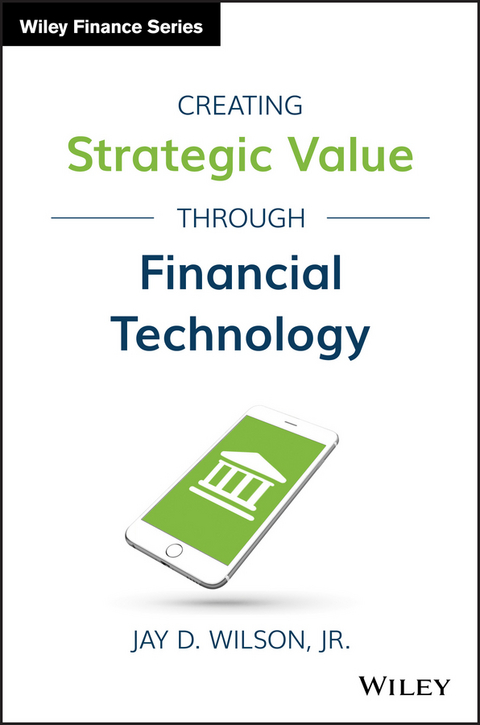
Creating Strategic Value through Financial Technology (eBook)
John Wiley & Sons (Verlag)
978-1-119-24387-8 (ISBN)
JAY D. WILSON, JR., is vice president of Mercer Capital's Depository Institutions practice. He leads the firm's FinTech industry team, publishes research quarterly related to the FinTech industry, and is involved in the valuation of FinTech companies, banks, thrifts, and credit unions for a variety of purposes including corporate strategic planning, transactions, equity compensation, and financial statement reporting.
Preface xi
Acknowledgments xv
Section One
Chapter 1 What is Financial Technology? 3
Technology's Impact on Financial Services 3
What is FinTech and Who are the Players? 5
Why the Hype for FinTech? 10
Why is FinTech Potentially So Important to Society? 12
Recent Trends and Market Conditions for the FinTech Industry 14
Conclusion 18
Notes 19
Chapter 2 Community Banks and FinTech 21
Is FinTech a Threat or an Opportunity for Community Banks? 21
FinTech's Potential Impact on Bank Valuation 29
How Community Banks Can Help FinTech Companies 31
Conclusion 32
Notes 33
Chapter 3 The Historical Context for FinTech 35
Introduction 35
FinTech History 35
Visa and MasterCard: The Largest IPOs in FinTech History 40
Core Vendors 43
Notes 50
Section Two
Chapter 4 State of Community Banks Embracing FinTech Today 53
Introduction 53
Overview of U.S. Community Bank Industry Trends 53
Banks and FinTech Increasingly Intersect 56
Serving More Customers Digitally 56
Evolving Regulatory Oversight of FinTech 61
Conclusion 66
Notes 67
Chapter 5 The Alternative Lending Niche 70
The Mortgage Market 70
The Consumer Lending Market 72
Government Regulation of Alternative Lending Platforms 78
Conclusion 79
Notes 80
Chapter 6 The Payments Niche 82
Trends to Watch 82
Digital Currencies and Blockchain Technology 91
Conclusion 99
Notes 100
Chapter 7 The Wealth Management Niche 104
Introduction 104
The Evolution of the Online Brokerage Industry 106
The Rise of Robo-Advisors 108
Conclusion 116
Notes 118
Chapter 8 InsurTech and the Future of Insurance 120
Introduction to InsurTech 121
Technology Trends in Insurance 123
Conclusion 129
Notes 129
Section Three
Chapter 9 Partnering with a FinTech Company 133
Introduction 133
Conclusion 154
Notes 155
Chapter 10 Early Stage FinTech Valuation Issues 156
Introduction 156
Why You Should Have a Valuation Performed 157
Valuation Considerations for FinTech Companies 160
What about Preferences and FinTech Valuations? 172
Special Issues: Valuations for Other Stakeholders 173
Conclusion 183
Notes 183
Chapter 11 Acquiring a FinTech Company 185
Introduction 185
Recent Trends in FinTech M&A Activity 187
Metrics to Analyze FinTech Transactions 192
Accounting Considerations and Goodwill Creation in FinTech Deals 202
Special Issues to Consider with FinTech M&A 218
Conclusion 224
Notes 224
Chapter 12 Liquidity Options Beyond a Sale 227
Introduction 227
Liquidity Options 228
Is Your Buy-Sell Agreement Solidly Built? 234
Conclusion 240
Notes 240
Chapter 13 Is There a Bubble Forming in FinTech? 242
Introduction 242
Factors Leading to a Bubble? 243
Signs That a Bubble May Be Forming in FinTech 246
Case Study of a FinTech Failure 246
Conclusion 251
Notes 252
Index 253
| Erscheint lt. Verlag | 22.3.2017 |
|---|---|
| Reihe/Serie | Wiley Finance |
| Wiley Finance Editions | Wiley Finance Editions |
| Sprache | englisch |
| Themenwelt | Recht / Steuern ► Wirtschaftsrecht |
| Wirtschaft ► Betriebswirtschaft / Management ► Finanzierung | |
| Wirtschaft ► Betriebswirtschaft / Management ► Wirtschaftsinformatik | |
| Schlagworte | Alternative Funding • alternative lending • creating financial services value • Creating Strategic Value through Financial Technology • Finance & Investments • Finance & Investments Special Topics • Financial Services • financial services efficiency • financial services innovation • Financial Technology • financial technology outlook • Finanz- u. Anlagewesen • Finanzwesen • FinTech • FinTech in banking • fintech innovation • fintech investment • FinTech niches • fintech solutions • FinTech themes • FinTech valuation • FinTech versus traditional financial services • future of financial services • future of FinTech • improving financial services cost structure • insurance FinTech • Jay D. Wilson, Jr. • lessons from FinTech • navigating financial technology • Spezialthemen Finanz- u. Anlagewesen |
| ISBN-10 | 1-119-24387-4 / 1119243874 |
| ISBN-13 | 978-1-119-24387-8 / 9781119243878 |
| Informationen gemäß Produktsicherheitsverordnung (GPSR) | |
| Haben Sie eine Frage zum Produkt? |
 PDF (Adobe DRM)
Kopierschutz: Adobe-DRM
Adobe-DRM ist ein Kopierschutz, der das eBook vor Mißbrauch schützen soll. Dabei wird das eBook bereits beim Download auf Ihre persönliche Adobe-ID autorisiert. Lesen können Sie das eBook dann nur auf den Geräten, welche ebenfalls auf Ihre Adobe-ID registriert sind.
Details zum Adobe-DRM
Dateiformat: PDF (Portable Document Format)
Mit einem festen Seitenlayout eignet sich die PDF besonders für Fachbücher mit Spalten, Tabellen und Abbildungen. Eine PDF kann auf fast allen Geräten angezeigt werden, ist aber für kleine Displays (Smartphone, eReader) nur eingeschränkt geeignet.
Systemvoraussetzungen:
PC/Mac: Mit einem PC oder Mac können Sie dieses eBook lesen. Sie benötigen eine
eReader: Dieses eBook kann mit (fast) allen eBook-Readern gelesen werden. Mit dem amazon-Kindle ist es aber nicht kompatibel.
Smartphone/Tablet: Egal ob Apple oder Android, dieses eBook können Sie lesen. Sie benötigen eine
Geräteliste und zusätzliche Hinweise
Buying eBooks from abroad
For tax law reasons we can sell eBooks just within Germany and Switzerland. Regrettably we cannot fulfill eBook-orders from other countries.
aus dem Bereich