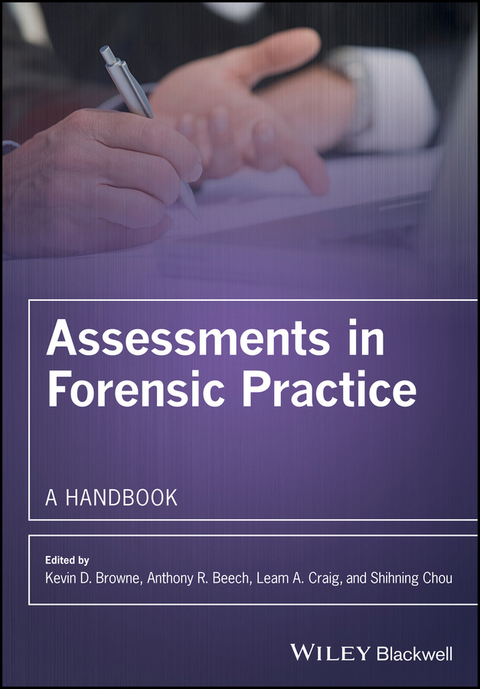
Assessments in Forensic Practice (eBook)
John Wiley & Sons (Verlag)
978-1-118-31455-5 (ISBN)
- criminal justice assessments
- offenders with mental disorders
- family violence
- policy and practice
Kevin D. Browne is Professor of Forensic Psychology and Child Health at the University of Nottingham.
Leam A. Craig is Director of Forensic Programmes at Forensic Psychology Practice Ltd, and an Honorary Lecturer in Forensic Psychology at the University of Birmingham.
Anthony R. Beech, D.Phil, FBPsS, C.Psychol (Forensic) is Professor of Criminological Psychology,University of Birmingham.
Assessments in Forensic Practice: A Handbook provides practical guidance in the assessment of the most frequently encountered offender subgroups found within the criminal justice system. Topics include: criminal justice assessments offenders with mental disorders family violence policy and practice
Kevin D. Browne is Professor of Forensic Psychology and Child Health at the University of Nottingham. Leam A. Craig is Director of Forensic Programmes at Forensic Psychology Practice Ltd, and an Honorary Lecturer in Forensic Psychology at the University of Birmingham. Anthony R. Beech, D.Phil, FBPsS, C.Psychol (Forensic) is Professor of Criminological Psychology,University of Birmingham.
About the Editors vii
Contributors ix
1. Introduction 1
Kevin D. Browne, Anthony R. Beech, Leam A. Craig and Shihning Chou
Part One Criminal Justice Assessments 5
2. Case Formulation and Risk Assessment 7
Peter Sturmey and William R. Lindsay
3. Assessment of Violence and Homicide 28
Kerry Sheldon and Kevin Howells
4. Sexual Offenders 52
Franca Cortoni, Anthony R. Beech and Leam A. Craig
5. The Assessment of Firesetters 76
Lynsey F. Gozna
6. Forensic Psychological Risk Assessment for the Parole Board 103
Louise Bowers and Caroline Friendship
7. Behavioral Assessment in Investigative Psychology 122
Eleanor M. Gittens and Kate Whitfield
Part Two Offenders with Mental Disorders 137
8. Assessing Risk of Violence in Offenders with Mental Disorders 139
James McGuire
9. Assessing Mental Capacity and Fitness to Plead in Offenders with Intellectual Disabilities: Implications for Practice 172
Leam A. Craig, Ian Stringer and Roger B. Hutchinson
10. Offenders with 'Personality Disorder' Diagnoses 198
Lawrence Jones and Phil Willmot
11. Offenders and Substance Abuse 217
Simon Duff
Part Three Family Violence 233
12. Community Approaches to the Assessment and Prevention of Intimate Partner Violence and Child Maltreatment 235
Kevin D. Browne, Shihning Chou and Vicki Jackson-Hollis
13. Psychological Assessment of Parenting in Family Proceedings 265
Karen Bailey, Eugene Ostapiuk and Taljinder Basra
14. Perpetrators of Intimate Partner Violence 295
Louise Dixon
Part Four Policy and Practice 317
15. Assessment of Hostage Situations and Their Perpetrators: In the Context of Domestic Violence 319
Carol A. Ireland
16. Assessing the Sexually Abused Child as a Witness 333
Kevin D. Browne
17. Working with Young Offenders 354
Clive R. Hollin and Ruth M. Hatcher
18. The Ethics of Risk Assessment 370
James Vess, Tony Ward and Pamela M. Yates
Index 387
Assessment in Forensic Practice: A Handbook is an interesting compilation of theme-based chapters by British psychologists. It is a wonderful primer on doing criminal assessments and provides an in-depth review of many standard assessment tools, such as the Historical Clinical Risk Management-20 (HCR-20) and the Violence Risk Appraisal Guide (VRAG). It also includes informative chapters concerning specific conditions, such as pyromania. The book is very good at covering large concepts that are often discussed in the psychiatric and psychological literature on criminal forensic assessment. Over the course of the book, many important areas are discussed, such as ethical concerns when doing forensic assessments, how to present opinions related to forensic assessment, and some of the inherent problems in forensic assessment, such as unknown base rates for malingering and difficulty with predicting the future.
Journal of Psychiatric Practice
"An eclectic collection of chapters which cover all aspects of scholarly understanding concerning sex offenders, Assessment and Treatment of Sex Offenders: A Handbook will prove invaluable to researchers, practitioners and students interested in furthering their understanding of this often complex offender group.
"This book will prove an essential text to professionals and students who are involved in the study of, assessment, treatment and/or management of sex offenders. A book which covers the area so comprehensively has been a significant omission for some time, and thus this text is timely and fulfils a significant gap in the academic market."
--Professor Jane L. Ireland, University of Central Lancashire
Contributors
Karen Bailey, CPsychol is a principal forensic psychologist in Birmingham and Solihull Mental Health Foundation Trust and trained to facilitate Safeguarding Children training within the trust. Her practice focuses on psychological and risk assessment in parenting, childcare and protection, family violence, child abuse, and neglect. Her experience also includes risk assessments of sexual and violent offenders via the Prison and Probation Services and preparation of expert witness reports of mandatory and discretionary life-sentenced and indeterminate sentenced prisoners. She has experience of providing oral evidence at lifer Parole Board reviews as well as in Family Courts and has presented research at conferences on child abuse and neglect and the role of criminality in poor parenting.
Taljinder Basra, DClinPsy is a HCPC registered clinical and forensic psychologist employed at Birmingham and Solihull Mental Health Foundation Trust, working in the Severe and Complex Care Directorate. He has several years’ experience in assessing risk in parents suspected of neglect and/or abuse, and offenders in a mental health hospital and in the community. He has also been involved in training and teaching risk-related topics to mental health professionals and university graduates in both the UK and India. His research has included investigating the demographic, personality styles, coping strategies, anger, and parental stress differences between abusive and neglectful parents. He is currently interested in exploring the role and prevalence of self-conscious emotions, such as shame in inpatient adult mental health service users who are in forensic settings.
Anthony R. Beech, DPhil, FBPsS is the Head of the Centre for Forensic and Criminological Psychology at the University of Birmingham, UK. He has authored over 180 peer-reviewed articles, over 50 book chapters, and six books, all in the area of forensic science/criminal justice. His particular areas of research interests are risk assessment; the neurobiological bases of offending; reducing online exploitation of children; and increasing psychotherapeutic effectiveness of the treatment given to offenders. In 2009 he received the Significant Achievement Award from the Association for the Treatment of Sexual Abusers in Dallas, Texas, and the Senior Award from the Division of Forensic Psychology, British Psychological Society, for recognition of his work in this area.
Louise Bowers, ForenPsyD is a chartered and registered forensic psychologist and a director of the Forensic Psychologist Service Ltd. Louise splits her time between giving expert evidence (Crown Court and Parole Board), providing therapy, delivering training, university lecturing, and working for the Health and Care Professions Council (HCPC). She was the first psychologist appointed to the Parole Board (2003–2010), where she was instrumental in developing the role of forensic psychology on the board. Louise’s doctorate research was an investigation of offense supportive cognition in young adult sexual offenders. Previous roles have included senior positions within the HM Prison Service, the NHS, and with a range of private providers of forensic services.
Kevin D. Browne, PhD, CPsychol FIBiol is the Head of the Centre for Forensic and Family Psychology at the University of Nottingham, UK. He has written extensively in the areas of family violence, institutional care, and deinstitutionalization of children, and has been working as a consultant to UNICEF. In the past, he has also been a temporary advisor to the World Health Organization on child health and the Chief Executive of the High Level Group for the Children in Romania. He was the Head of the World Health Organization Collaborating Centre for Child Care and Protection from 2006 to its closure in 2009.
Shihning Chou, PhD is an assistant professor and forensic psychologist. She is the Deputy Director of the Centre for Forensic and Family Psychology, Division of Psychiatry and Applied Psychology, School of Medicine, University of Nottingham and has carried out research on international adoption, deinstitutionalization of children, and parenting interventions. Her practice focuses on psychological and risk assessment in parenting, childcare and protection, and family violence. Her current research interests lie in the development of offending/harmful behavior and psychological vulnerability, childhood victimization, child-to-parent violence, psychological sequelae, and recovery and family well-being after political violence. She is also interested in forensic occupational and health issues such as the impact of staff and situational variables on patients/residents.
Franca Cortoni, PhD, CPsych is a clinical and forensic psychologist. She is an associate professor at the School of Criminology of the Université de Montréal and a research fellow at the International Centre for Comparative Criminology. Since 1989, she has worked with and conducted research on male and female sexual offenders. Dr Cortoni has published extensively and made numerous presentations at national and international conferences on sexual offender issues. Among others, she has co-edited a book on female sexual offenders and a book on criminal violence (published in French). She is also a member of the editorial board of Sexual Abuse: A Journal of Research and Treatment and of the Journal of Sexual Aggression.
Leam A. Craig, PhD, CPsychol FBPsS, FAcSS is a consultant forensic and clinical psychologist and partner at Forensic Psychology Practice Ltd. He is Professor (Hon) of Forensic Psychology at the Centre for Forensic and Criminological Psychology, University of Birmingham, and Visiting Professor of Forensic Clinical Psychology at the School of Social Sciences, Birmingham City University, UK. He is a Fellow of the British Psychological Society, Fellow of the Academy of Social Sciences and recipient of the Senior Academic Award from the Division of Forensic Psychology for distinguished contributions to academic knowledge in forensic psychology. He is a chartered and registered (forensic and clinical) psychologist, a chartered scientist, holder of the European Certificate in Psychology and a Full Member of the Academy of Experts. He is currently a Consultant to the National Probation Service on working with offenders with personality disorders. He has previously been instructed by the Catholic and Church of England Dioceses, the South African Police Service, and the United States Air Force as an expert witness. He has published over 80 research articles in a range of research and professional journals along with 10 books. He is a series editor for the What Works in Offender Rehabilitation book series published by Wiley-Blackwell. His research interests include sexual and violent offenders, personality disorder and forensic risk assessment, and the use of expert witnesses in civil and criminal courts. He sits on the editorial boards of several international journals.
Louise Dixon, PhD is a forensic psychologist who has specialized in the prevention of and intervention in violent behavior for over a decade, with a particular focus on the family, children, and young people. She is currently a reader at Victoria University at Wellington. She specializes in the prevention of interpersonal aggression and violence. Primarily, her research has centered on the study of intimate partner violence and abuse, and the overlap with child maltreatment in the family. Louise has received funding from prestigious UK research councils such as the Economic and Social Research Council, Higher Education Funding Council for England, and the Police Knowledge fund. She is a series editor for the What Works in Offender Rehabilitation book series published by Wiley-Blackwell.
Simon Duff, PhD is a chartered and registered forensic psychologist working academically at the Centre for Forensic and Family Psychology, Division of Psychiatry and Applied Psychology, School of Medicine, University of Nottingham and clinically at the Mersey Forensic Psychology Service in Liverpool. He has carried out research concerned with aspects of stalking, sexual offending, working memory, and hypnosis. His practice focuses on working with individuals who have sexually abused children, and individuals with sexual fetishes that have led to prosecution. His current research interests lie in stalking, sexual offending, fetishes, non-offending partners of men who have offended against children, and aspects of denial.
Caroline Friendship, PhD is a chartered and registered forensic psychologist who is a psychologist member of the Parole Board and also works in private practice. Her current roles involve the risk assessment of prisoners and the provision of research consultancy services to criminal justice organizations. Previous posts include Principal Psychologist with Her Majesty’s Prison Service and Principal Research Officer for the Home Office (now Ministry of Justice). She has written over 20 peer-reviewed publications relating to the use of reconviction as an outcome measure and evaluating offending behavior programs.
Eleanor M. Gittens, PhD is a recognized teacher in Forensic and Investigative Psychology. She has carried out research on the spatial behavior of offenders, criminal careers, violence, and violent offenders. Her current research interests lie in the development of criminal behavior and the progression of the criminal career; offender and geographical profiling; investigative interviewing; and intelligence-led policing.
Lynsey F. Gozna, PhD is a...
| Erscheint lt. Verlag | 13.3.2017 |
|---|---|
| Sprache | englisch |
| Themenwelt | Geisteswissenschaften ► Psychologie |
| Recht / Steuern ► Strafrecht ► Kriminologie | |
| Sozialwissenschaften | |
| Schlagworte | Forensic Psychology • forensic psychology, clinical psychology, family violence, domestic violence, criminal justice, the criminal justice system, offenders with mental disorders, offenders with intellectual disabilities • Forensische Psychologie • Psychologie • Psychology |
| ISBN-10 | 1-118-31455-7 / 1118314557 |
| ISBN-13 | 978-1-118-31455-5 / 9781118314555 |
| Informationen gemäß Produktsicherheitsverordnung (GPSR) | |
| Haben Sie eine Frage zum Produkt? |
 EPUB (Adobe DRM)
Kopierschutz: Adobe-DRM
Adobe-DRM ist ein Kopierschutz, der das eBook vor Mißbrauch schützen soll. Dabei wird das eBook bereits beim Download auf Ihre persönliche Adobe-ID autorisiert. Lesen können Sie das eBook dann nur auf den Geräten, welche ebenfalls auf Ihre Adobe-ID registriert sind.
Details zum Adobe-DRM
Dateiformat: EPUB (Electronic Publication)
EPUB ist ein offener Standard für eBooks und eignet sich besonders zur Darstellung von Belletristik und Sachbüchern. Der Fließtext wird dynamisch an die Display- und Schriftgröße angepasst. Auch für mobile Lesegeräte ist EPUB daher gut geeignet.
Systemvoraussetzungen:
PC/Mac: Mit einem PC oder Mac können Sie dieses eBook lesen. Sie benötigen eine
eReader: Dieses eBook kann mit (fast) allen eBook-Readern gelesen werden. Mit dem amazon-Kindle ist es aber nicht kompatibel.
Smartphone/Tablet: Egal ob Apple oder Android, dieses eBook können Sie lesen. Sie benötigen eine
Geräteliste und zusätzliche Hinweise
Buying eBooks from abroad
For tax law reasons we can sell eBooks just within Germany and Switzerland. Regrettably we cannot fulfill eBook-orders from other countries.
aus dem Bereich