


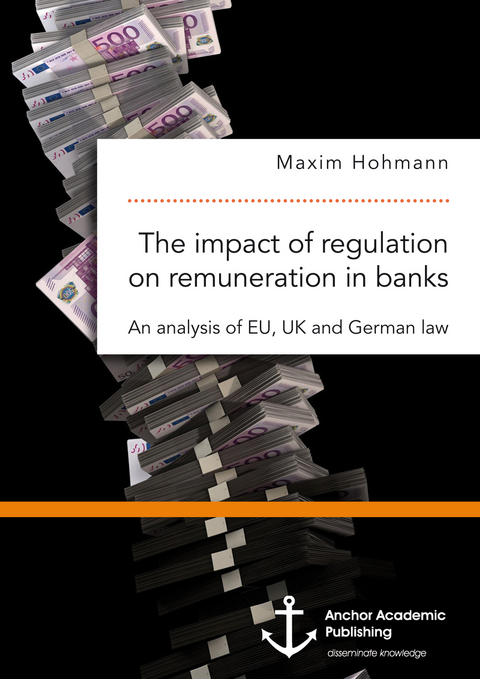
The impact of regulation on remuneration in banks. An analysis of EU, UK and German law
Anchor Academic Publishing (Verlag)
9783960670759 (ISBN)
Text Sample:Chapter III. Negative Impact of Regulation:1. Costs:Regulation of banker's remuneration may increase costs as the rules have to be implemented in banks, executed and a supervisory body has to be created. For the implementation, new staff has to be hired or existing employees need training. External advice may be necessary. The new remuneration policy needs to be designed or changed. To manage risks associated with remuneration adequately, banks may need to purchase special risk management software's. However, such software's and other necessary measures are costly, and may be an obstacle for smaller banks. Supervision, secured through externals and a permanent internal supervisory body, creates higher costs for banks and the public. Finally, banks have to communicate with regulatory authorities and provide data. Such (public) disclosure can lead to competitive disadvantages. Those interventions will raise labour and administrative costs, which finally have to be paid from banks customers, merely the public.2. Attractiveness of the market:Europe's financial centres could become less attractive due to the regulation of remuneration. Regulation of banker's remuneration is '(...) restricting the exercise of market power in many instances'. Regulation can cause competitive disadvantages for banks. Bonuses set incentives for employees' good performance and are a part of cost flexibility in a bank. If an institution can only pay lower salaries, highly skilled staff may opt for another company with '(...) more attractive remuneration packages for skilled people (...)' in a financial market outside Europe.3. Common goods:Common goods can be diversely defined, due to different cultural perspectives. Common goods are beneficial values for the entire public or some social groups. Banks have an important role in the monetary policy, creating a payment system and providing loans. They offer bank accounts, which are necessary for our today's financial system. Furthermore, banks gather money and redistribute liquidity to other market-participants. Considering those facts, banks are of "specific public interest". However, such interest is not necessarily a public good or needs special regulatory attention. Bank accounts and loans are not of more importance than any other services offered in the market. There are no apparent criteria to determine public goods. Banks are private entities with rights to entrepreneurial freedom. Such freedom is a fundamental right, of high value for economies and should not be subject to any limitations. Regulations with regard to remuneration restrict such freedom.However, if bank services are considered to be a public good, laws do not protect such good for the public. The regulations do not often promote the public good, but incentives of some individuals in a certain area. It is necessary to have well-trained staff to keep and protect that good. However failure of a few banks leads to the urge of society in having someone accountable. Politicians in their endless efforts to raise more votes use the public interest for their own benefit, by making the whole banking sector responsible for the action of a few. The political approach was to convince voters with stricter regulations on banks. The public interest is an attractive mean to justify regulatory intervention. However, the real incentive behind such action, in this case to raise votes, remains in the dark.Limitation of remuneration to secure the public interest is not a sufficient mean to prevent market failure. Conversely, over-regulating leads to a bank's business failure, which destabilises the market. Regulations may raise the risk of market failure. Moreover, the rules concerning remuneration did not really change the public opinion that managers get paid inappropriately. Over-regulating should, therefore, be avoided as it does not stabilise the financial market nor satisfy the public's opinion.IV. Necessity to regulate
| Erscheinungsdatum | 13.02.2017 |
|---|---|
| Sprache | englisch |
| Maße | 155 x 220 mm |
| Gewicht | 110 g |
| Einbandart | Paperback |
| Themenwelt | Recht / Steuern ► Wirtschaftsrecht ► Bank- und Kapitalmarktrecht |
| Wirtschaft ► Betriebswirtschaft / Management | |
| Schlagworte | Bank • Common Good • European Union Legislation • Financial System • Industrial law • Legislation in Germany • Legislation in the UK • Limitation of remuneration • Regulation • Remuneration • Risk |
| ISBN-13 | 9783960670759 / 9783960670759 |
| Zustand | Neuware |
| Informationen gemäß Produktsicherheitsverordnung (GPSR) | |
| Haben Sie eine Frage zum Produkt? |
aus dem Bereich


