The Handbook of the Criminology of Terrorism (eBook)
632 Seiten
Wiley-Blackwell (Verlag)
978-1-118-92397-9 (ISBN)
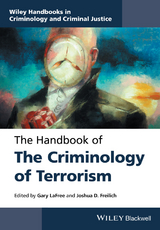
The Handbook of the Criminology of Terrorism features a collection of essays that represent the most recent criminological research relating to the origins and evolution of, along with responses to, terrorism, from a criminological perspective.
- Offers an authoritative overview of the latest criminological research into the causes of and responses to terrorism in today's world
- Covers broad themes that include terrorism's origins, theories, methodologies, types, relationship to other forms of crime, terrorism and the criminal justice system, ways to counter terrorism, and more
- Features original contributions from a group of international experts in the field
- Provides unique insights into the field through an exclusive focus on criminological conceptual frameworks and empirical studies that engage terrorism and responses to it
Gary LaFree is Director of the National Consortium for the Study of Terrorism and Responses to Terrorism (START) and a Distinguished Scholar and Professor of Criminology and Criminal Justice at the University of Maryland. His most recent book (with Laura Dugan and Erin Miller) is Putting Terrorism in Context (2015).
Joshua D. Freilich is a member of the Criminal Justice Department and the Criminal Justice PhD Program at John Jay College. He is the Creator and co-Director of the United States Extremist Crime Database (ECDB), an open source relational database of violent and financial crimes committed by political extremists in the U.S.
Gary LaFree is Director of the National Consortium for the Study of Terrorism and Responses to Terrorism (START) and a Distinguished Scholar and Professor of Criminology and Criminal Justice at the University of Maryland. His most recent book (with Laura Dugan and Erin Miller) is Putting Terrorism in Context (2015). Joshua D. Freilich is a member of the Criminal Justice Department and the Criminal Justice PhD Program at John Jay College. He is the Creator and co-Director of the United States Extremist Crime Database (ECDB), an open source relational database of violent and financial crimes committed by political extremists in the U.S.
Notes on Contributors
Robert Agnew is Samuel Candler Dobbs Professor of Sociology at Emory University. His research focuses on the causes of crime and delinquency, especially general strain theory. Recent books include Juvenile Delinquency: Causes and Control (with Timothy Brezina, Oxford University Press, 2015) and Toward a Unified Criminology: Integrating Assumptions about Crime, People, and Society (New York University Press, 2011).
J. Keith Akins is an associate professor of criminal justice at the University of Houston–Victoria. He is a disabled veteran of the US Army. Prior to his current appointment, he taught at New Mexico State University and, before that, he was an Investigative Researcher with the Anti‐Defamation League. His research interests include terrorists and the perpetrators of hate crimes.
Robert Apel is an associate professor of criminal justice at Rutgers University, Newark. His research interests include the intersections of the labor market, crime control policy, and the life course.
Enrique Desmond Arias is an associate professor of public policy in the School of Policy, Government, and International Affairs at George Mason University. He is the author of Drugs and Democracy in Rio de Janeiro: Trafficking, Social Networks, and Public Security (University of North Carolina Press, 2006) and co‐editor of Violent Democracies in Latin America (Duke University Press, 2010).
Randy Borum is a professor and director of intelligence studies in the School of Information at the University of South Florida. He previously served on the Director of National Intelligence’s Intelligence Science Board (ISB), and has studied behavioral dynamics in violent extremism and counterintelligence. He has authored/co‐authored more than 150 professional publications, and currently serves as senior editor for the Journal of Strategic Security and for Military Cyber Affairs.
Noémie Bouhana is a senior lecturer in security and crime science at University College London, where she leads the Counter‐Terrorism Research Group. Her research addresses the causes of terrorist propensity development. She directs the €2.9 million EU FP7 PRIME project on lone‐actor terrorism and was recently selected to receive a US$1 million Minerva grant to study the social ecology of radicalization. Her recent publications have appeared in Legal and Criminological Psychology and Frontiers in Human Neuroscience.
Katharine A. Boyd is a criminology lecturer in the Sociology, Anthropology and Philosophy department at the University of Exeter. Her research focuses on terrorism and other forms of violence and crime and the use of quantitative methods in social science.
Alex Braithwaite is an associate professor of international relations in the School of Government and Public Policy at the University of Arizona. His research addresses the causes and geography of various forms of violent and non‐violent political conflict, including terrorism and insurgency. His research appears in Journal of Politics, Criminology, International Studies Quarterly, Journal of Quantitative Criminology, and Terrorism and Political Violence, among others.
William Braniff is the executive director of the National Consortium for the Study of Terrorism and Responses to Terrorism (START) at the University of Maryland. He has previously served as an officer in the US Army, as a federal employee at the National Nuclear Security Agency, and as the director of practitioner education at the Combating Terrorism Center at West Point. His research focuses on domestic and international terrorism and countering violent extremism (CVE).
Bryan F. Bubolz is an assistant professor in the Department of Criminology and Criminal Justice at Southern Illinois University Carbondale. His research interests include street gangs, violent extremism, domestic terrorism, and desistance. Recent publications have appeared in the Journal of Research in Crime and Delinquency, Deviant Behavior, American Behavioral Scientist, and The Sociological Quarterly.
Jennifer Varriale Carson holds a PhD from the University of Maryland in criminology and criminal justice. Her work focuses on policy evaluation, particularly the use of quasi‐experimental methods in assessing counterterrorism efforts, and can be found in a number of published works including the Journal of Quantitative Criminology, Deviant Behavior, and Terrorism and Political Violence.
Steven M. Chermak is a professor in the School of Criminal Justice at Michigan State University. He studies the criminal and terrorist activities of US extremists. His work has primarily focused on analysis of data in the United States Extremist Crime Database—a national open‐source database that includes data on the violent and financial crimes committed by extremists in the United States. His recent publications have appeared in Journal of Quantitative Criminology, Studies in Conflict and Terrorism, and Crime and Delinquency.
Kelly R. Damphousse serves as dean in the College of Arts and Sciences and as Presidential Professor of Sociology at the University of Oklahoma. He has served as the co‐editor of Social Science Quarterly since 2010 and as associate director of The American Terrorism Study since 1994. His terrorism research with Brent L. Smith has been published in journals such as Criminology, Justice Quarterly, Criminology and Public Policy, and the International Journal of Contemporary Sociology.
Laura M. DeMarco is a PhD candidate in the Department of Sociology at the Ohio State University. Her research interests focus on crime and intergroup conflict and the consequences of incarceration.
Michael Distler is a doctoral candidate in the Department of Criminology and Criminal Justice at the University of Maryland, College Park. He is also a research assistant at the National Consortium for the Study of Terrorism and Responses to Terrorism (START), working on data collection for the Global Terrorism Database (GTD). His research interests include terrorist tactics, situational crime prevention, and policing.
Laura Dugan is a professor in the Department of Criminology and Criminal Justice at the University of Maryland. Her research examines the consequences of violence and the efficacy of violence prevention/intervention policy and practice. She co‐authored Putting Terrorism into Context: Lessons Learned from the World’s Most Comprehensive Terrorism Database (Routledge, 2014). She has also written more than 50 journal articles and book chapters.
Susan Fahey is an associate professor of criminal justice at Stockton University. Dr. Fahey is the co‐coordinator of Stockton University’s homeland security track and criminal justice concentration, as well as coordinator of its internship program. Her research interests include failed states and terrorism, right‐wing extremism, terrorist targeting and organizations, and the collection of terrorism databases. She previously worked on the Global Terrorism Database at the National Consortium for the Study of Terrorism and Responses to Terrorism.
Joshua D. Freilich is a member of the Criminal Justice Department and the Criminal Justice PhD Program at John Jay College. He is the creator and co‐director of the United States Extremist Crime Database (ECDB), an open‐source relational database of violent and financial crimes committed by political extremists in the United States. His research has been funded by the Department of Homeland Security (DHS) and the National Institute of Justice (NIJ). His research focuses on the causes of and responses to terrorism, measurement issues, bias crimes, and criminology theory, especially environmental criminology and crime prevention.
Jeff Gruenewald is an assistant professor in the School of Public and Environmental Affairs at Indiana University–Purdue University, Indianapolis. He is also a research affiliate and investigator for the National Consortium for the Study of Terrorism and Responses to Terrorism (START Center). His recent research addresses issues of domestic terrorism, homeland security, and homicide. His work has appeared in journals such as Justice Quarterly, Criminology and Public Policy, and Terrorism and Political Violence.
Mark S. Hamm is a former prison warden from Arizona and currently a professor of criminology at Indiana State University and a senior research fellow at the Terrorism Center, John Jay College of Criminal Justice, City University of New York. In the 1980s and 1990s, he wrote widely about right‐wing extremists in the United States, as well as on subjects as diverse as apocalyptic violence, cop‐killer rap, and ethnography and terror. His books include The Spectacular Few: Prisoner Radicalization and the Evolving Terrorist Threat (NYU Press, 2013); Terrorism as Crime: From Oklahoma City to Al‐Qaeda and Beyond (NYU Press, 2007); In Bad Company: America's Terrorist Underground (Northeastern University Press, 2002); Apocalypse in Oklahoma: Waco and Ruby Ridge Revenged (Northeastern University Press, 1997); and American Skinheads: The Criminology and Control of Hate Crime (Praeger Publishers, 1993). He received three major grants from the National Institute of Justice:...
| Erscheint lt. Verlag | 29.11.2016 |
|---|---|
| Reihe/Serie | Wiley Handbooks in Criminology |
| Wiley Handbooks in Criminology | Wiley Handbooks in Criminology and Criminal Justice |
| Sprache | englisch |
| Themenwelt | Recht / Steuern ► Strafrecht ► Kriminologie |
| Sozialwissenschaften ► Politik / Verwaltung | |
| Sozialwissenschaften ► Soziologie | |
| Schlagworte | 9/11 • criminological research • Criminology • Criminology of terrorism • domestic terrorism • Global Terrorism • International Terrorism • Kriminologie • Law • Political Revolution / Violence / Terrorism • Political Science • Political violence • Politikwissenschaft • Politische Revolution, Gewalt, Terrorismus • Rechtswissenschaft • Sociology • Sociology Special Topics • Soziologie • Spezialthemen Soziologie • terrorism • terrorism research • Terrorismus |
| ISBN-10 | 1-118-92397-9 / 1118923979 |
| ISBN-13 | 978-1-118-92397-9 / 9781118923979 |
| Informationen gemäß Produktsicherheitsverordnung (GPSR) | |
| Haben Sie eine Frage zum Produkt? |
 EPUB (Ohne DRM)
Digital Rights Management: ohne DRM
Dieses eBook enthält kein DRM oder Kopierschutz. Eine Weitergabe an Dritte ist jedoch rechtlich nicht zulässig, weil Sie beim Kauf nur die Rechte an der persönlichen Nutzung erwerben.
Dateiformat: EPUB (Electronic Publication)
EPUB ist ein offener Standard für eBooks und eignet sich besonders zur Darstellung von Belletristik und Sachbüchern. Der Fließtext wird dynamisch an die Display- und Schriftgröße angepasst. Auch für mobile Lesegeräte ist EPUB daher gut geeignet.
Systemvoraussetzungen:
PC/Mac: Mit einem PC oder Mac können Sie dieses eBook lesen. Sie benötigen dafür die kostenlose Software Adobe Digital Editions.
eReader: Dieses eBook kann mit (fast) allen eBook-Readern gelesen werden. Mit dem amazon-Kindle ist es aber nicht kompatibel.
Smartphone/Tablet: Egal ob Apple oder Android, dieses eBook können Sie lesen. Sie benötigen dafür eine kostenlose App.
Geräteliste und zusätzliche Hinweise
Buying eBooks from abroad
For tax law reasons we can sell eBooks just within Germany and Switzerland. Regrettably we cannot fulfill eBook-orders from other countries.
aus dem Bereich