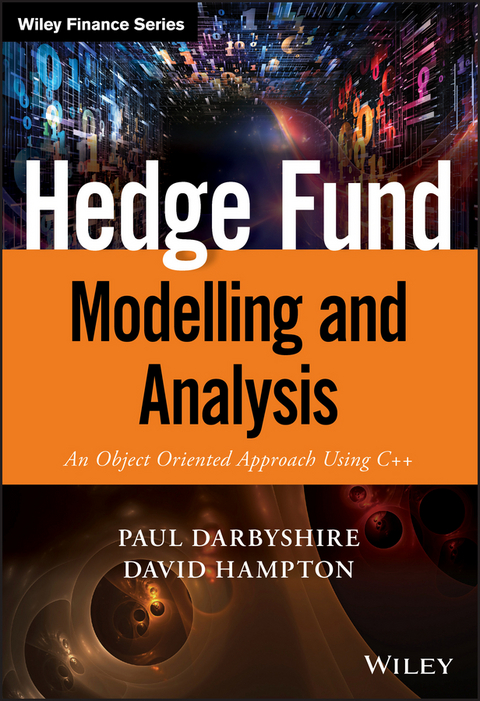
Hedge Fund Modelling and Analysis (eBook)
John Wiley & Sons (Verlag)
978-1-118-87955-9 (ISBN)

Low interest rates, overcrowded markets and greater regulatory oversight are just some of the many reasons it is close to impossible for hedge funds to draw competitive returns. The solution for many hedge fund managers, quantitative investment analysts and risk managers is to adopt new technologies, platforms and programming languages to better manage their risks and maximise the benefits of their return profiles.
Hedge Fund Modelling and Analysis is a full course in the latest analytic strategies for hedge fund investing, complete with a one-of-a-kind primer on both C++ and object oriented programming (OOP). Covering both basic and risk-adjusted performance measures, this practitioner's guide enables you to manage risk easily and make the most of key statistics with simple and advanced analysis techniques. This highly anticipated third book in the widely used Hedge Fund Modelling and Analysis series is the only guide available for applying the powerful C++ language to revolutionise hedge fund trading. Even if you've never worked with code before, the focused overview of C++ gives you everything you need to navigate the technical aspects of object oriented programming, which enables you to build sophisticated analysis programs from small units of reusable code. This book is your breakthrough introduction to winning with hedge funds in the new reality of trading.
Jumpstart your new approach to beating the markets with:
- All the guidance and hands-on support you need to use quantitative strategies to optimise hedge fund decision-making.
- Illustrative modelling exercises and worked-out problems demonstrating what to expect when assessing risk and return factors in the real world.
- A companion website offering additional C++ programs, algorithms and data to download.
Make reading Hedge Fund Modelling and Analysis your new routine and gain all the insight and relevant information you need to beat the markets.
PAUL DARBYSHIRE gained his PhD in Theoretical Physics from King's College London and then began his career working as a Quantitative Analyst and Trader at HSBC on the Exotic Derivatives and Structured Products desk. He has subsequently been involved in the development and implementation of a variety of trading and risk management platforms for a number of major investent banks around the globe. Since 2005, Paul has been responsible for the analysis and design of cutting-edge algorithms in the development of behavioural finance and decision-making models at the University of Oxford. Paul also provides many private equity firms, hedge funds and investment management companies with senior consultancy in areas such as dynamic portfolio optimisation, trading platform design, software engineering and risk management.
DAVID HAMPTON gained his PhD in Electrical Engineering from the Queen's University of Belfast and an international MBA from Institut Superieur de Gestion in Paris, New York and Tokyo before joining Bank of America Capital Markets in London. David was previously an Adjunct Finance Professor at Skema Business School in Sophia Antipolis where he taught Financial Engineering and Excel/VBA Programming at the MSc level. At EDHEC Business School in Nice, he was responsible for managing their range of five MSc courses as Assistant Dean of the Financial Economics Track. An NFA registered CTA since 1996, David has been active as a consultant to the hedge fund community and as a Hedge Fund Manager with particular expertise in Global Macro Managed Futures and Long Short Equity investment styles.
This is the third book in the authorial team's popular Hedge Fund Modelling and Analysis series, which includes Hedge Fund Modelling and Analysis using MATLAB and Hedge Fund Modelling and Analysis Using Excel and VBA.
Use powerful C++ algorithms and Object Oriented Programming (OOP) to aid in hedge fund decision making Low interest rates, overcrowded markets and greater regulatory oversight are just some of the many reasons it is close to impossible for hedge funds to draw competitive returns. The solution for many hedge fund managers, quantitative investment analysts and risk managers is to adopt new technologies, platforms and programming languages to better manage their risks and maximise the benefits of their return profiles. Hedge Fund Modelling and Analysis is a full course in the latest analytic strategies for hedge fund investing, complete with a one-of-a-kind primer on both C++ and object oriented programming (OOP). Covering both basic and risk-adjusted performance measures, this practitioner's guide enables you to manage risk easily and make the most of key statistics with simple and advanced analysis techniques. This highly anticipated third book in the widely used Hedge Fund Modelling and Analysis series is the only guide available for applying the powerful C++ language to revolutionise hedge fund trading. Even if you've never worked with code before, the focused overview of C++ gives you everything you need to navigate the technical aspects of object oriented programming, which enables you to build sophisticated analysis programs from small units of reusable code. This book is your breakthrough introduction to winning with hedge funds in the new reality of trading. Jumpstart your new approach to beating the markets with: All the guidance and hands-on support you need to use quantitative strategies to optimise hedge fund decision-making. Illustrative modelling exercises and worked-out problems demonstrating what to expect when assessing risk and return factors in the real world. A companion website offering additional C++ programs, algorithms and data to download. Make reading Hedge Fund Modelling and Analysis your new routine and gain all the insight and relevant information you need to beat the markets.
PAUL DARBYSHIRE gained his PhD in Theoretical Physics from King's College London and then began his career working as a Quantitative Analyst and Trader at HSBC on the Exotic Derivatives and Structured Products desk. He has subsequently been involved in the development and implementation of a variety of trading and risk management platforms for a number of major investent banks around the globe. Since 2005, Paul has been responsible for the analysis and design of cutting-edge algorithms in the development of behavioural finance and decision-making models at the University of Oxford. Paul also provides many private equity firms, hedge funds and investment management companies with senior consultancy in areas such as dynamic portfolio optimisation, trading platform design, software engineering and risk management. DAVID HAMPTON gained his PhD in Electrical Engineering from the Queen's University of Belfast and an international MBA from Institut Superieur de Gestion in Paris, New York and Tokyo before joining Bank of America Capital Markets in London. David was previously an Adjunct Finance Professor at Skema Business School in Sophia Antipolis where he taught Financial Engineering and Excel/VBA Programming at the MSc level. At EDHEC Business School in Nice, he was responsible for managing their range of five MSc courses as Assistant Dean of the Financial Economics Track. An NFA registered CTA since 1996, David has been active as a consultant to the hedge fund community and as a Hedge Fund Manager with particular expertise in Global Macro Managed Futures and Long Short Equity investment styles. This is the third book in the authorial team's popular Hedge Fund Modelling and Analysis series, which includes Hedge Fund Modelling and Analysis using MATLAB and Hedge Fund Modelling and Analysis Using Excel and VBA.
Hedge Fund Modelling and Analysis 3
Contents 9
Preface 13
C++ Source Code 13
Hypothetical Hedge Fund Data 17
Book Website 17
1 Essential C++ 19
1.1 A Brief History of C and C++ 19
1.2 A Basic C++ Program 20
1.3 Variables 22
1.3.1 Characters and Strings 23
1.3.2 Variable Declarations 26
1.3.3 Type Casting 27
1.3.4 Variable Scope 28
1.3.5 Constants 29
1.4 Operators 30
1.4.1 The Assignment Operator 30
1.4.2 Arithmetic Operators 32
1.4.3 Relational Operators 33
1.4.4 Logical Operators 34
1.4.5 Conditional Operator 35
1.5 Input and Output 36
1.6 Control Structures 39
1.6.1 Branching 39
1.6.2 Looping 43
1.6.3 The for Loop 43
1.6.4 The while Loop 45
1.6.5 The do … while Loop 47
1.7 Arrays 48
1.8 Vectors 49
1.9 Functions 51
1.9.1 Call-by-Value vs. Call-by-Reference 54
1.9.2 Overloading Functions 57
1.10 Object Oriented Programming 59
1.10.1 Classes and Abstract Data Types 60
1.10.2 Encapsulation and Interfaces 61
1.10.3 Inheritance and Overriding Functions 62
1.10.4 Polymorphism 63
1.10.5 An Example of a Class 64
1.10.6 Getter and Setter Methods 67
1.10.7 Constructors and Destructors 70
1.10.8 A More Detailed Class Example 73
1.10.9 Implementing Inheritance 79
1.10.10 Operator Overloading 82
2 The Hedge Fund Industry 89
2.1 What are Hedge Funds? 89
2.2 The Structure of a Hedge Fund 92
2.2.1 Fund Administrators 92
2.2.2 Prime Brokers 93
2.2.3 Custodian, Auditors and Legal 94
2.3 The Global Hedge Fund Industry 95
2.3.1 North America 97
2.3.2 Europe 98
2.3.3 Asia 99
2.4 Specialist Investment Techniques 100
2.4.1 Short Selling 100
2.4.2 Leverage 101
2.4.3 Liquidity 102
2.5 Recent Developments for Hedge Funds 103
2.5.1 UCITS Hedge Funds 103
2.5.2 The European Passport 106
2.5.3 Restrictions on Short Selling 106
3 Hedge Fund Data Sources 109
3.1 Hedge Fund Databases 109
3.2 Major Hedge Fund Indices 110
3.2.1 Non-Investable and Investable Indices 110
3.2.2 Dow Jones Credit Suisse Hedge Fund Indices (www.hedgeindex.com) 112
3.2.3 Hedge Fund Research (www.hedgefundresearch.com) 118
3.2.4 FTSE Hedge (www.ftse.com) 120
3.2.5 Greenwich Alternative Investments (www.greenwichai.com) 122
3.2.6 Morningstar Alternative Investment Center (www.morningstar.com/advisor/alternative-investments.htm) 126
3.2.7 EDHEC Risk and Asset Management Research Centre (www.edhec-risk.com) 130
3.3 Database and Index Biases 131
3.3.1 Survivorship Bias 131
3.3.2 Instant History Bias 133
3.4 Benchmarking 133
3.4.1 Tracking Error 134
4 Statistical Analysis 137
4.1 The Stats Class 137
4.2 The Utils Class 138
4.3 The Import Class 141
4.4 Basic Performance Plots 145
4.4.1 Value Added Index 145
4.4.2 Histograms 148
4.5 Probability Distributions 149
4.5.1 Populations and Samples 150
4.6 Probability Density Function 151
4.7 Cumulative Distribution Function 152
4.8 The Normal Distribution 152
4.8.1 Standard Normal Distribution 154
4.9 Visual Tests for Normality 154
4.9.1 Inspection 154
4.9.2 Normal Probability Plot 155
4.10 Moments of a Distribution 156
4.10.1 Mean and Standard Deviation 156
4.10.2 Skew 159
4.10.3 Kurtosis 160
4.11 Covariance and Correlation 164
4.12 Linear Regression 176
4.12.1 Coefficient of Determination 181
4.12.2 Residual Plots 185
5 Performance Measurement 191
5.1 The PMetrics Class 191
5.2 The Intuition Behind Risk-Adjusted Returns 192
5.2.1 Risk-Adjusted Returns 200
5.3 Absolute Risk-Adjusted Return Metrics 202
5.4 The Sharpe Ratio 205
5.5 Market Models 209
5.5.1 The Information Ratio 210
5.5.2 The Treynor Ratio 215
5.5.3 Jensens Alpha 221
5.5.4 M-Squared 223
5.6 The Minimum Acceptable Return 225
5.6.1 The Sortino Ratio 225
5.6.2 The Omega Ratio 229
6 Mean-Variance Optimisation 231
6.1 The Optimise Class 231
6.2 Mean-Variance Analysis 232
6.2.1 Portfolio Return and Variance 232
6.2.2 The Mean-Variance Optimisation Problem 247
6.2.3 The Global Minimum Variance Portfolio 262
6.2.4 Short Sale Constraints 264
7 Market Risk Management 265
7.1 The RMetrics Class 265
7.2 Value-at-Risk 266
7.3 Traditional VaR Methods 269
7.3.1 Historical Simulation 269
7.3.2 Parametric Method 272
7.3.3 Monte-Carlo Simulation 279
7.4 Modified VaR 281
7.5 Expected Shortfall 284
7.6 Extreme Value Theory 289
7.6.1 Block Maxima 290
7.6.2 Peaks Over Threshold 290
References 295
Index 297
EULA 304
| Erscheint lt. Verlag | 21.10.2016 |
|---|---|
| Reihe/Serie | The Wiley Finance Series | Wiley Finance Series |
| Sprache | englisch |
| Themenwelt | Recht / Steuern ► Wirtschaftsrecht |
| Wirtschaft ► Betriebswirtschaft / Management ► Finanzierung | |
| Schlagworte | C# • C# algorithms • Code • C# programming language • David Hampton • Excel/VBA analysis • Finance & Investments • Financial Risk • Finanz- u. Anlagewesen • Finanzwesen • Hedge Fund • hedge fund analysis • Hedge Fund Analysis and Modeling Using C# • hedge fund decision making • hedge fund managers • hedge fund modeling • hedge fund risks • Hedge Funds • investment styles • manage return • manage risk • MATLAB analysis • minimize risk • New Technologies • non-normal returns data • Object oriented programming (OOP) • optimal fund performance • optimizing hedge fund decisions • Paul Darbyshire • Quantitative Strategies • return factors • risk-adjusted performance measures • risk/return profiles • sophisticated analysis • Statistics • technological platforms • Volatility |
| ISBN-10 | 1-118-87955-4 / 1118879554 |
| ISBN-13 | 978-1-118-87955-9 / 9781118879559 |
| Informationen gemäß Produktsicherheitsverordnung (GPSR) | |
| Haben Sie eine Frage zum Produkt? |
 PDF (Adobe DRM)
Kopierschutz: Adobe-DRM
Adobe-DRM ist ein Kopierschutz, der das eBook vor Mißbrauch schützen soll. Dabei wird das eBook bereits beim Download auf Ihre persönliche Adobe-ID autorisiert. Lesen können Sie das eBook dann nur auf den Geräten, welche ebenfalls auf Ihre Adobe-ID registriert sind.
Details zum Adobe-DRM
Dateiformat: PDF (Portable Document Format)
Mit einem festen Seitenlayout eignet sich die PDF besonders für Fachbücher mit Spalten, Tabellen und Abbildungen. Eine PDF kann auf fast allen Geräten angezeigt werden, ist aber für kleine Displays (Smartphone, eReader) nur eingeschränkt geeignet.
Systemvoraussetzungen:
PC/Mac: Mit einem PC oder Mac können Sie dieses eBook lesen. Sie benötigen eine
eReader: Dieses eBook kann mit (fast) allen eBook-Readern gelesen werden. Mit dem amazon-Kindle ist es aber nicht kompatibel.
Smartphone/Tablet: Egal ob Apple oder Android, dieses eBook können Sie lesen. Sie benötigen eine
Geräteliste und zusätzliche Hinweise
Buying eBooks from abroad
For tax law reasons we can sell eBooks just within Germany and Switzerland. Regrettably we cannot fulfill eBook-orders from other countries.
aus dem Bereich