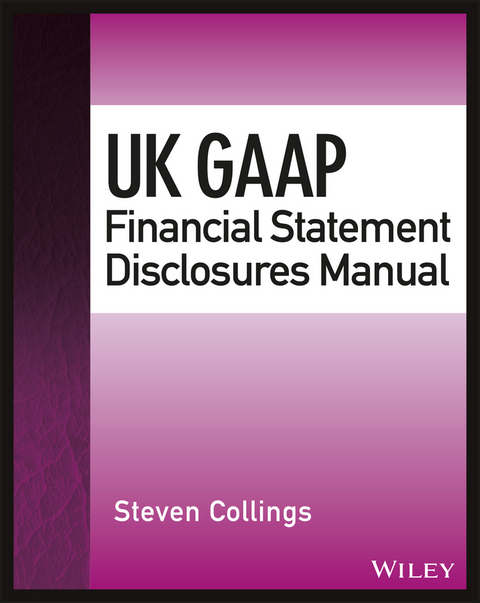
UK GAAP Financial Statement Disclosures Manual (eBook)
John Wiley & Sons (Verlag)
978-1-119-13277-6 (ISBN)
UK GAAP Financial Statement Disclosures Manual is the practical handbook accounting professionals need to prepare audit-proof financial statements. The recent establishment of the new UK GAAP has brought significant changes to financial reporting, and this guide collects all of the latest guidelines into one place. Clear, concise and heavily geared toward practical application, this book is designed for easy navigation with stand-alone chapters and real-world examples. You'll find step-by-step guidance for the entire disclosure process, with explicit instruction on what to include, how to include it and why. Financial statements prepared from 2015/2016 in the UK and Republic of Ireland will appear significantly updated, and this manual gives you the guidance you need to understand what's required to achieve full compliance.
Insufficient or incorrect disclosures are frequently the reason why financial statements are rendered deficient. This book provides practitioners with a reference and guide for all aspects of financial statement disclosure preparation.
- Get up to speed on the most recent UK GAAP guidelines
- Understand the 'what' and 'why' of disclosure statements
- Study real-world example statements for practical guidance
- Prepare statements that stand up to auditor and regulator scrutiny
Many practitioners fall afoul of regulators' criticisms with subjective, incomplete, omitted or incorrect disclosures, resulting in sanctions being brought against the practitioner or the firm. Financial statement disclosure emphasis is on transparency at a time when changes in the profession require an entirely new method of preparation. For practitioners who need to stay ahead of the curve, UK GAAP Financial Statement Disclosures Manual is the invaluable reference to keep within arm's reach.
A practical manual for preparing UK GAAP-compliant disclosures UK GAAP Financial Statement Disclosures Manual is the practical handbook accounting professionals need to prepare audit-proof financial statements. The recent establishment of the new UK GAAP has brought significant changes to financial reporting, and this guide collects all of the latest guidelines into one place. Clear, concise and heavily geared toward practical application, this book is designed for easy navigation with stand-alone chapters and real-world examples. You'll find step-by-step guidance for the entire disclosure process, with explicit instruction on what to include, how to include it and why. Financial statements prepared from 2015/2016 in the UK and Republic of Ireland will appear significantly updated, and this manual gives you the guidance you need to understand what's required to achieve full compliance. Insufficient or incorrect disclosures are frequently the reason why financial statements are rendered deficient. This book provides practitioners with a reference and guide for all aspects of financial statement disclosure preparation. Get up to speed on the most recent UK GAAP guidelines Understand the 'what' and 'why' of disclosure statements Study real-world example statements for practical guidance Prepare statements that stand up to auditor and regulator scrutiny Many practitioners fall afoul of regulators' criticisms with subjective, incomplete, omitted or incorrect disclosures, resulting in sanctions being brought against the practitioner or the firm. Financial statement disclosure emphasis is on transparency at a time when changes in the profession require an entirely new method of preparation. For practitioners who need to stay ahead of the curve, UK GAAP Financial Statement Disclosures Manual is the invaluable reference to keep within arm's reach.
STEVEN COLLINGS, FMAAT FCCA is the Audit and Technical Director at Leavitt Walmsley Associates, Ltd., a Manchester-based firm of Chartered Certified Accountants. He is a member of the Financial Reporting Council's UK GAAP Technical Advisory Group, tasked with advising the Corporate Reporting Council on all issues relating to UK accounting standards, and a prolific author and lecturer in the accounting and auditing sphere. Steve has received numerous awards for his contributions to the field.
Foreword vii
Preface ix
Acknowledgements xi
About the Author xiii
1 The Structure of UK GAAP 1
2 Interaction of the Companies Act 2006 21
3 The Directors' Report and Strategic Report 45
4 The Income Statement/Statement of Comprehensive Income 67
5 Statement of Financial Position (Balance Sheet) 83
6 The Statement of Changes in Equity 105
7 The Statement of Cash Flows 115
8 The Auditor's Report 133
9 Accounting Policies, Estimates and Errors 157
10 Operating Segments 175
11 Directors' Remuneration Report 185
12 Taxation 201
13 Fixed Assets and Investment Property 215
14 Government Grants 235
15 Financial Investments 247
16 Financial Instruments 263
17 Leasing 285
18 Inventories 305
19 Provisions and Contingencies 315
20 Transactions with Directors 333
21 Events After the Reporting Period 347
22 Going Concern 365
23 Related Parties 385
24 Consolidated Financial Statements 409
25 Filing Financial Statements with Companies House 429
26 Interim Financial Reporting 441
27 Earnings Per Share 455
28 Financial Statements for Micro-Entities 465
29 Insurance 485
Index 493
1
The Structure of UK GAAP
- Introduction
- FRS 102 The Financial Reporting Standard Applicable in the UK and Republic of Ireland
- The EU Accounting Directive
- Response by the Financial Reporting Council
- The Structure of New UK GAAP
- Key Points
Introduction
Financial reporting in the UK and Republic of Ireland has undergone considerable change over the last few years. This is because the standard-setters in the UK and Republic of Ireland (the Financial Reporting Council (FRC)) had always foreseen entities reporting under an international-based financial reporting framework. Since 2005, listed companies in the UK and Republic of Ireland have had to report under EU-adopted IFRS and during the transition to IFRS there were considerable problems encountered meaning lessons had to be learned. Since 2005, the FRC (previously the Accounting Standards Board) have been actively producing a framework for private companies to report under, which is based on IFRS. The intention by the (now defunct) Accounting Standards Board was to adopt an IFRS-based framework because IFRS has gathered pace much faster over the years. In addition, having a framework which is based on IFRS is said to improve comparability and consistency and open up capital markets.
FRS 102 The Financial Reporting Standard Applicable in the UK and Republic of Ireland
FRS 102 The Financial Reporting Standard applicable in the UK and Republic of Ireland was issued on 14 March 2013. This marked the end of several years' work by the FRC (and the previous Accounting Standards Board) in developing a standard which was based on IFRS and which could be used by private companies. The standard itself was initially 350 pages long, which was a considerable reduction in volume from previous UK GAAP, which was some 3,500+ pages long. Professional accountants had often complained about the sheer volume of UK GAAP and the voluminous disclosures which it mandates. The Accounting Standards Board at the time also acknowledged that UK GAAP had become too voluminous and disjointed and hence it was more cost-effective to develop a new UK GAAP rather than change the previous GAAP.
FRS 102 is itself based on IFRS for SMEs, although it is not identical to IFRS for SMEs because IFRS for SMEs was not compatible with UK and Republic of Ireland companies legislation. In addition, IFRS for SMEs is based on the concept of ‘public accountability’, a concept which proved very difficult to define in the eyes of UK legislation. The initial Exposure Drafts of FRS 102 were based on the concept of public accountability, but this would have meant that certain entities would have had to adopt EU-adopted IFRS (for example, the smallest of pension schemes), which would not have been appropriate because of the associated disclosure requirements which IFRS requires.
FRS 102 was originally issued in March 2013 and was mandatory for accounting periods commencing on or after 1 January 2015 for those companies who were not reporting under the small companies' regime (i.e. the Financial Reporting Standard for Smaller Entities (the FRSSE)). Early adoption was permissible, although the take-up for early adoption was not vast. Initially, medium-sized businesses were the main entities to adopt FRS 102 for their accounting periods beginning on or after 1 January 2015 and the original plan was to ensure that the medium-sized businesses transitioned across to the new regime and then the FRC would see how smoothly those transitions had gone. Small companies would continue to report under the FRSSE and originally the FRC said that they would eventually have to align the FRSSE with FRS 102 to ensure that no significant disparities in accounting and disclosures existed between the two standards.
The EU Accounting Directive
On 26 June 2013, the EU issued Directive 2013/34/EU of the European Parliament and of the Council (referred to as the EU Accounting Directive (the Directive)). It replaced the 4th and 7th Accounting Directives and established minimum legal requirements for financial statements in the EU as well as providing 100 Member State options. The overarching objective of the Directive is to allow more companies to have access to a less burdensome financial reporting regime than was the case under the previous Companies Act 2006. There are three core objectives to the Directive, which are to:
- simplify accounting requirements so as to reduce the administrative burden on companies with particular emphasis focused on smaller companies;
- increase the clarity and comparability of financial statements of companies so as to reduce the cost of capital and increase the level of cross-border trade and merger and acquisition activity; and
- protect essential user needs by retaining necessary accounting information for users.
The Directive's objectives are therefore to simplify the accounting requirements for small entities within its scope and hence reduce the levels of disclosures contained in the financial statements. The Directive achieves this objective by applying a ‘think small first’ approach and this approach:
- introduces a ‘building block’ approach to the statutory accounts whereby disclosure levels are increased depending on the size of the undertaking;
- reduces the number of options available to preparers in respect of recognition, measurement and presentation; and
- creates a largely harmonised small companies' regime and, for the first time, limits the amount of information which Member States are permitted to require small undertakings to place in their annual financial statements.
The Directive states that small, medium-sized and large undertakings should be defined and distinguished by reference to balance sheet total, net turnover and the average number of employees during the financial year because this criterion usually provides objective evidence as to the size of the undertaking. The Directive also allows Member States the option of using maximum mandatory thresholds to determine company sizes or minimum mandatory thresholds. The Department for Business Innovation and Skills (BIS) confirmed that in order to allow more companies access to a less burdensome financial reporting regime, it would apply the maximum mandatory thresholds in the Directive (Chapter 2 examines the new thresholds).
In January 2015, BIS issued their response to the consultation in which it confirmed its decision to take advantage of the maximum thresholds which the Directive permits. This would, according to BIS, allow 11,000 medium-sized companies to be re-categorised and enable them to take advantage of the small companies' regime, thus allowing them to make less disclosure in their financial statements than would otherwise be the case. In their response to the consultation, BIS also confirmed that they would also apply the mandatory increases in the thresholds for medium-sized and large businesses. The transposition of the Directive into company law completed on 26 March 2015 and became effective from 6 April 2015 for accounting periods commencing on or after 1 January 2016, or for accounting periods commencing on or after 1 January 2015, but before 1 January 2016 if the directors wished. This early adoption clause was built into the legislation to allow a medium-sized business to consider whether it would fall to be classed as small under the revised Companies Act 2006 and hence possibly take advantage of the new small companies' regime.
Response by the Financial Reporting Council
In light of the revisions to the Companies Act 2006, the FRC issued three Exposure Drafts on 19 February 2015 as follows:
- FRED 58 Draft FRS 105 The Financial Reporting Standard applicable to the Micro-entities Regime;
- FRED 59 Draft Amendments to FRS 102 The Financial Reporting Standard applicable in the UK and Republic of Ireland – Small entities and other minor amendments; and
- FRED 60 Draft Amendments to FRS 100 Application of Financial Reporting Requirements and FRS 101 Reduced Disclosure Framework.
Unlike when the FRC have previously issued Exposure Drafts, on issuance of the above three Exposure Drafts, the FRC also included an ‘Overview Document’, which gave a brief outline as to the FRC's overall intentions. In addition to overhauling the financial reporting regime for smaller and micro-entities, the FREDs also incorporated other minor amendments to the FRSs.
The FRC took the decision to issue three FREDs in order to make a distinction between the different standards which have been affected by the proposals.
The Exposure Drafts were open for comment until April 2015. Once the comment period closed, the FRC took on board feedback which they received on the Exposure Drafts from various commentators and then made further changes to arrive at a set of finalised standards for small and micro-entities. The most notable changes to the Exposure Drafts in arriving at finalised standards were as follows:
- A complete restructuring of Section 1A of FRS 102 Small Entities. The end result is a much more user-friendly and concise section and has the specific disclosure requirements split into two Appendices: Appendix C outlines those disclosures which are legally required and Appendix D outlines those disclosures which are encouraged in order that the financial statements of a...
| Erscheint lt. Verlag | 1.9.2016 |
|---|---|
| Reihe/Serie | Wiley Regulatory Reporting | Wiley Regulatory Reporting |
| Sprache | englisch |
| Themenwelt | Recht / Steuern ► Wirtschaftsrecht |
| Wirtschaft ► Betriebswirtschaft / Management ► Rechnungswesen / Bilanzen | |
| Schlagworte | 2015-2016 UK GAAP • 2015 UK GAAP standards • Accounting • GAAP • GAAP (US-Vorschriften Rechnungslegung) • Leavitt Walmsley Associates • Rechnungslegung • Rechnungswesen • Steven Collings • UK GAAP changes • UK GAAP compliance • UK GAAP disclosure examples • UK GAAP disclosure guidelines • UK GAAP disclosure help • UK GAAP disclosure preparation • UK GAAP disclosure problems • UK GAAP disclosure reference • UK GAAP disclosure requirements • UK GAAP disclosure tutorial • UK GAAP Financial Statement Disclosures Manual • UK GAAP financial statements • UK GAAP handbook • UK GAAP updates • writing UK GAAP disclosures |
| ISBN-10 | 1-119-13277-0 / 1119132770 |
| ISBN-13 | 978-1-119-13277-6 / 9781119132776 |
| Informationen gemäß Produktsicherheitsverordnung (GPSR) | |
| Haben Sie eine Frage zum Produkt? |
 EPUB (Adobe DRM)
Kopierschutz: Adobe-DRM
Adobe-DRM ist ein Kopierschutz, der das eBook vor Mißbrauch schützen soll. Dabei wird das eBook bereits beim Download auf Ihre persönliche Adobe-ID autorisiert. Lesen können Sie das eBook dann nur auf den Geräten, welche ebenfalls auf Ihre Adobe-ID registriert sind.
Details zum Adobe-DRM
Dateiformat: EPUB (Electronic Publication)
EPUB ist ein offener Standard für eBooks und eignet sich besonders zur Darstellung von Belletristik und Sachbüchern. Der Fließtext wird dynamisch an die Display- und Schriftgröße angepasst. Auch für mobile Lesegeräte ist EPUB daher gut geeignet.
Systemvoraussetzungen:
PC/Mac: Mit einem PC oder Mac können Sie dieses eBook lesen. Sie benötigen eine
eReader: Dieses eBook kann mit (fast) allen eBook-Readern gelesen werden. Mit dem amazon-Kindle ist es aber nicht kompatibel.
Smartphone/Tablet: Egal ob Apple oder Android, dieses eBook können Sie lesen. Sie benötigen eine
Geräteliste und zusätzliche Hinweise
Buying eBooks from abroad
For tax law reasons we can sell eBooks just within Germany and Switzerland. Regrettably we cannot fulfill eBook-orders from other countries.
aus dem Bereich