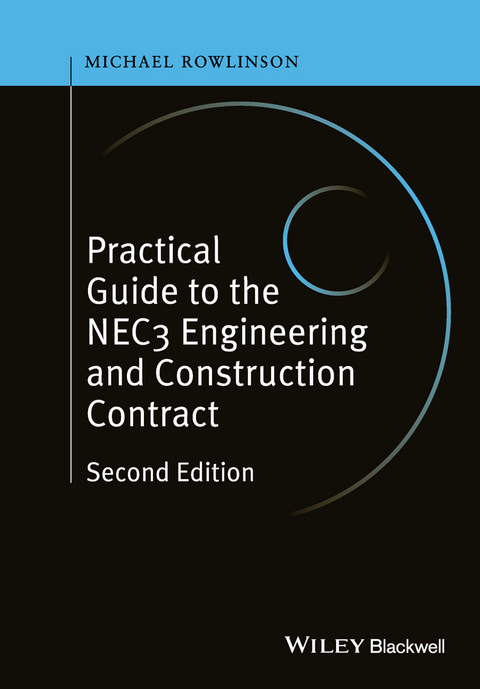
Practical Guide to the NEC3 Engineering and Construction Contract (eBook)
John Wiley & Sons (Verlag)
978-1-119-03299-1 (ISBN)
Michael Rowlinson MSc, DipArb, MRICS, FCIOB, FCIArb, FCInstCES, is principal of Michael Rowlinson Associates Limited. An experienced construction professional having qualified initially as a Chartered Quantity Surveyor and later as a Chartered Builder, Michael specialises in all aspects of contract drafting, contract management, contract administration, construction law, claims and dispute resolution. As part of his work Michael lectures extensively and has written many published articles and two books the NEC3 family of contracts.
Launched in 1993, the NEC Engineering and Construction Contract has become one of the UK's leading standard forms of contract for major construction and civil engineering projects. The third edition, popularly known as NEC3, is a process based contract embodying project and commercial management best practice, so its basic philosophy differs from the more adversarial approach of other standard construction contracts. Since the first edition of this book, the third edition of the contract has seen the introduction of a new secondary option for use in the UK and amendments to a number of clauses. In addition, in September 2011, changes were introduced to cater for the amendments to the Housing Grants, Construction and Regeneration Act 1996 contained in the Local Democracy, Economic Development and Construction Act 2009, which became effective for all new contracts entered into from 1 October 2011. These amendments have been incorporated into the text. A Practical Guide to the NEC3 Engineering and Construction Contract will be useful to everyone in the construction industry working on a project under this contract. It will be of interest to the complete construction supply chain, including employers, construction professions, contractors and sub-contractors, as well as consultants and lawyers advising any of these parties, either in the preparation of contract documentation or the day to day management or the resolution of problem situations which may arise.
Michael Rowlinson MSc, DipArb, MRICS, FCIOB, FCIArb, FCInstCES, is principal of Michael Rowlinson Associates Limited. An experienced construction professional having qualified initially as a Chartered Quantity Surveyor and later as a Chartered Builder, Michael specialises in all aspects of contract drafting, contract management, contract administration, construction law, claims and dispute resolution. As part of his work Michael lectures extensively and has written many published articles and two books the NEC3 family of contracts.
Chapter 1
Introduction
1.1 General
In writing this guide I have set out to provide a view, much of it personal, as to how to get the most out of the third edition of the New Engineering Contract Engineering and Construction Contract (ECC). It is no secret that I am a fan of this contract and, as a result, may be willing to overlook what many perceive as it faults or weaknesses. In this guide I have tried to identify and suggest ways in which the procedures and aims of the contract can be simplified so that users do not become unnecessarily bogged down in procedure, but instead concentrate on achieving the goals of the ECC. This guide therefore goes through the procedure in detail as intended by the relevant clauses, but concentrates on practical issues to provide suggestions which the parties can use to achieve the overall intent and spirit of the ECC and to reach the common goal.
With this guide, you get what it says on the cover: A Practical Guide to the NEC3 ECC Form of Contract. It is a guide to provide users of the ECC, both novice and experienced, with a view of all its various philosophies, principles, mechanisms and vagaries. The reader will be guided through the contract in a manner that will enable him or her to use this guide for reference without necessarily having to read it all: in other words, a practical guide rather than a stuffy text book. That said, there will be an amount of cross-referencing between sections in order to avoid repetition, so users will need to follow these references to find more detailed supporting guidance to particular issues. One area that is not cross-referenced is the term ‘spirit of mutual trust and cooperation’ as found in clause 10.1 of the ECC, although used extensively throughout the guide. If users are uncertain of the meaning of this phrase, then they need to re-read Chapter 4.
To assist the reader in finding where any particular clause, related legal case or UK statute is referred to in the text, a comprehensive index of such references is included in Tables A1.1–A1.3 in Appendix 1.
The more I have worked with this contract over the years, the more I have come to think of it not as a contract but as a Project Management Procedures Manual. This should not be a surprise as the original contract was drafted by project managers for construction professionals (and not by lawyers for other lawyers and judges).
Nevertheless, we must not lose sight of the fact that the ECC is a contract and, as such, legally binds those parties that enter into a contract incorporating these standard terms.
This second edition of the book was requested by the publisher after three successful years for the first edition. During that period, NEC had re-printed the third edition of the contract, together with the rest of the family. This re-print had made relatively minor amendments to a number of clauses and introduced a new secondary option for use in the UK. These amendments have been incorporated into the text as part of this revision. At the same time, references to the previous text have been expunged. The clauses that have been amended as part of the re-print are indicated in Table A1.1 of Appendix 1 by means of an asterisk (*) in the clause number column.
In addition, NEC had issued amendments in September 2011 which made changes to two of the Options (W2 and Y(UK)2) to cater for the amendments to the Housing Grants, Construction and Regeneration Act 1996 contained in the Local Democracy, Economic Development and Construction Act 2009, which became effective for all new contracts entered into from 1 October 2011. These had been referred to in the first edition of this book as being expected to be effective from 1 April 2011, but the delay had not been announced until the original text had gone to print.
Within this revision I have also taken the opportunity to make amendments and additions to the contents to include my own evolving knowledge of the ECC and developments to the practical side which have come to my attention from various sources. Some useful suggestions from reviewers of the first edition commissioned by the publisher have also been considered and included as appropriate and practical.
1.2 Mechanics not law
Being a practical guide, this book considers the mechanics of the contract and not of the law. As a practicing construction professional, I am interested in the successful outcome of the project for all parties involved. From my point of view, the employing organisation should get what it wants in terms of a project finished on time, to the required quality and within budget (providing, of course, that the budget was reasonable in the first place). The consultants should be recognised for their contribution, whether it be design, management or commercially orientated, and be paid a reasonable fee for the service they provide. The contractors and subcontractors who carry out the work should be allowed to work efficiently, be recognised as having contributed to the project and make a profit.
Only those projects that satisfy all of the above criteria should be considered as being successful. Every organisation, whether it be a company, partnership or individual who is involved in a project, has its own needs and goals from that project. A good project will recognise this simple fact of business. It is when all the parties involved recognise each other’s business goals (see Section 4.4.3) from the project, and work to align these goals, that success is achieved for all. As soon as one of the organisations involved feels dissatisfied, then the seeds of a dispute have been sown. As the industry knows, such seeds germinate easily and freely; once they appear on a project they can spread faster than any invasive weed.
Following on from the earlier editions, the ECC is drafted to impose the best practices within project management on the parties with the goal of avoiding disputes. It is the mechanics of these procedures and how to make them work effectively that is the focus of this guide.
As a consequence the guide does not consider the law in relation to the ECC, except where reference is needed to explain why something is included or to confirm that, in relation to the law in the UK, those requirements have been complied with by the ECC (or not as the case may be).
1.3 A simple formula for understanding a contract
Let us face it: all contracts are confusing when you first try to work out what it all means. I picked up a simple formula for considering contracts many years ago from an experienced Chief Quantity Surveyor of a contracting organisation, who came to my then local centre of The Chartered Institute of Building to give an evening talk on Joint Contracts Tribunal (JCT) Contracts. It did not matter that he was talking about JCT Contracts. What I took away from that talk was a formula which I still use today in relation to any contract or procedural document that I encounter; this formula holds good in all such situations. I still have the piece of paper on which I noted the few words I needed to remind me of what to do. I rarely look at that piece of paper now as the formula has become second nature to me in relation to every contract or set of procedures which I read.
The formula is in two parts. The first part can be remembered by four words: WHO, WHAT, WHEN and HOW.
To expand, a contract is a document which sets out the rights and obligations of the parties to that contract, no matter what the contract is for. In the construction and related industries such contracts cover (usually by necessity) a range of extensive rights and obligations for both parties, how such rights and obligations are to be administered and the involvement of agents to carry out specified duties for one or both of the parties. WHO, the first of our four key words, relates to the administration of these rights and obligations. The WHO in the ECC will be one of the five named persons including the Employer, the Project Manager, the Supervisor, the Contractor or the Adjudicator. The specific roles of these individuals are covered in detail in Sections 5.2–5.6.
By its processes and procedures, the ECC sets out WHAT must or may be done in the event that a certain circumstance arises. The WHAT will involve the WHO doing something as set out in the contract.
WHEN that something is to be done is also set out by the contract. In the case of the ECC, the timetable for WHEN these things shall be done is clear and forms a key part of the processes and procedures under the contract. Failure to comply with these processes and procedures in accordance with the requirements specified by WHEN can result in a right being forfeited because of this failure.
Finally, the ECC sets out HOW the process or procedure shall be carried out. Again, the ECC is prescriptive as to the HOW, although much of the HOW is set out in general terms that apply across all of the subsequent detailed processes and procedures.
To summarise, the first part of the formula (which holds good for all contracts and not just the ECC) is to consider WHO does WHAT, WHEN they do it and HOW it is to be done. Understanding these things is important as the ECC creates what are known in legal circles as conditions precedent. Although the English Courts do not like such provisions, they can be effective if drafted in certain terms (for further comment on conditions precedent, see Section 1.5).
When dealing with specific processes and procedures in this guide,...
| Erscheint lt. Verlag | 3.5.2016 |
|---|---|
| Sprache | englisch |
| Themenwelt | Recht / Steuern ► EU / Internationales Recht |
| Technik ► Bauwesen | |
| Schlagworte | Amendments to Clauses • Baubetrieb • Bauingenieur- u. Bauwesen • Baurecht • Civil Engineering & Construction • Civil engineering projects • Construction Contract Claims • Construction Dispute Resolution • construction law • Construction Management • Construction Supply Chain • Housing Grants, Construction and Regeneration Act 1996 • Local Democracy, Economic Development and Construction Act 2009 • major construction projects • NEC Engineering and Construction Contract • Preparation of Contract Documentation • Process Based Contract • Project Management Best Practice • Resolution of Problem Situations • Standard forms of contract |
| ISBN-10 | 1-119-03299-7 / 1119032997 |
| ISBN-13 | 978-1-119-03299-1 / 9781119032991 |
| Informationen gemäß Produktsicherheitsverordnung (GPSR) | |
| Haben Sie eine Frage zum Produkt? |
 EPUB (Adobe DRM)
Kopierschutz: Adobe-DRM
Adobe-DRM ist ein Kopierschutz, der das eBook vor Mißbrauch schützen soll. Dabei wird das eBook bereits beim Download auf Ihre persönliche Adobe-ID autorisiert. Lesen können Sie das eBook dann nur auf den Geräten, welche ebenfalls auf Ihre Adobe-ID registriert sind.
Details zum Adobe-DRM
Dateiformat: EPUB (Electronic Publication)
EPUB ist ein offener Standard für eBooks und eignet sich besonders zur Darstellung von Belletristik und Sachbüchern. Der Fließtext wird dynamisch an die Display- und Schriftgröße angepasst. Auch für mobile Lesegeräte ist EPUB daher gut geeignet.
Systemvoraussetzungen:
PC/Mac: Mit einem PC oder Mac können Sie dieses eBook lesen. Sie benötigen eine
eReader: Dieses eBook kann mit (fast) allen eBook-Readern gelesen werden. Mit dem amazon-Kindle ist es aber nicht kompatibel.
Smartphone/Tablet: Egal ob Apple oder Android, dieses eBook können Sie lesen. Sie benötigen eine
Geräteliste und zusätzliche Hinweise
Buying eBooks from abroad
For tax law reasons we can sell eBooks just within Germany and Switzerland. Regrettably we cannot fulfill eBook-orders from other countries.
aus dem Bereich