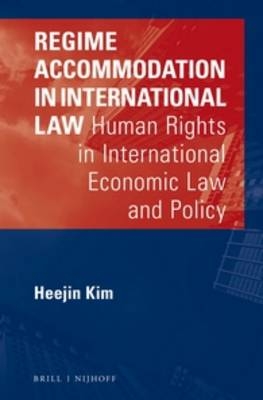
Regime Accommodation in International Law
Martinus Nijhoff (Verlag)
978-90-04-32550-0 (ISBN)
In Regime Accommodation in International Law: Human Rights in International Economic Law and Policy, Heejin Kim analyses the ways in which international human rights and economic law interact and conflict across a range of complex issues. These sub-branches of international law are not entirely autonomous; as the author shows, they have been developed in a close relation to each other. International law – imperfect as it is – provides means to resolve the antinomies arising from conflicting rights and obligations under these sub-fields. Against the difficulties of addressing non-economic concerns including human rights in the practice of WTO and foreign investment regime, Kim examines how decision-makers at different stages of international economic policy-making can accommodate, invoke, or reflect human rights in a better way.
Heejin Kim, LL.M., J.S.D. (2014), Yale Law School, is a Postdoctoral Fellow at the Faculty of Law, National University of Singapore.
Aknowledgements
List of Abbreviations
Table of Cases
CHAPTER 1. THE PROBLEM
A.“A Relationship to Discover
B.The Structure of the Research Project
CHAPTER 2. THE CONCEPTUAL FRAMEWORK: INTERACTION AND THE CONFLICT OF MULTIPLE INTERNATIONAL REGIMES
A.Meaning of International “Regime”
1.Regime in International Relations Scholarship
2.Regime in International Legal Scholarship and Jurisprudence
3.Summary
B.Regime Interaction and Conflict in International Law
1.Primary Reasons for the Growing Regime Conflict
1.1Fragmentation of International Law
1.2Difficulties of Conflict Management in International Law
2.Multiple Dimensions of the Regime Conflict
3.Norm Conflict in International Law
3.1The Narrow Definition of Conflict
3.2The Broad Definition of Conflict
3.3Summary
C.Regime Accommodation in International Law
1.Legislative Accommodation
2.Administrative Accommodation
3.Adjudicative Accommodation
CHAPTER 3. REGIME INTERACTION AND CONFLICT BETWEEN INTERNATIONAL HUMAN RIGHTS AND ECONOMIC REGIME IN THE CONTEXT OF HISTORICAL EVOLUTION OF INTERNATIONAL LAW AND INSTITUTION
A.International Law in Permanent Development
B.The Advent of International Law
1.Precursors of International Law in Pre-Westphalia Era
1.1Searching for the Foundations of Human Rights
1.2The Discovery of New Continents
1.3The Growing Sovereign Interests in International Commerce
1.4Rise of Private Merchants
1.5Implications
2.The Rise of the Modern Law of Nations
2.1The State-centric Perspective of the Law of Nations
2.2The Unpopular Notion: Human Rights Protection through International Law
2.2.1Early Initiatives
2.2.2The Enlightenment Project: Philosophical and Political Discourse on Human Rights
2.2.3Human Rights as an International Matter of Concern?
2.2.3.1Diplomatic Protection and the Treatment of Foreign Merchants
2.2.3.2The Prohibition of Slave Trade
2.2.3.3Life and Security of Individuals in International Humanitarian Law
2.2.3.4Other Human Rights Issues Discussed in International Forum
2.3State-building Efforts and the Early Development of International Economic Regulation
2.3.1Trade and Investment
2.3.1.1Economic Liberalism and the International Commerce
2.3.1.2The Emergence of International Legal/Non-Legal Arrangements in the field of Trade and Investment Regulation
(i)Inter-State Commercial Exchange
(ii)Protecting Aliens and their Properties Abroad
Diplomatic Protection
Legal Protection under the Commercial Treaties Concluded between Major States
Unequal Treaties and the Use of Force in the Relationship with the Colonies and Weaker States
Use of Claims Commission and Arbitration
2.3.2Colonial Expansion as a Wealth Accumulation Policy
2.4International Codification Conferences
C.International Human Rights and Economic Law Regime
1.Background
2.The Rise of International Human Rights Law Regime
2.1UN-based Human Rights Arrangements
2.1.1International Bill of Rights
2.1.1.1Rules and Institutions under the ICCPR
2.1.1.2Rules and Institutions under the ICESCR
2.1.2Various UN Human Rights Arrangements
2.1.3Works of UN Human Rights Treaty Bodies
2.2Regional Human Rights Protection Mechanisms
2.3Features of the Development in International Human Rights Regime
2.3.1Interdependence and Universality of Human Rights
2.3.2Legal Rights and Obligations
2.3.3The Multilayered Structure of Human Rights Protection
2.3.4Weak Enforcement
3.International Economic Law – The Promotion of Free Trade and Foreign Investment
3.1The Early Construction of the International Trading System and the Legal Regulation of Foreign Investment
3.1.1Interwar Years
3.1.2Failed Attempts to Create the International Trade Organization
3.2Between Bilateralism and Multilateralism
3.2.1The Immediate Post-Bretton Woods Moment
3.2.1.1The Adoption of the GATT 1947
3.2.1.2The Inception of the BITs Program
3.2.2Major Developments in the Subsequent Decades
3.2.2.1Some Features of the Period in Relation to IEL Development
3.2.2.2From the GATT to the WTO
(i)Eight Rounds of Trade Negotiations Under GATT Framework
(ii)Uruguay to Doha: The WTO System
3.2.2.3International Regulation for Foreign Investment
(i)Bilateral Arrangements in Foreign Investment Protection
(ii)Multilateral Initiatives to develop International Standards of Foreign Investment Protection
(iii)Recent Developments in International Law and Arbitration
International Investment Agreements
Investment Treaty Arbitration
D.Common Grounds
1.Treaty-based Foundations – Binding Rights and Obligations
2.Equal Status
3.International Agreements Governed by Public International Law
4.The “Public” Nature – Relationship between States and the Individuals
5.Aims for the Peace and Security of International Community
CHAPTER 4. THE PROJECT OF REGIME ACCOMMODATION: MANAGING INTERACTION AND CONFLICT BETWEEN INTERNATIONAL HUMAN RIGHTS AND ECONOMIC LAW
A.Legislative Efforts and Administrative Coordination
1.Relationship with External International Agreements and Organizations
1.1Coexisting Rights and Obligations in Other International Agreements
1.2Priority of One Treaty Over Another
1.3Coordination with Other International Organizations
2.Environmental Regulation in International Economic Law and Policy
2.1Multilateral Setting
2.2Regional and Bilateral Setting
3.Labor Standards in International Economic Law and Policy
3.1Multilateral Setting
3.2Regional and Bilateral Setting
4.The Relationship between Human Rights and International Economic Law and Policy
4.1The Work of UN Human Rights Agencies and Other Organizations
4.2The Field of International Economic Law and Policy
4.2.1Multilateral Setting
4.2.1.1WTO Exception Clauses
4.2.1.2WTO Waivers 180
(i)Kimberley Waiver
(ii)TRIPS Waiver
4.2.1.3Human Rights Impact Assessments
4.2.2Regional and Bilateral Setting
4.2.2.1Human Rights-related Clauses in the FTAs and BITs
4.2.2.2Human Rights Impact Assessments
B.IEL Adjudication in the WTO, the ICSID, and Other Settings
1.International Courts and Tribunals (ICs) in Conflict Resolution and Management
1.1Conventional Rules of Conflict Resolution Techniques
1.1.1The Lex superior Principle – Hierarchy of International Law
1.1.2The Rules of Lex posterior and Lex specialis
1.1.2.1The Lex Posterior Rule
1.1.2.2The Lex Specialis Rule
1.1.3Article 31(3)(c) and the Principle of Systematic Integration
1.1.3.1Academic Analysis of Article 31(3)(c)
1.1.3.2Legislative Efforts toward the Codification of Article 31(3)(c)
1.1.3.3Judicial Application of Article 31(3)(c)
(i)Pre-VCLT Jurisprudence
(ii)Post-VCLT Jurisprudence
International Court of Justice
European Court of Human Rights
1.1.3.4Article 31(3)(c) and Conflict Resolution
1.2Other Conflict Resolution Techniques: the Private International Law Method
2.Environmental and Social Protection in the WTO Adjudication
2.1GATT Cases involving Environmental and Social Regulations
2.2WTO Disputes involving Environmental and Social Regulations
2.2.1Relationship with Public International Law
2.2.2Environmental Protection and Sanitary Regulation
2.2.3Public Health
2.2.4Public Morals
2.2.5Freedom of Expression
3.Environmental and Social Protection in the Investor-State Arbitration
3.1Claims of Foreign Investors
3.1.1Arbitrary Arrest, Detention and Deportation
3.1.2Moral Damage
3.2Counter-Claims of the Host States
3.2.1Anti-Racial Discrimination Policy
3.2.2Cultural Heritage Protection
3.2.3Access to Water
3.2.4Tobacco Control and Public Health
3.3Non-Disputing Parties Submission
3.3.1Access to Water
3.3.2Rights of Indigenous Populations
3.3.3Tobacco Control and Public Health
3.4Arbitral Tribunals
3.4.1ECtHR Jurisprudence
3.4.1.1Right to a Court
3.4.1.2Meaning of Expropriation
3.4.2ICJ Jurisprudence
3.4.2.1Meaning of “Arbitrary”
3.4.2.2Standard of Compensation
3.4.3Treaty Interpretation in light of Article 31(3)(c) of the VCLT
3.4.4Relationship with Public International Law
3.4.5Cultural Heritage Protection
3.4.6Access to Water
CHAPTER 5: GUIDELINES FOR DECISIONMAKERS: HUMAN RIGHTS IN INTERNATIONAL ECONOMIC LAW AND POLICY
A.IEL’s Approaches to Accommodate Human Rights
1.Legislative Accommodation
2.Administrative Accommodation
3.Adjudicative Accommodation – Practices of the WTO Dispute Settlement Bodies and Investment Tribunals
B.Concluding Remarks
Selected Bibliography
Index
| Erscheinungsdatum | 15.08.2016 |
|---|---|
| Sprache | englisch |
| Maße | 155 x 235 mm |
| Gewicht | 711 g |
| Themenwelt | Recht / Steuern ► EU / Internationales Recht |
| Recht / Steuern ► Öffentliches Recht ► Völkerrecht | |
| ISBN-10 | 90-04-32550-6 / 9004325506 |
| ISBN-13 | 978-90-04-32550-0 / 9789004325500 |
| Zustand | Neuware |
| Informationen gemäß Produktsicherheitsverordnung (GPSR) | |
| Haben Sie eine Frage zum Produkt? |
aus dem Bereich