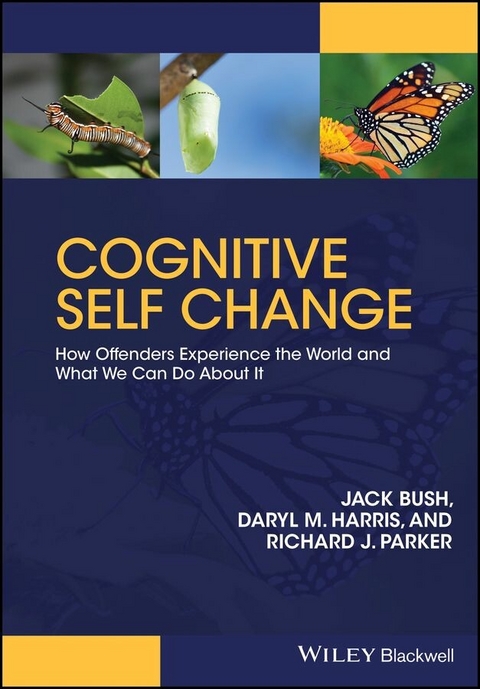
Cognitive Self Change (eBook)
John Wiley & Sons (Verlag)
978-1-119-12142-8 (ISBN)
This book draws on the latest literature to highlight a fundamental challenge in offender rehabilitation; it questions the ability of contemporary approaches to address this challenge, and proposes an alternative strategy of criminal justice that integrates control, opportunity, and autonomy.
• Provides an up to date review of the links between cognition and criminal behavior, as well as treatment and rehabilitation
• Engages directly with the antisocial underpinnings of criminal behavior, a major impediment to treatment and rehabilitation
• Outlines a clear strategy for communicating with offenders which is firmly rooted in the 'What Works' literature, is evidence-based, and provides a way of engaging even the most antisocial of offenders by presenting them with meaningful opportunities to change
• Offers hands-on instructions based upon the real-life tactics and presentation of the high-risk offender
Jack Bush has developed and delivered treatment programs for offenders since 1973. His primary focus has been on the processes and strategies of Cognitive Self Change, which he has adapted to high-risk offenders, violent offenders, substance abusers, female offenders, and domestic abusers. He is co-author of the program, Thinking For A Change, published by The National Institute of Corrections (Washington D.C.).
Daryl M. Harris is a Chartered and Registered Clinical Psychologist working with the Gwent Forensic Rehabilitation Service. He is also director of Positive Approaches to Crime and Exclusion (PACE) Ltd. This organisation has supported the implementation of Cognitive Self Change in several jurisdictions, written and supported the implementation of accredited interventions, and undertaken research into instrumental and gang violence. He has also worked with probation staff in Wales to develop an award winning approach to working with difficult to engage offenders.
Richard Parker is the Program Manager for designing and implementing sex offender, violent offender and general offender programs in Juvenile Justice NSW. Prior to this he was the Principal Psychologist, Offender Intervention Programs in ACT Corrective Services. He is currently investigating the role of moral emotions in the onset and maintenance of child sexual offending.
COGNITIVE SELF CHANGE The consensus amongst the leading researchers in the offender treatment area is that the comprehensive and sophisticated clinical methods the authors have derived for offender treatment are unsurpassed. Indeed, they have formed the basis for what is known as the core correctional practices for reducing anti-social behavior. Paul Gendreau, Professor Emeritus, University of New Brunswick Bush and colleagues phenomenologically based approach to offender rehabilitation is based explicitly on the stories they have collected from prisoners and probationers and is a welcome contribution to an academic literature that too often obfuscates the actual work involved in delivering help to the hardest to reach in the criminal justice system. Shadd Maruna, Ph.D., Dean of the Rutgers School of Criminal Justice Cognitive Self Change presents a practical guide to rehabilitation based on understanding the way individual offenders experience themselves and the world around them at the moment they offend. De-incentivizing criminal behavior and replacing it with self-empowered change are the keys to upending the traditionally antagonistic relationship between criminals and those meant to help them change. The authors, with their experience of working with offenders and implementing rehabilitation programs, have drawn together clinical and academic perspectives on the treatment of high-risk offenders, analyzing current approaches to treatment and the problems encountered in their application. Cognitive Self Change rejects the traditional dichotomy of control versus treatment, devising instead a strategy that integrates both. Focusing on high-risk and hard-core offenders, not just those that are ready to change, they discuss why offenders offend, why they are seldom motivated to change, and why they often fail to engage in treatment. This leads to a strategy of communication that teaches offenders a set of skills they can use to change themselves, and that motivates them to do so.
JACK BUSH is the author of several correctional treatment programs, including Thinking for a Change (with Juliana Taymans and Barry Glick, National Institute of Corrections, 1997) and Decision Points (with Juliana Taymans, Charles Robinson, and Steve Swisher, 2014). He has developed and delivered Cognitive Self Change in several jurisdictions in America, the UK, Europe, and Australia. DARYL M. HARRIS has worked with offenders within secure and community criminal justice and mental health systems. He has co-authored, managed, and delivered a range of accredited interventions. This has included supporting the implementation and delivery of Cognitive Self Change in Australia and the UK. Daryl is currently employed as a Clinical Psychologist by the Department of Forensic Psychiatry within the Aneurin Bevan University Health Board, Wales; and is the Clinical Lead for the Wales Offender Personality Disorder Pathway. RICHARD J. PARKER has worked with a range of jurisdictions in Australia with a wide range of offenders, including both adults and juveniles. He introduced Cognitive Self Change to Australia and has designed and implemented programs for sexual offenders, violent offenders, and substance abusers.
Preface ix
Acknowledgements xi
Introduction 1
Understanding Offending Behavior 1
Hard?-Core 5
Cognitive Self Change 9
A Human Connection 12
Phenomenology and Self?]reports: Some Preliminary Comments about Method 14
Summary of Chapters 16
1 The Idea of Criminal Thinking 25
Ellis, Beck, and Antisocial Schemas 33
Psychopathology or Irresponsibility 39
An Alternative Point of View 44
2 Offenders Speak their Minds 48
Seven Male Offenders 49
Three Young Women 58
Three Violent Mental Health Patients 62
Two Problematic Groups 64
Three British Gang Members 72
Conclusions and Interpretations 75
3 Cognitive-Emotional-Motivational Structure 78
The Idea of Conscious Agency: a Likely Story 79
Will and Volition, Self and Self?]interest 82
The Model 85
Basic Outlaw Logic: Learning the Rewards of Criminal Thinking 89
Variations of Criminal Thinking 92
Conclusions and Implications 94
4 Supportive Authority and the Strategy of Choices 97
The Problem of Engagement 97
Conditions of Communication and Engagement 99
Supportive Authority 102
Rethinking Correctional Treatment 109
The Strategy of Choices 109
Final Comments 115
5 Cognitive Self Change 118
Four Basic Steps 121
Collaboration and the Strategy of Choices 139
Brief Notes on Program Delivery: Group Size, Duration and Intensity, Facilitator Qualifications and Training 141
6 Extended Applications of Supportive Authority 145
Why Offenders Need Help 145
Not Either/Or: Some Promising Examples 146
The System as the Intervention: Some Recent Examples 152
Supportive Authority, Revisited 157
An Idealistic Proposal (with modest expectations) 159
7 How We Know: Some Observations about Evidence 162
Introduction 162
Cognitive Self Change 164
The Significance of Subjectivity 165
Science and Subjectivity 169
Bibliography 175
Index 183
| Erscheint lt. Verlag | 28.3.2016 |
|---|---|
| Sprache | englisch |
| Themenwelt | Geisteswissenschaften ► Psychologie |
| Recht / Steuern ► Strafrecht ► Kriminologie | |
| Sozialwissenschaften | |
| Schlagworte | antagonistic relationship • antiauthority • attitudes • Behavior • Between • challenges • Change • criminal • deincentivizing • First Step • Forensic Psychology • Forensische Psychologie • Keys • meant • Offenders • Psychologie • Psychology • Rehabilitation • selfempowered • Special • traditionally • Treatment • World |
| ISBN-10 | 1-119-12142-6 / 1119121426 |
| ISBN-13 | 978-1-119-12142-8 / 9781119121428 |
| Informationen gemäß Produktsicherheitsverordnung (GPSR) | |
| Haben Sie eine Frage zum Produkt? |
 PDF (Adobe DRM)
Kopierschutz: Adobe-DRM
Adobe-DRM ist ein Kopierschutz, der das eBook vor Mißbrauch schützen soll. Dabei wird das eBook bereits beim Download auf Ihre persönliche Adobe-ID autorisiert. Lesen können Sie das eBook dann nur auf den Geräten, welche ebenfalls auf Ihre Adobe-ID registriert sind.
Details zum Adobe-DRM
Dateiformat: PDF (Portable Document Format)
Mit einem festen Seitenlayout eignet sich die PDF besonders für Fachbücher mit Spalten, Tabellen und Abbildungen. Eine PDF kann auf fast allen Geräten angezeigt werden, ist aber für kleine Displays (Smartphone, eReader) nur eingeschränkt geeignet.
Systemvoraussetzungen:
PC/Mac: Mit einem PC oder Mac können Sie dieses eBook lesen. Sie benötigen eine
eReader: Dieses eBook kann mit (fast) allen eBook-Readern gelesen werden. Mit dem amazon-Kindle ist es aber nicht kompatibel.
Smartphone/Tablet: Egal ob Apple oder Android, dieses eBook können Sie lesen. Sie benötigen eine
Geräteliste und zusätzliche Hinweise
Buying eBooks from abroad
For tax law reasons we can sell eBooks just within Germany and Switzerland. Regrettably we cannot fulfill eBook-orders from other countries.
aus dem Bereich