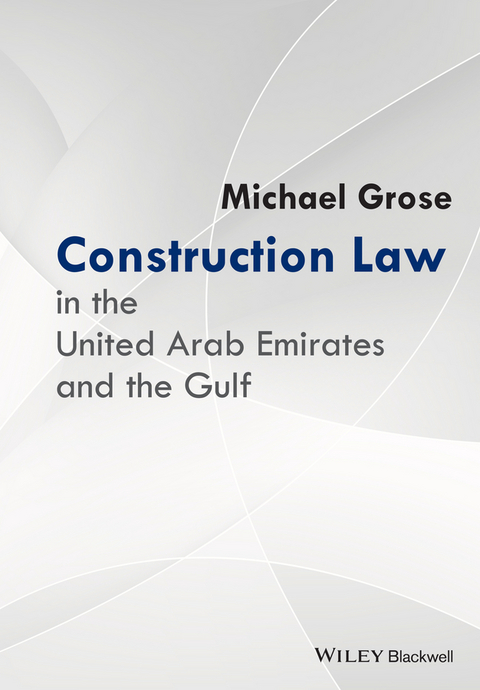
Construction Law in the United Arab Emirates and the Gulf (eBook)
John Wiley & Sons (Verlag)
978-1-119-08595-9 (ISBN)
Michael Grose obtained a law degree in the UK before completing his legal training in 1993 with an international law firm in the City of London. He relocated to Dubai in 1998 where he is the head of the regional construction and projects practice of a global law firm. As a veteran of the Gulf, Michael has extensive knowledge not only of the region's laws but also the application of these laws to construction contracts and disputes. Michael frequently reviews, advises on and prepares construction contracts for major projects, bringing him into frequent contact with the FIDIC suite of contract conditions. He has drafted amendments to these conditions to adapt them for use in the Gulf and to address the most commonly arising issues. Michael has also been involved in many of the region's largest and most high profile construction and engineering disputes. As a result, he has considerable experience of conducting arbitration in the Gulf, including as an arbitrator appointed by the Dubai International Arbitration Centre. Working with licensed local advocates he has acted on numerous occasions for clients in the Gulf's domestic courts. This has included taking cases through all stages of the court proceedings, from obtaining freezing orders against bank guarantees, attending court appointed experts' meetings through to the execution of final judgments. He is also familiar with proceedings the Dubai International Financial Centre Courts having, amongst other things, acted for a main contractor in the first construction case to come to trial in the DIFC Courts. Michael has also presented at numerous conferences, including the Commercial Law Conference in Bahrain (organised by the United States Department of Commerce) for members of the region's judiciary, the inaugural international conference of the Society of Construction Law held in Singapore and the inaugural conference of the Gulf branch of the Society of Construction Law. He is recommended in the top tier of all the leading independent legal directories including Who's Who Legal, Chambers Global and Legal 500.
Construction Law in the United Arab Emirates and the Gulf is an authoritative guide to construction law in the United Arab Emirates and the Gulf. The principal theme is the contrast between construction law in an Islamic civil law jurisdiction and construction law in a common law jurisdiction. the first authoritative text on the application of the laws of the UAE extensive extracts from the region's applicable laws, all translated from Arabic, and hundreds of judgments of the most senior courts used to back up the analysis provided
Michael Grose obtained a law degree in the UK before completing his legal training in 1993 with an international law firm in the City of London. He relocated to Dubai in 1998 where he is the head of the regional construction and projects practice of a global law firm. As a veteran of the Gulf, Michael has extensive knowledge not only of the region's laws but also the application of these laws to construction contracts and disputes. Michael frequently reviews, advises on and prepares construction contracts for major projects, bringing him into frequent contact with the FIDIC suite of contract conditions. He has drafted amendments to these conditions to adapt them for use in the Gulf and to address the most commonly arising issues. Michael has also been involved in many of the region's largest and most high profile construction and engineering disputes. As a result, he has considerable experience of conducting arbitration in the Gulf, including as an arbitrator appointed by the Dubai International Arbitration Centre. Working with licensed local advocates he has acted on numerous occasions for clients in the Gulf's domestic courts. This has included taking cases through all stages of the court proceedings, from obtaining freezing orders against bank guarantees, attending court appointed experts' meetings through to the execution of final judgments. He is also familiar with proceedings the Dubai International Financial Centre Courts having, amongst other things, acted for a main contractor in the first construction case to come to trial in the DIFC Courts. Michael has also presented at numerous conferences, including the Commercial Law Conference in Bahrain (organised by the United States Department of Commerce) for members of the region's judiciary, the inaugural international conference of the Society of Construction Law held in Singapore and the inaugural conference of the Gulf branch of the Society of Construction Law. He is recommended in the top tier of all the leading independent legal directories including Who's Who Legal, Chambers Global and Legal 500.
Al-amdu lillah - finally, a proper book on construction law in the Gulf region... Michael Grose's book is an indispensable guide to anyone with an interest in the law relating to construction contracts in the Gulf region. It is practical, sensible, and based on unrivalled research. Like certain provisions of the Civil Codes, this book is mandatory --Richard Harding QC, in Construction Law International
1
Overview
Construction law, for the purpose of this text, comprises the laws of the United Arab Emirates and the Arab Gulf states excluding Iraq (Bahrain, Kuwait, Oman, Qatar and Saudi Arabia) as applied to the issues commonly arising out of construction projects. As no clear separation exists between the applicable laws and the general legislative framework in these jurisdictions a review of construction law must cover, as a minimum, the key elements of this general legislative framework. An overview of the applicable legal regime of these jurisdictions is the purpose of this introductory chapter.
But the applicable legislative framework is not merely an interesting backdrop to construction law. An appreciation of the legal systems of the United Arab Emirates and the Gulf states is critical not only to an understanding of the application of construction law in these jurisdictions but also to overcoming preconceptions based on academic and judicial contributions to the topic in jurisdictions where construction law has been a recognised branch of law for many years. Although the disputes and differences that arise on projects in the Gulf are essentially the same as those that arise in other jurisdictions, the applicable laws, although in some respects similar to those elsewhere, have their own unique heritage, resulting not only in differences of emphasis and analysis but also, in some cases, a departure from what might be considered elsewhere to be orthodox principles of construction law.
1.1 Basis of government
Bahrain, Kuwait, Oman, Qatar and the United Arab Emirates each have a written constitution.1 Although Saudi Arabia does not have a written constitution in a conventional sense, the KSA Basic Law of Government serves a similar purpose but provides that the constitution is the Qur’an and the Sunna.2
Each constitution declares the existence of an independent sovereign state and that state’s part in a broader Arab nation. In the case of Saudi Arabia this is expressed as a commitment to ‘the aspirations of the Arab and Muslim nation to solidarity’.3
Uniquely among the Gulf states, the UAE Constitution brought the country into existence. The UAE Constitution is, in effect, an agreement between the rulers of the emirates of Abu Dhabi, Dubai, Sharjah, Ajman, Umm Al Quwain and Fujairah. Ras Al Khaimah joined the other six emirates in adopting the UAE Constitution the following year.4 The UAE Constitution, reflecting the incorporation of the seven constituent emirates, declares the United Arab Emirates a Federal state, paving the way for the creation of a Federal or Union Government.
Each of the other Gulf states is governed by a constitutional monarch, albeit with varying degrees of consultative and representative input. In Bahrain the constitutional monarch formally operates alongside a democratic form of government.5
1.2 Division of powers in the UAE
The powers of the UAE Federal Government are defined in and limited by the UAE Constitution which lays down guidelines for legislation required to establish the machinery of government, including the administration of justice. Except insofar as the rulers of each emirate ceded power to the Federal Government pursuant to the Constitution,6 they retained for themselves and their successors power over the internal affairs of their respective emirates:
Each emirate exercises, in accordance with Article (3) of the Constitution, sovereignty over its territorial land and water in all affairs in which the Federation is not competent pursuant to the Constitution, including court jurisdiction which is an act of sovereignty. Each emirate is obliged, pursuant to Article (10) of the Constitution, to respect the independence and sovereignty of the other emirates in regards to their internal affairs within the scope of the Constitution.7
In consequence, there are two tiers of government in the United Arab Emirates: the Federal Government and each government of the seven emirates.
Both tiers of government have their own legislative authority, the Federal Government by virtue of the UAE Constitution and the governments of each emirate by virtue of their retained sovereignty. As a result, there are also two tiers of laws: Federal laws which apply in all emirates, and emirate laws which apply only in the emirate by which such laws are enacted.8
The UAE Federal Government is represented by the Supreme Council,9 which is composed of the rulers of each emirate and which elects a president and vice-president, each for a five year term.10 The ruler of each emirate represents that emirate and exercises both legislative and executive authority to the extent not ceded to the UAE Federal Government pursuant to the UAE Constitution.11
The UAE Federal Government’s authority covers not only areas of national interest such as foreign affairs, defence and internal security but extends to domestic affairs, covering specified industries such as banking, insurance and publishing. Significantly for the construction industry, the UAE Federal Government has authority over the introduction of laws pertaining to civil and commercial transactions, in effect, submitting the law of contract to the jurisdiction of the UAE Federal Government. Construction law in the United Arab Emirates is, in consequence, predominantly a matter of Federal law.
Nevertheless, power over construction and related activities was not ceded to the Federal Government except for the construction, maintenance and improvement of union roads.12 Each emirate retains power, therefore, to enact legislation covering the construction industry, provided that such legislation does not conflict with any Federal laws of general application. Given the significance of the construction sector in the development of a young country it will come as no surprise that each emirate has exercised this residual power to regulate the industry within their respective territories. The Emirates of Abu Dhabi and Dubai in particular, have taken the opportunity to introduce a large number of laws regulating the construction industry within their respective borders.
1.3 Islamic Shari’ah
The Islamic Shari’ah, in essence, is the law of the Islamic religion as derived principally from the Holy Qur’an and the Sunna, the code of conduct established through example by the Prophet Mohammed.13
The Islamic Shari’ah plays a central role in the legal system of all the Gulf states. Thus, for example, the UAE Constitution records the status of the Islamic Shari’ah in the following terms:
Islam is the official religion of the Union. The Islamic Shari’ah shall be the main source of legislation in the Union.14
By virtue of the UAE Constitution and those of Bahrain, Kuwait, Qatar and Oman15 it is a guiding principle in the formulation of all legislation that the main source for such legislation shall be the Islamic Shari’ah. Thus, the Islamic Shari’ah provides the inspiration for the legislation that applies within these Gulf states. However, notwithstanding its constitutional status, the Islamic Shari’ah is neither directly applicable nor the exclusive source of legislation, which may be supplemented by or draw on sources other than the Islamic Shari’ah.16
In contrast, the KSA Basic Law of Government expresses the role of the Islamic Shari’ah in the following terms:
The Kingdom of Saudi Arabia is a sovereign Arab Islamic state with Islam as its religion. The Constitution [of the Kingdom of Saudi Arabia] is the Quran and the Sunna of His Prophet, peace be upon him.
This is more than merely a difference of emphasis, reflecting, instead, a direct application of the Islamic Shari’ah to the extent that no relevant temporal laws exist.
In practice, the laws of the Gulf states, with the exception of Saudi Arabia the history of which sets it apart from the other Gulf states, not only borrow heavily from the laws of other Arab countries, in particular those of Egypt, but also in many cases reflect the needs of an expanding and diversifying economy in which domestic and foreign businesses play a crucial part. As a result, these laws share many common features not only with those of other Gulf states but also with the laws of countries further afield. Despite these external influences there is no doubt that the primary legislation of Bahrain, Kuwait, Qatar, Oman and the United Arab Emirates draws on principles derived from the Islamic Shari’ah.17
The influence of the Islamic Shari’ah is further underpinned by legislation requiring the domestic courts to apply its provisions alongside applicable laws, customs and principles. Thus, it is provided in relation to UAE Federal Courts:
Federal courts shall enforce the provisions of the Islamic Shari’ah and the Federal Laws and other laws in force and shall enforce customary rules and general legal principles that are not in contradiction of the Islamic Shariah.18
In practice, this requirement finds expression in the reliance of judges on one of the four schools of Islamic jurisprudence: Hanbali, Hanafi, Shafi’i and Maliki. Precedence is given in the United Arab Emirates to the jurisprudence or teachings of the schools of Imam Malik and Imam Ahmad bin Hanbal and in Saudi Arabia to the latter.19
Resolution of conflicts between local laws and provisions of the Islamic Shari’ah in circumstances where these are incompatible is a matter left to the...
| Erscheint lt. Verlag | 16.3.2016 |
|---|---|
| Sprache | englisch |
| Themenwelt | Recht / Steuern ► EU / Internationales Recht |
| Technik ► Bauwesen | |
| Schlagworte | Ambiguity • Bahrain • bank bonds • Baubetrieb • Bauingenieur- u. Bauwesen • Baurecht • beneficial interest • capped damages • cause • Civil Code • Civil Engineering & Construction • Commerce law • commerce law and commercial code • construction law • Construction Management • criminal damage • deceit • Delict • delict and tort • diya and arsh • Duress • FIDIC conditions • financial free zones • Fraud • Icsid • imprTvision • Inherent risk • insurance • Islamic Shari'ah • judgment debt • judicial set-off • Kuwait • labour law • Letter of Intent • liquidated damages • liquidated debt • mandatory set-off • Massenermittlung u. Bauökonomie • Massenermittlung u. Bauökonomie • misconduct • Muqawala • negligence • Negotiations • Obligation of Means • obligation of result • Oman • prevention principle • Privity • Qatar • Quantity Surveying & Construction Economics • Res judicata • riyadh convention • Saudi Arabia • sub-contract • Tort • UAE • Vereinigte Arabische Emirate • vicarious liability • wear and tear |
| ISBN-10 | 1-119-08595-0 / 1119085950 |
| ISBN-13 | 978-1-119-08595-9 / 9781119085959 |
| Informationen gemäß Produktsicherheitsverordnung (GPSR) | |
| Haben Sie eine Frage zum Produkt? |
 EPUB (Adobe DRM)
Kopierschutz: Adobe-DRM
Adobe-DRM ist ein Kopierschutz, der das eBook vor Mißbrauch schützen soll. Dabei wird das eBook bereits beim Download auf Ihre persönliche Adobe-ID autorisiert. Lesen können Sie das eBook dann nur auf den Geräten, welche ebenfalls auf Ihre Adobe-ID registriert sind.
Details zum Adobe-DRM
Dateiformat: EPUB (Electronic Publication)
EPUB ist ein offener Standard für eBooks und eignet sich besonders zur Darstellung von Belletristik und Sachbüchern. Der Fließtext wird dynamisch an die Display- und Schriftgröße angepasst. Auch für mobile Lesegeräte ist EPUB daher gut geeignet.
Systemvoraussetzungen:
PC/Mac: Mit einem PC oder Mac können Sie dieses eBook lesen. Sie benötigen eine
eReader: Dieses eBook kann mit (fast) allen eBook-Readern gelesen werden. Mit dem amazon-Kindle ist es aber nicht kompatibel.
Smartphone/Tablet: Egal ob Apple oder Android, dieses eBook können Sie lesen. Sie benötigen eine
Geräteliste und zusätzliche Hinweise
Buying eBooks from abroad
For tax law reasons we can sell eBooks just within Germany and Switzerland. Regrettably we cannot fulfill eBook-orders from other countries.
aus dem Bereich