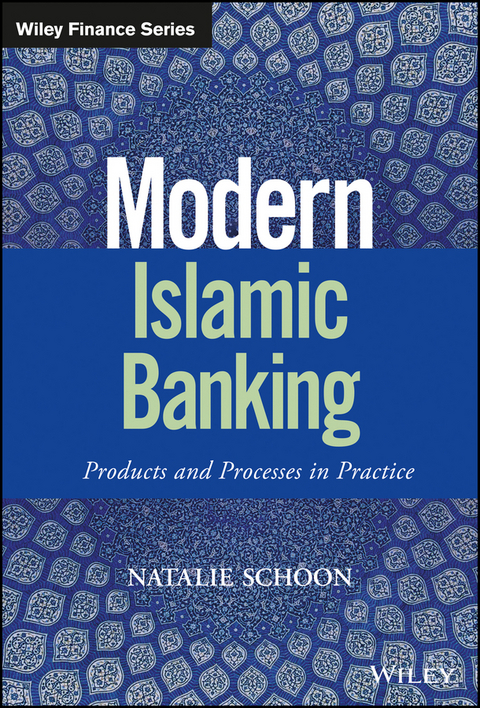
Modern Islamic Bankingprovides a comprehensive, up-to-the-minute guide to the products, processes and legal doctrines underlying Islamic banking. Written by a pioneering practitioner in the field, this book provides thorough guidance and expert-level perspective on the principles and applications of this alternative-banking model. You'll begin by learning the fundamentals, vocabulary and key concepts of Islamic banking, then explore key products including istisna'a, murabaha, musharaka, ijara, sukuk, and salam. Coverage then moves into practical applications of Islamic products to a variety of contexts including asset management, treasury, risk management, venture capital, SME finance, micro-finance and taxation. Regulatory frameworks are discussed in detail, including extensive coverage of post-financial crisis Islamic bank valuation.
Islamic banking has experienced rapid growth over the past decade, a trend that is set to continue given the sector's successful weathering of the financial crisis. This book brings you up to speed on this alternative way of banking, and shows you how it applies within your own current practices.
- Understand the principles of Islamic banking and finance
- Learn the products, vocabulary and key concepts of the field
- Consider the applications in a variety of financial contexts
- Explore the regulatory frameworks and valuation of Islamic banks
Islamic banking practices differ from Western banking in fundamental ways - it's these differences that shielded the sector during the global crisis, but they also require practitioners to understand a whole new set of rules, products and practices. Modern Islamic Banking gives you a solid understanding of the fundamentals and expert insight into modern practical applications.
NATALIE SCHOON is a principal consultant with Formabb, which provides advisory services and training for financial institutions in Islamic finance, treasury, risk management and rules and regulations. She is on the board of advisors of Noriba Investing, which manages Halal investment portfolios for its clients, and is a visiting fellow at the ICMA Centre in Reading. She is also an accredited trainer for the Islamic Finance Qualification offered by the Chartered Institute of Securities and Investments.
A complete, detailed guide to modern Islamic banking fundamentals Modern Islamic Bankingprovides a comprehensive, up-to-the-minute guide to the products, processes and legal doctrines underlying Islamic banking. Written by a pioneering practitioner in the field, this book provides thorough guidance and expert-level perspective on the principles and applications of this alternative-banking model. You'll begin by learning the fundamentals, vocabulary and key concepts of Islamic banking, then explore key products including istisna'a, murabaha, musharaka, ijara, sukuk, and salam. Coverage then moves into practical applications of Islamic products to a variety of contexts including asset management, treasury, risk management, venture capital, SME finance, micro-finance and taxation. Regulatory frameworks are discussed in detail, including extensive coverage of post-financial crisis Islamic bank valuation. Islamic banking has experienced rapid growth over the past decade, a trend that is set to continue given the sector's successful weathering of the financial crisis. This book brings you up to speed on this alternative way of banking, and shows you how it applies within your own current practices. Understand the principles of Islamic banking and finance Learn the products, vocabulary and key concepts of the field Consider the applications in a variety of financial contexts Explore the regulatory frameworks and valuation of Islamic banks Islamic banking practices differ from Western banking in fundamental ways it's these differences that shielded the sector during the global crisis, but they also require practitioners to understand a whole new set of rules, products and practices. Modern Islamic Banking gives you a solid understanding of the fundamentals and expert insight into modern practical applications.
NATALIE SCHOON is a principal consultant with Formabb, which provides advisory services and training for financial institutions in Islamic finance, treasury, risk management and rules and regulations. She is on the board of advisors of Noriba Investing, which manages Halal investment portfolios for its clients, and is a visiting fellow at the ICMA Centre in Reading. She is also an accredited trainer for the Islamic Finance Qualification offered by the Chartered Institute of Securities and Investments.
List of Figures xi
List of Tables xiii
Acknowledgements xv
About the Author xvii
Introduction xix
CHAPTER 1 Historical Developments 1
1.1 The History of Finance 1
1.2 The History of Islamic Finance 5
CHAPTER 2 Economic Principles 7
2.1 Early Economic Thought 7
2.2 The Prohibition of Interest 9
2.3 Modern Economics and Banking 36
2.4 Islamic Ethics 38
2.5 Contracts and Prohibitions 40
2.6 Sharia'a and Prohibitions 43
CHAPTER 3 Islamic Finance Products Explained 51
3.1 Definitions 51
3.2 The Asset 52
3.3 Transaction Types 53
3.4 Bond-Like Instruments 63
CHAPTER 4 Distribution of Islamic Products 73
4.1 Distribution Channels and Sharia'a Compliance 73
4.2 Sharia'a Compliant versus Sharia'a Based 74
4.3 Competition or Opportunity 75
CHAPTER 5 Application of Islamic Products in Retail Finance 77
5.1 Current Accounts 77
5.2 Credit Cards 78
5.3 Deposit Accounts 79
5.4 Funds 83
5.5 Mortgage Products 84
5.6 Personal Loans 85
5.7 Transfers 87
CHAPTER 6 Application of Islamic Products in Treasury 89
6.1 Interbank Liquidity 89
6.2 Hedging 94
6.3 Combination of Transaction Types 98
6.4 Asset-Based Securities 99
6.5 Syndication 99
CHAPTER 7 Application of Islamic Products in Corporate Finance 101
7.1 Trade Finance 101
7.2 Project Finance 103
7.3 Property Finance 108
7.4 Leasing 113
CHAPTER 8 Application of Islamic Products to Private Equity 115
CHAPTER 9 The Role of the London Metal Exchange 117
9.1 The London Metal Exchange 117
9.2 Warrants 118
9.3 LME Base Metals 119
CHAPTER 10 Asset Management 121
10.1 Selection of Sharia'a compliant investments 122
10.2 Types of Funds 124
CHAPTER 11 Risks in Islamic Banks 125
CHAPTER 12 Governance 129
12.1 Roles 130
12.2 Social Responsibilities 132
12.3 Structures and Variations of Sharia'a Supervisory Boards 133
12.4 Serving on Multiple Boards 133
CHAPTER 13 The Islamic Financial Infrastructure 135
13.1 Regulatory Institutions 135
13.2 Socially Responsible Investments and Micro-finance 137
13.3 The Case for LIBOR 139
CHAPTER 14 Capital Adequacy Concerns 141
14.1 Challenges within the Basel Capital Adequacy Framework 141
14.2 IFSB Capital Adequacy Standards 142
14.3 Capital Adequacy for Islamic Banks around the World 148
14.4 Expected Future Developments in Capital Adequacy 149
CHAPTER 15 How to Value a Bank 151
15.1 The Components 152
15.2 The Models 153
15.3 The Special Case of Banks 154
15.4 The Special Case of Islamic Banks 154
15.5 Can a Bank be Valued? 155
CHAPTER 16 The Future 157
GLOSSARY 159
SELECT BIBLIOGRAPHY 161
INDEX 163
CHAPTER 1
Historical Developments
The evolution of Islamic finance in modern history is only a small part of overall banking history, and in its current form only spans a period of around 60 years. This does not imply that Islamic finance did not exist prior to the mid-1960s. Comparable to other modes of financing, it has gone through periods of increased as well as diminished popularity, and ceased to exist for long periods of time. This chapter will look at the general history of banking as well as the way Islamic finance has evolved.
1.1 The History of Finance
Financial services have historically always played an important role in the economy of every society. Banks mobilise funds from investors and apply them to investments in trade and business. Although the actual origin of banking is difficult to determine, the history of banking is long and varied, and the financial system as we know it now is generally ascribed to the Florentine bankers of the fourteenth to seventeenth centuries ad.1 The word “bank”, for example, is derived from the Italian word banco (for the merchant's bench). Interestingly enough, the word “bank” also assists in tracing the origins of “bankruptcy”, which relates to the breaking of a merchant's bench in medieval Italy as a signal of failure. Whether it be safe keeping, money changing, investing funds on behalf of others or making other capital goods such as land available at a charge, financial services have been around in some form for a long time. Even pre-dating the invention of money, safekeeping of valuables was long a task ascribed to religious temples. Deposits would initially have consisted of grain, but also other valuable goods such as cattle and agricultural implements, followed by precious metals such as gold. The latter would typically have been stored in a form that was easy to transport such as plates or bars. There were good reasons to store valuables in temples: the continuous stream of visitors would make it difficult for any thief to go about his business unnoticed, in addition to which they tended to be well built, making them secure. Perhaps even more importantly, temples were sacred places that were deemed to provide additional protection against potential thieves.
Evidence exists of priests in Babylon lending money to merchants as early as the eighteenth century bc, and the Code of Hammurabi,2 believed to have been written around 1760 bc, includes laws governing banking operations in ancient Mesopotamia. Although not the first known law, it is the best-preserved one. Table 1.1 provides some examples of the laws in the code that are related to financial services.
Table 1.1 Selected entries from the Code of Hammurabi
| Law | Description |
| 48 | If any one owe a debt for a loan, and a storm prostrates the grain, or the harvest fail, or the grain does not grow for lack of water; in that year he need not give his creditor any grain, he washes his debt-tablet in water and pays no rent for this year. |
| 49 | If any one take money from a merchant, and give the merchant a field tillable for corn or sesame and order him to plant corn or sesame in the field, and to harvest the crop; if the cultivator plant corn or sesame in the field, at the harvest the corn or sesame that is in the field shall belong to the owner of the field and he shall pay corn as rent, for the money he received from the merchant, and the livelihood of the cultivator shall he give to the merchant. |
| 50 | If he give a cultivated corn-field or a cultivated sesame-field, the corn or sesame in the field shall belong to the owner of the field, and he shall return the money to the merchant as rent. |
| 51 | If he have no money to repay, then he shall pay in corn or sesame in place of the money as rent for what he received from the merchant, according to the royal tariff. |
| 52 | If the cultivator do not plant corn or sesame in the field, the debtor's contract is not weakened. |
| 119 | If any one fail to meet a claim for debt, and he sell the maid servant who has borne him children, for money, the money which the merchant has paid shall be repaid to him by the owner of the slave and she shall be freed. |
| 121 | If any one store corn in another man's house he shall pay him storage at the rate of one gur for every five ka of corn per year. |
In addition, any compensation for loss of articles in safekeeping and the amount of rent to be paid for having the usufruct3 of land and different species of livestock was clearly defined.
In the Roman Empire, money lenders would conduct their transactions from benches in the middle of enclosed courtyards rather than setting up shops. The ancient Roman money lenders merely converted any currency into the currency of Rome, which was the only legal tender in the city, and are not known to have provided any further financial services.
At the time of the ancient Greeks, bankers not only converted currency but also invested in projects and other businesses. Banking was no longer restricted to temples, and other entities such as money changers also conducted financial transactions including loans, deposits, exchange of currency and validation of coins. Trade finance, in the form of letters of credit, flourished. Money lenders in one city would, against a fee, write a credit note that could be cashed elsewhere in the country, which meant that no coins needed to be carried around on their journey, nor did guards have to be hired to protect it. Interestingly enough, most of the early bankers in Greece were foreign residents, and there is little known about the individual bankers themselves, although records have been found relating to Pasion (c.430–370 bc), originally a Phoenician slave, who rose to be one of the wealthiest citizens in Athens and owned one of the most successful private banks in Athens.4
Credit-based banking spread in the Mediterranean world from the fourth century bc. In Egypt grain has long been one of the most used forms of money, in addition to precious metals. State granaries functioned as banks, and when Egypt briefly fell under Greek rule, the government granaries were transformed into a network of grain banks with a centralised head office function in Alexandria. Payments could be effected by transfers between accounts without any physical money changing hands.
The Romans then perfected the administrative aspect of banking and introduced enhanced regulations of financial institutions, in the wider sense of the word. The practice of charging and paying interest developed further and became more competitive. However, as a direct result of the Romans' preference for cash, the development of the banking system itself was limited. Additional restrictions were introduced on the banking system by theologians and philosophers, mainly due to the fact that the charging and paying of interest was deemed to be immoral. With the fall of the Roman Empire, banking declined significantly in western Europe and did not feature again until the time of the Crusades from the late eleventh century ad.
The Crusades, in combination with the expansion of European trade and commerce, led to an increase in the demand for financial services. As a result of people travelling to a variety of different countries, there was a significant demand for money-changing services. Any service that would make it possible to transfer large sums of money without the complications of having to carry chests full of gold around and requirements for elaborate precautions against theft was particularly in demand. Crusades were expensive and the participants often had to borrow money, which was regularly done by mortgaging land and buildings. The terms were, however, far more favourable to the lender than to the borrower, as a result of which the demand for mortgages deteriorated over time.
The development of international trade led directly to the requirement for a foreign exchange type contract, the first of which was recorded in 1156 in Genoa.5 The use of these types of contracts expanded significantly, not only because of the requirements following the development of international trade, but also since profits from time differences in a foreign exchange contract were not covered by canon laws against usury.
Financial contracts of this time were largely governed by Christian beliefs, which prohibited interest on the basis that it would be a sin to pay back more or less than what was borrowed. In addition, justness of price and fairness were important underlying guiding principles that applied to society as a whole and included financial services. The evolution from an interest-free to an interest-based banking system did, of course, not happen overnight, but was based on a number of factors such as the change from agrarian to commercial economies, the move towards pricing on the basis of supply and demand, decentralisation of the Church, and the recognition of money as a factor of production.6
During the Middle Ages, until the thirteenth century, the Church was the largest single entity possessing significant wealth and was an important lender. However, the impact of the Church declined, and as commerce flourished and generated more wealth than could be reinvested in commerce alone, it was the...
| Erscheint lt. Verlag | 16.2.2016 |
|---|---|
| Reihe/Serie | The Wiley Finance Series |
| Wiley Finance Series | Wiley Finance Series |
| Sprache | englisch |
| Themenwelt | Recht / Steuern ► Wirtschaftsrecht |
| Wirtschaft ► Betriebswirtschaft / Management ► Finanzierung | |
| Betriebswirtschaft / Management ► Spezielle Betriebswirtschaftslehre ► Bankbetriebslehre | |
| Schlagworte | Finance & Investments • Finanz- u. Anlagewesen • Finanzwesen • Formabb • Islam • Islamic banking applications • Islamic banking fundamentals • Islamic banking guide • Islamic banking in Western contexts • Islamic banking key concepts • Islamic banking operations • Islamic banking paradigm • Islamic banking post financial crisis • Islamic banking primer • Islamic banking procedures • Islamic banking products • Islamic banking valuation • Islamic banking vocabulary • Islamic banks • Islamic microfinance • Islamisches Bankwesen • Modern Islamic Banking: Products, Processes, in Practice • Natalie Schoon • practical Islamic banking • Religion & Theology • Religion u. Theologie • understanding Islamic banking |
| ISBN-13 | 9781119127215 / 9781119127215 |
| Informationen gemäß Produktsicherheitsverordnung (GPSR) | |
| Haben Sie eine Frage zum Produkt? |
 EPUB (Adobe DRM)
Kopierschutz: Adobe-DRM
Adobe-DRM ist ein Kopierschutz, der das eBook vor Mißbrauch schützen soll. Dabei wird das eBook bereits beim Download auf Ihre persönliche Adobe-ID autorisiert. Lesen können Sie das eBook dann nur auf den Geräten, welche ebenfalls auf Ihre Adobe-ID registriert sind.
Details zum Adobe-DRM
Dateiformat: EPUB (Electronic Publication)
EPUB ist ein offener Standard für eBooks und eignet sich besonders zur Darstellung von Belletristik und Sachbüchern. Der Fließtext wird dynamisch an die Display- und Schriftgröße angepasst. Auch für mobile Lesegeräte ist EPUB daher gut geeignet.
Systemvoraussetzungen:
PC/Mac: Mit einem PC oder Mac können Sie dieses eBook lesen. Sie benötigen eine
eReader: Dieses eBook kann mit (fast) allen eBook-Readern gelesen werden. Mit dem amazon-Kindle ist es aber nicht kompatibel.
Smartphone/Tablet: Egal ob Apple oder Android, dieses eBook können Sie lesen. Sie benötigen eine
Geräteliste und zusätzliche Hinweise
Buying eBooks from abroad
For tax law reasons we can sell eBooks just within Germany and Switzerland. Regrettably we cannot fulfill eBook-orders from other countries.
aus dem Bereich