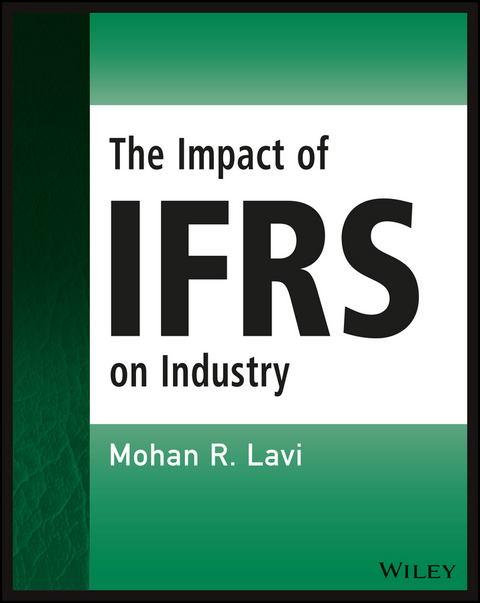
The Impact of IFRS on Industry (eBook)
John Wiley & Sons (Verlag)
978-1-119-04748-3 (ISBN)
One of the biggest challenges of any reporting standard is how best to interpret and implement it in the context of a specific company or industry, given that each industry has its own intricacies and nuances. The Impact of IFRS on Industry provides specific guidance on applying IFRS in a diverse range of sectors.
Opening with an overview of IFRS, including a summary of all the standards, the book goes on to provide detailed coverage of the standards that can impact all industries, including IAS-40, IFRS 1, and IFRS 5. Thereafter, it offers practical advice and guidance on the application of IFRS in specific industries, including automotive; oil and gas; bio-sciences; infrastructure; airlines; media and communications; government-owned entities; mining; software; banking and financial services; insurance; FMCG; shipping; pharmaceuticals; telecoms; real estate and construction; power; SMEs; retail; e-commerce; and the service sector. The book concludes with a discussion on the collateral impact of implementing IFRS and how forthcoming IFRS Standards could impact specific industries.
Worked examples are used throughout to demonstrate how the standards are applied in practice.
- Understand the IFRS standards comprehensively
- Learn which standards impact all industries
- Examine the ways in which IFRS is applied in practice
- See how different standards are applied in specific industries
Suitable as a quick reference or a comprehensive guide, The Impact of IFRS on Industry gives you the real-world IFRS answers you need.
The industry-specific guide to IFRS interpretation and application One of the biggest challenges of any reporting standard is how best to interpret and implement it in the context of a specific company or industry, given that each industry has its own intricacies and nuances. The Impact of IFRS on Industry provides specific guidance on applying IFRS in a diverse range of sectors. Opening with an overview of IFRS, including a summary of all the standards, the book goes on to provide detailed coverage of the standards that can impact all industries, including IAS-40, IFRS 1, and IFRS 5. Thereafter, it offers practical advice and guidance on the application of IFRS in specific industries, including automotive; oil and gas; bio-sciences; infrastructure; airlines; media and communications; government-owned entities; mining; software; banking and financial services; insurance; FMCG; shipping; pharmaceuticals; telecoms; real estate and construction; power; SMEs; retail; e-commerce; and the service sector. The book concludes with a discussion on the collateral impact of implementing IFRS and how forthcoming IFRS Standards could impact specific industries. Worked examples are used throughout to demonstrate how the standards are applied in practice. Understand the IFRS standards comprehensively Learn which standards impact all industries Examine the ways in which IFRS is applied in practice See how different standards are applied in specific industries Suitable as a quick reference or a comprehensive guide, The Impact of IFRS on Industry gives you the real-world IFRS answers you need.
Mohan R. Lavi is the Finance Director of Ellucian Higher Education Systems India Pvt Ltd, Bangalore, and owns a consulting firm, Arthazastra Management Services India Pvt Ltd. He is a chartered accountant with over twenty years of experience across a wide variety of industries.
Preface vii
Acknowledgements ix
1 Introduction: The Background and Evolution of IFRS, and a Discussion on Why IFRS Would Have an Impact on Industry 1
2 Summary of Disclosures Under IFRS Standards 7
3 IFRS Standards that Could Impact All Industries 43
4 The Impact of IFRS Standards on Specific Industries 75
5 Forthcoming IFRS Standards That Could Impact Industry 231
6 Collateral Impact of a Transition to IFRS 237
Afterword 245
Appendix: Impact Summary 247
Index 251
Chapter 2
Summary of Disclosures Under IFRS Standards
To many, IFRS is all about disclosures. The insertion of the words “financial reporting” in place of “accounting” in the erstwhile International Accounting Standards was intended to send out a message that accounting is passé, financial reporting is in. Financial reporting in essence means disclosures. The disclosure requirements in IFRS are, to say the least, intense. Apart from the disclosure requirements mentioned in most Standards, IFRS has Standards exclusively for disclosures: IAS 24 Related Party Transactions, IFRS 7 Financial Instruments: Disclosures, IFRS 8 Operating Segments and IFRS 11 Disclosure of Interests in Other Entities are examples. However, it has to be mentioned that the disclosure requirements in other Standards are equally intense: IAS 36 requires extensive disclosures to be made when an asset tests positive for impairment. In stark contrast, the disclosure requirements required by IAS 23 Borrowing Costs are mentioned only in about four paragraphs. The mantra for an entity moving over to an IFRS world will be “just disclose it.”
A summary of the disclosure requirements in major IFRS Standards is provided here. A disclaimer has to be made here – the list is by no means exhaustive since some paragraphs in IFRS Standards draw references to other IFRS Standards. An entity doing IFRS for the first time would do well do develop a detailed checklist for disclosures. There are quite a few available online but it would be ideal to get one done internally because it just seems like the right thing to do.
2.1 IFRS 3 Business Combinations
The acquirer shall disclose information that enables users of its financial statements to evaluate the nature and financial effect of a business combination that occurs either:
- during the current reporting period; or
- after the end of the reporting period but before the financial statements are authorised for issue.
The acquirer shall disclose information that enables users of its financial statements to evaluate the financial effects of adjustments recognised in the current reporting period that relate to business combinations that occurred in the period or previous reporting periods.
2.2 IFRS 4 Insurance Contracts
An entity need not apply the disclosure requirements in this IFRS to comparative information that relates to annual periods beginning before 1 January 2005, except for the disclosures about accounting policies, and recognised assets, liabilities, income and expense (and cash flows if the direct method is used).
If it is impracticable to apply a particular requirement to comparative information that relates to annual periods beginning before 1 January 2005, an entity shall disclose that fact. Applying the liability adequacy test to such comparative information might sometimes be impracticable, but it is highly unlikely to be impracticable to apply other requirements to such comparative information. IAS 8 explains the term “impracticable.”
An entity need not disclose information about claims development that occurred earlier than five years before the end of the first financial year in which it applies this IFRS. Furthermore, if it is impracticable, when an entity first applies this IFRS, to prepare information about claims development that occurred before the beginning of the earliest period for which an entity presents full comparative information that complies with this IFRS, the entity shall disclose that fact.
2.3 IFRS 5 Non-Current Assets Held for Sale
An entity shall disclose the following information in the notes in the period in which a non-current asset (or disposal group) has been either classified as held for sale or sold:
- a description of the non-current asset (or disposal group);
- a description of the facts and circumstances of the sale, or leading to the expected disposal, and the expected manner and timing of that disposal;
- the gain or loss recognised and, if not separately presented in the statement of comprehensive income, the caption in the statement of comprehensive income that includes that gain or loss;
- if applicable, the reportable segment in which the non-current asset (or disposal group) is presented in accordance with IFRS 8 Operating Segments.
If applicable, an entity shall disclose, in the period of the decision to change the plan to sell the non-current asset (or disposal group), a description of the facts and circumstances leading to the decision and the effect of the decision on the results of operations for the period and any prior periods presented.
2.4 IFRS 6 Evaluation and Exploration of Mineral Resources
An entity shall disclose information that identifies and explains the amounts recognised in its financial statements arising from the exploration for and evaluation of mineral resources.
An entity shall disclose:
- its accounting policies for exploration and evaluation expenditures including the recognition of exploration and evaluation assets;
- the amounts of assets, liabilities, income and expense and operating and investing cash flows arising from the exploration for and evaluation of mineral resources.
An entity shall treat exploration and evaluation assets as a separate class of assets and make the disclosures required by either IAS 16 or IAS 38 consistent with how the assets are classified.
2.5 IFRS 7 Financial Instruments: Disclosures
The two main categories of disclosures required by IFRS 7 are:
- information about the significance of financial instruments; and
- information about the nature and extent of risks arising from financial instruments.
2.5.1 Information About the Significance of Financial Instruments
2.5.1.1 Statement of Financial Position
Disclose the significance of financial instruments for an entity's financial position and performance. This includes disclosures for each of the following categories:
- financial assets measured at fair value through profit and loss, showing separately those held for trading and those designated at initial recognition;
- held-to-maturity investments;
- loans and receivables;
- available-for-sale assets;
- financial liabilities at fair value through profit and loss, showing separately those held for trading and those designated at initial recognition; and
- financial liabilities measured at amortised cost.
Other Balance Sheet-Related Disclosures
- Special disclosures about financial assets and financial liabilities designated to be measured at fair value through profit and loss, including disclosures about credit risk and market risk, changes in fair values attributable to these risks and the methods of measurement.
- Reclassifications of financial instruments from one category to another (e.g. from fair value to amortised cost or vice versa).
- Information about financial assets pledged as collateral and about financial or non-financial assets held as collateral.
- Reconciliation of the allowance account for credit losses (bad debts) by class of financial assets.
- Information about compound financial instruments with multiple embedded derivatives.
- Breaches of terms of loan agreements.
2.5.1.2 Statement of Comprehensive Income
- Items of income, expense, gains, and losses, with separate disclosure of gains and losses from:
- financial assets measured at fair value through profit and loss, showing separately those held for trading and those designated at initial recognition,
- held-to-maturity investments,
- loans and receivables,
- available-for-sale assets,
- financial liabilities measured at fair value through profit and loss, showing separately those held for trading and those designated at initial recognition,
- financial liabilities measured at amortised cost.
Other Income Statement-Related Disclosures
- Total interest income and total interest expense for those financial instruments that are not measured at fair value through profit and loss.
- Fee income and expense.
- Amount of impairment losses by class of financial assets.
- Interest income on impaired financial assets.
2.5.1.3 Other Disclosures
- Accounting policies for financial instruments.
- Information about hedge accounting, including:
- description of each hedge, hedging instrument, and fair values of those instruments, and nature of risks being hedged,
- for cash flow hedges, the periods in which the cash flows are expected to occur, when they are expected to enter into the determination of profit or loss, and a description of any forecast transaction for which hedge accounting had previously been used but which is no longer expected to occur.
- If a gain or loss on a hedging instrument in a cash flow hedge has been recognised in other comprehensive income, an entity should disclose the following:
- the amount that was so recognised in other comprehensive income during the period,
- the amount that was removed from equity and included in profit or loss for the period,
- the amount that was removed from equity during the period and included in the initial measurement of...
| Erscheint lt. Verlag | 11.2.2016 |
|---|---|
| Reihe/Serie | Wiley Regulatory Reporting |
| Wiley Regulatory Reporting | Wiley Regulatory Reporting |
| Sprache | englisch |
| Themenwelt | Recht / Steuern ► Wirtschaftsrecht |
| Wirtschaft ► Betriebswirtschaft / Management ► Rechnungswesen / Bilanzen | |
| Wirtschaft ► Betriebswirtschaft / Management ► Unternehmensführung / Management | |
| Schlagworte | Accounting • applying IFRS • Branchenspezifisches Rechnungswesen • financial audit • Financial Reporting • IFRS • IFRS answers • IFRS APPLICATION • IFRS by industry • IFRS by sector • IFRS compliance • IFRS guidance • IFRS guide • IFRS in industry • IFRS interpretation • IFRS issues • IFRS reference • IFRS reporting standards • IFRS resources • IFRS standards explained • IFRS training • implementing IFRS • industry-specific IFRS • International Accounting • Internationales Rechnungswesen • Mohan R. Lavi • real world IFRS • Rechnungswesen • Special Industry Accounting • The Impact of IFRS on Industry • understanding IFRS |
| ISBN-10 | 1-119-04748-X / 111904748X |
| ISBN-13 | 978-1-119-04748-3 / 9781119047483 |
| Informationen gemäß Produktsicherheitsverordnung (GPSR) | |
| Haben Sie eine Frage zum Produkt? |
 EPUB (Adobe DRM)
Kopierschutz: Adobe-DRM
Adobe-DRM ist ein Kopierschutz, der das eBook vor Mißbrauch schützen soll. Dabei wird das eBook bereits beim Download auf Ihre persönliche Adobe-ID autorisiert. Lesen können Sie das eBook dann nur auf den Geräten, welche ebenfalls auf Ihre Adobe-ID registriert sind.
Details zum Adobe-DRM
Dateiformat: EPUB (Electronic Publication)
EPUB ist ein offener Standard für eBooks und eignet sich besonders zur Darstellung von Belletristik und Sachbüchern. Der Fließtext wird dynamisch an die Display- und Schriftgröße angepasst. Auch für mobile Lesegeräte ist EPUB daher gut geeignet.
Systemvoraussetzungen:
PC/Mac: Mit einem PC oder Mac können Sie dieses eBook lesen. Sie benötigen eine
eReader: Dieses eBook kann mit (fast) allen eBook-Readern gelesen werden. Mit dem amazon-Kindle ist es aber nicht kompatibel.
Smartphone/Tablet: Egal ob Apple oder Android, dieses eBook können Sie lesen. Sie benötigen eine
Geräteliste und zusätzliche Hinweise
Buying eBooks from abroad
For tax law reasons we can sell eBooks just within Germany and Switzerland. Regrettably we cannot fulfill eBook-orders from other countries.
aus dem Bereich