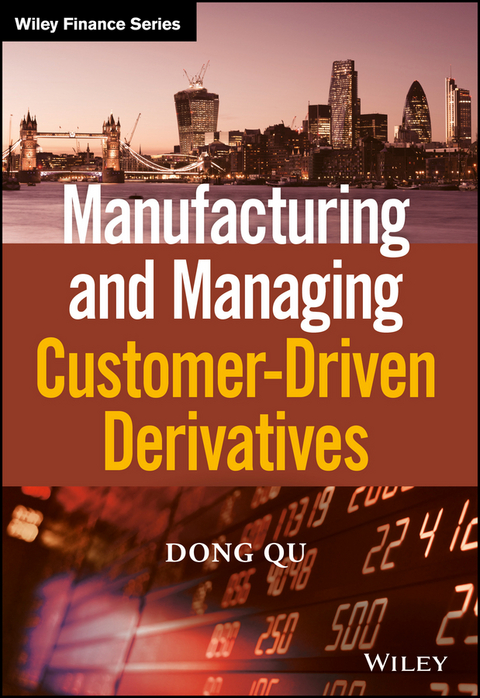
Manufacturing and Managing Customer-Driven Derivatives (eBook)
John Wiley & Sons (Verlag)
978-1-118-63253-6 (ISBN)
Manufacturing and Managing Customer-Driven Derivatives
Manufacturing and Managing Customer-Driven Derivatives sheds light on customer-driven derivative products and their manufacturing process, which can prove a complicated topic for even experienced financial practitioners. This authoritative text offers up-to-date knowledge and practices across a broad range of topics that address the entire manufacturing, pricing and risk management process, including practical knowledge and industrial best practices. This resource blends quantitative and business perspectives to provide an in-depth understanding of the derivative risk management skills that are necessary to adopt in the competitive financial industry.
Manufacturing and managing customer-driven derivative products have become more complex due to macro factors such as the multi-curve environments triggered by the recent financial crises, stricter regulatory requirements of consistent modelling and managing frameworks, and the need for risk/reward optimisation.
- Explore the fundamental components of the derivatives business, including equity derivatives, interest rates derivatives, real estate derivatives, and real life derivatives, etc.
- Examine the life cycle of manufacturing derivative products and practical pricing models
- Deep dive into a wide range of customer-driven structured derivative products, their investment or hedging payoff features and associated risk exposures
- Examine the implications of changing regulatory standards, which can increase costs in the banking sector
- Discover practical yet sophisticated product analysis, quantitative modeling, infrastructure integration, risk analysis, and hedging analysis
- Gain insight on how banks should handle complex derivatives products
Manufacturing and Managing Customer-Driven Derivatives is an essential guide for quants, structurers, derivatives traders, risk managers, business executives, insurance industry professionals, hedge fund managers, academic lecturers, and financial math students who are interested in looking at the bigger picture of the manufacturing, pricing and risk management process of customer-driven derivative transactions.
Manufacturing and Managing Customer-Driven Derivatives Manufacturing and Managing Customer-Driven Derivatives sheds light on customer-driven derivative products and their manufacturing process, which can prove a complicated topic for even experienced financial practitioners. This authoritative text offers up-to-date knowledge and practices across a broad range of topics that address the entire manufacturing, pricing and risk management process, including practical knowledge and industrial best practices. This resource blends quantitative and business perspectives to provide an in-depth understanding of the derivative risk management skills that are necessary to adopt in the competitive financial industry. Manufacturing and managing customer-driven derivative products have become more complex due to macro factors such as the multi-curve environments triggered by the recent financial crises, stricter regulatory requirements of consistent modelling and managing frameworks, and the need for risk/reward optimisation. Explore the fundamental components of the derivatives business, including equity derivatives, interest rates derivatives, real estate derivatives, and real life derivatives, etc. Examine the life cycle of manufacturing derivative products and practical pricing models Deep dive into a wide range of customer-driven structured derivative products, their investment or hedging payoff features and associated risk exposures Examine the implications of changing regulatory standards, which can increase costs in the banking sector Discover practical yet sophisticated product analysis, quantitative modeling, infrastructure integration, risk analysis, and hedging analysis Gain insight on how banks should handle complex derivatives products Manufacturing and Managing Customer-Driven Derivatives is an essential guide for quants, structurers, derivatives traders, risk managers, business executives, insurance industry professionals, hedge fund managers, academic lecturers, and financial math students who are interested in looking at the bigger picture of the manufacturing, pricing and risk management process of customer-driven derivative transactions.
DONG QU is the global head of the Quantitative Product Group at UniCredit, having previously worked at banks including HSBC, Nikko and Abbey/Santander. He is credited with being instrumental in industrialising barrier reverse convertibles. The barrier protection feature has since become a market stalwart as an industry- standard risk-reduction tool. During his career, He has worked in derivative pricing and hedging models, associated trading and risk management infrastructures, and gained first-hand experience and in-depth knowledge of customer-driven derivatives across major asset classes, including equity, interest rate, FX, credit and real estate.
"Like many people on the quantitative side of finance I've often wondered why and how the more complex derivatives are created. I mean, some of the term sheets I've seen are just downright bizarre. Well, thanks to Dong Qu, the expert in both quant finance and the business side, now I know. Dong covers everything from creative ideas, country specifics, regulatory issues, and tax implications, to modeling and risk management. This is an excellent book, unique for its breadth of coverage, genuinely for the whole business of quantitative finance."
Paul Wilmott, Wilmott Magazine
"With so many books out there on derivatives pricing, I thought it was impossible to write a new, original one. Dong Qu proved I was wrong. Not only does this volume focus on the main industry-standard pricing models, it also sheds light on the typical workflow and development process of derivatives contracts in banks, from quant library design to meeting new regulatory risk-management requirements. I wish this book was out there when I started my career as a front-office quant!"
Fabio Mercurio, Global Head of Quant Analytics, Bloomberg
"Everything you always wanted to know about financial derivatives but were afraid to ask could also be the title of this book. Written by an author with over 20 years of experience in the industry, this book joins practical hedging, risk management and regulation issues with sophisticated yet not overly complicated maths. An absolute must for all practitioners and very informative for academicians."
Dariusz Gatarek, Professor, Polish Academy of Sciences
"This book has been expertly written from a practitioner's viewpoint. Dong Qu uses his vast experience of working in major global banks to create an operationally relevant textbook, delivering a range and subject matter which is very readable and applicable in today's financial markets. He writes clearly and authoritatively on all aspects of the life-cycle, manufacturing and regulation of structured products. He also uses his mathematical skills to explore and clearly explain pricing models, whilst never ignoring the practicalities of applying quantitative models to actual risk management requirements."
Andrew Law, Global Head of Institutional Sales & Structuring, Bank of Ireland Global Markets
Chapter 1
Evolving Derivative Business Environment
The derivatives business has evolved in terms of customer needs, product ranges and models and infrastructure required for managing the derivatives products. It is a business that requires comprehensive understanding of the quantitative and organizational setup, and one must pay attention to the overall picture, as well as individual components.
Customer-Driven Derivative Product Categories
Derivative products are explicitly or implicitly embedded in many financial product types:
- retail structured products;
- insurance investment products;
- pension products;
- securitization products;
- real estate (property) products;
- etc.
There are many different ways to categorize customer-driven derivative products: by asset classes, by payoffs, by client sectors, etc. At the high level, they can also be categorized by the intended purposes of the derivative products, as seen in Table 1.1.
Table 1.1 Customer-driven derivative products
| Category | Intended Purpose |
| Structured Derivative Products | Structured derivative products are primarily intended for investment purposes. They offer investors alternative investment opportunities and access to new asset classes or markets. The buy side includes retail investors, high net worth and private banking customers, and institutional investors. |
| Derivative Hedging Products | Derivative hedging products are primarily designed for the hedging needs of institutional and corporate clients. They can be and should be used as effective risk management and mitigation tools. Large proportions of such products are interest rate hedging products. |
Retail structured derivative products are by far the most varied in product types and payoffs innovation across all major asset classes, including equity, commodity, interest rate, FX and credit. Structured derivative products modify the risk/reward profile and hence the risk-adjusted returns. Their returns can therefore be better defined and clarified. One can also incorporate protection barrier features into many types of product to reduce the risk of losing capital.
Structured life insurance products also become popular in the low interest rate environment, whereby insurance companies look into new investment areas and products, in order to fulfil the promised coupons embedded in certain products. As life insurance institutions will be subject to Solvency II capital requirement, the products with low guarantee will attract lower capital requirement.
Structured derivative business has undergone profound changes over the years, in manufacturing processes and distribution mechanisms. The products become more tailor-made, coupled with the fact that distribution channels are moving towards e-platforms, which in turn encourages more individual product features. The manufacturing process encompasses product design, quantitative modelling, trading and risk systems integration, and validation. The overall process has become much more complex and infrastructures must also build in various required regulatory constraints. Therefore an integrated comprehensive manufacturing approach is vital to keep the whole process economically viable. The products' competitions have also been extended towards the longer end, from traditional short-dated (e.g. typically < 5 years) products to long-dated products, including pension products serving the ageing population.
Financial promotions of derivative products not only require the sell sides to get facts right, i.e. what the product does, what the cash and tenure commitment is it is also a compliant requirement to explain clearly to the customers the risks involved. Setting a strict and high standard on products and their risk management ensures a sustainable product design process which is vital for the long-term success of the derivative business.
Lessons in Derivatives and Crises
Financial derivatives are a double-edged sword. Understanding and using them well, derivatives can be valuable investment tools, and effective risk management and mitigation instruments. Misunderstanding and misusing them can lead to amplified losses. Over the decades, there have been many documented and undocumented derivative losses. Table 1.2 lists some of the well-known and high profile cases dating back to early 1990s. These derivative losses resulted either from outright wrong and misunderstood positions or from unwinding losses because of forced margin calls.
Table 1.2 Sample derivative losses
| Decade | Organization | LOSSES | Transactions |
| 1990s | Metallgesellschaft | $1.3 billion | Energy futures |
| 1990s | Codelco | $207 million | Copper futures |
| 1990s | Cargill (Minnetonka Fund) | $100 million | Mortgage derivatives |
| 1990s | Kashima Oil | $1.5 billion | Currency derivatives |
| 1990s | Procter & Gamble | $157 million | Leveraged interest rate and currency swaps |
| 1990s | Askin Capital Management | $600 million | Repo and mortgage derivatives |
| 1990s | Air Products and Chemicals | $113 million | Leveraged interest rate and currency swaps |
| 1990s | Piper Jaffray Cos. | $700 million | Mortgage derivatives |
| 1990s | Sears | $237 million | Swaps |
| 1990s | Orange County, Calif. | $1.6 billion | Leveraged repo |
| 1990s | Capital Corporate Federal Credit Union | $126 million | Mortgage derivatives |
| 1990s | Sumitomo Bank | $1.8 billion | Copper futures |
| 1990s | First Capital Strategists | $128 million | Stock index futures |
| 1990s | Postipankki | $110 million | Mortgage derivatives and structured notes |
| 1990s | NatWest | $90 million | Interest rate options |
| 1990s | UBS | $170 million | Equity derivatives |
| 1990s | UBS | $120 million | Equity derivatives |
| 1990s | UBS | $75 million | Convertible bonds |
| 1990s | LTCM | $500 million | Leveraged spreads |
| 2000s | Allied Irish Banks | $700 million | Currency derivatives |
| 2000s | China Aviation Oil | $550 million | Commodity derivatives |
| 2000s | China State Reserve Co. | $300 million | Copper futures |
| 2000s | Hedge funds | Undisclosed large sum | Credit tranche baskets |
| 2000s | Credit Suisse | $120 million | Equity derivatives (Korea) |
| 2009 | A European Bank | €100 million | Bermudan swaptions |
| 2009 | Brazilian Corporates | $28 billion | FX Tarfs (Real) |
| 2009 | Korean Corporates | $4 billion | FX Tarfs (Won) |
| 2009 | Citic Pacific | $2.4 billion | FX Tarfs (Australian Dollar) |
| 2012 | JP Morgan | $6 billion | Credit derivatives index |
| 2013 | A Portuguese entity | €450 million | Exotic swaps with accumulating coupons |
| 2014 | Asian corporates | $3 billion | FX Tarfs (offshore renminbi) |
Derivative Losses
As can be seen in Table 1.2, derivative losses have happened frequently in the past. While the frequency of these occurrences may have become less on average, the individual loss amount has actually become larger. This indicates that lessons have not been learned fully. Derivatives are highly leveraged instruments. One must fully understand the risky nature of the derivatives as well as their practical operational details. It is essential to build adequate technical and operational frameworks before embarking on highly leveraged activities. Derivatives business should consist of a comprehensive set of technical, risk management and operational control tools.
Table 1.2 does not include rogue trading that occurred at Barings, Société Générale and UBS. For completeness, they are listed in Table 1.3 and it is striking to see how similar they all look. The last column shows one of the common features of rogue trading; they...
| Erscheint lt. Verlag | 28.1.2016 |
|---|---|
| Reihe/Serie | The Wiley Finance Series |
| Wiley Finance Series | Wiley Finance Series |
| Sprache | englisch |
| Themenwelt | Recht / Steuern ► Wirtschaftsrecht |
| Wirtschaft ► Betriebswirtschaft / Management ► Finanzierung | |
| Schlagworte | a guide to customer-driven derivatives • customer-driven derivatives • Dong Qu • Finance & Investments • Finanz- u. Anlagewesen • Finanzwesen • how to use structured derivatives • managing structured derivatives • Manufacturing and Managing Customer-Driven Derivatives • manufacturing structured derivatives • risk managing customer-driven derivatives, derivative business, structured derivative business, customer-driven derivative business. • risk managing structured derivatives, effectively using structured derivatives • structured derivative product basics • structured derivative products • succeeding with structured derivatives • what are structured derivatives |
| ISBN-10 | 1-118-63253-2 / 1118632532 |
| ISBN-13 | 978-1-118-63253-6 / 9781118632536 |
| Informationen gemäß Produktsicherheitsverordnung (GPSR) | |
| Haben Sie eine Frage zum Produkt? |
 EPUB (Adobe DRM)
Kopierschutz: Adobe-DRM
Adobe-DRM ist ein Kopierschutz, der das eBook vor Mißbrauch schützen soll. Dabei wird das eBook bereits beim Download auf Ihre persönliche Adobe-ID autorisiert. Lesen können Sie das eBook dann nur auf den Geräten, welche ebenfalls auf Ihre Adobe-ID registriert sind.
Details zum Adobe-DRM
Dateiformat: EPUB (Electronic Publication)
EPUB ist ein offener Standard für eBooks und eignet sich besonders zur Darstellung von Belletristik und Sachbüchern. Der Fließtext wird dynamisch an die Display- und Schriftgröße angepasst. Auch für mobile Lesegeräte ist EPUB daher gut geeignet.
Systemvoraussetzungen:
PC/Mac: Mit einem PC oder Mac können Sie dieses eBook lesen. Sie benötigen eine
eReader: Dieses eBook kann mit (fast) allen eBook-Readern gelesen werden. Mit dem amazon-Kindle ist es aber nicht kompatibel.
Smartphone/Tablet: Egal ob Apple oder Android, dieses eBook können Sie lesen. Sie benötigen eine
Geräteliste und zusätzliche Hinweise
Buying eBooks from abroad
For tax law reasons we can sell eBooks just within Germany and Switzerland. Regrettably we cannot fulfill eBook-orders from other countries.
aus dem Bereich