


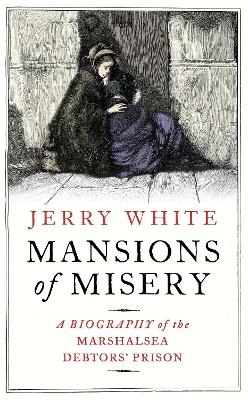
Mansions of Misery
A Biography of the Marshalsea Debtors’ Prison
Seiten
2016
The Bodley Head Ltd (Verlag)
978-1-84792-302-8 (ISBN)
The Bodley Head Ltd (Verlag)
978-1-84792-302-8 (ISBN)
- Titel ist leider vergriffen;
keine Neuauflage - Artikel merken
But the prison was also a microcosm of London life and it housed a colourful range of characters, including Charles Dickens’s father. We get to know the trumpeter John Grano who wined and dined with the prison governor and continued to compose music whilst other prisoners were tortured and starved to death.
Selected as a Book of the Year by BBC History Magazine
For Londoners of the eighteenth and nineteenth centuries, debt was a part of everyday life. But when your creditors lost their patience, you might be thrown into one of the capital’s most notorious jails: the Marshalsea Debtors’ Prison.
The Marshalsea became a byword for misery; in the words of one of its inmates, it was `hell in epitome’. But the prison was also a microcosm of London life and it housed a colourful range of characters, including Charles Dickens’s father. The experience haunted the writer, who went on to immortalise the Marshalsea in his work, most memorably in Little Dorrit.
In Mansions of Misery, acclaimed chronicler of the capital Jerry White introduces us to the Marshalsea’s unfortunate prisoners – rich and poor; men and women; spongers, fraudsters and innocents. We get to know the trumpeter John Grano who wined and dined with the prison governor and continued to compose music whilst other prisoners were tortured and starved to death. We meet the bare-knuckle fighter known as the Bold Smuggler, who fell on hard times after being beaten by the Chelsea Snob. And then there’s Joshua Reeve Lowe, who saved Queen Victoria from assassination in Hyde Park in 1820, but whose heroism couldn’t save him from the Marshalsea.
Told through these extraordinary lives, Mansions of Misery gives us a fascinating and unforgettable cross-section of London life from the early 1700s to the 1840s.
Selected as a Book of the Year by BBC History Magazine
For Londoners of the eighteenth and nineteenth centuries, debt was a part of everyday life. But when your creditors lost their patience, you might be thrown into one of the capital’s most notorious jails: the Marshalsea Debtors’ Prison.
The Marshalsea became a byword for misery; in the words of one of its inmates, it was `hell in epitome’. But the prison was also a microcosm of London life and it housed a colourful range of characters, including Charles Dickens’s father. The experience haunted the writer, who went on to immortalise the Marshalsea in his work, most memorably in Little Dorrit.
In Mansions of Misery, acclaimed chronicler of the capital Jerry White introduces us to the Marshalsea’s unfortunate prisoners – rich and poor; men and women; spongers, fraudsters and innocents. We get to know the trumpeter John Grano who wined and dined with the prison governor and continued to compose music whilst other prisoners were tortured and starved to death. We meet the bare-knuckle fighter known as the Bold Smuggler, who fell on hard times after being beaten by the Chelsea Snob. And then there’s Joshua Reeve Lowe, who saved Queen Victoria from assassination in Hyde Park in 1820, but whose heroism couldn’t save him from the Marshalsea.
Told through these extraordinary lives, Mansions of Misery gives us a fascinating and unforgettable cross-section of London life from the early 1700s to the 1840s.
Professor Jerry White teaches London history at Birkbeck, University of London. He is the author of an acclaimed trilogy of London from the eighteenth to the twentieth centuries. His more recent books include Mansions of Misery: A Biography of the Marshalsea Debtors' Prison and Zeppelin Nights, a social history of London during the First World War. He was awarded the honorary degree of Doctor of Literature by the University of London in 2005 and is a Fellow of the Royal Historical Society.
| Erscheinungsdatum | 27.09.2016 |
|---|---|
| Verlagsort | London |
| Sprache | englisch |
| Maße | 162 x 240 mm |
| Gewicht | 788 g |
| Themenwelt | Geisteswissenschaften ► Geschichte ► Regional- / Ländergeschichte |
| Geschichte ► Teilgebiete der Geschichte ► Kulturgeschichte | |
| Recht / Steuern ► Strafrecht ► Kriminologie | |
| ISBN-10 | 1-84792-302-X / 184792302X |
| ISBN-13 | 978-1-84792-302-8 / 9781847923028 |
| Zustand | Neuware |
| Informationen gemäß Produktsicherheitsverordnung (GPSR) | |
| Haben Sie eine Frage zum Produkt? |
Mehr entdecken
aus dem Bereich



aus dem Bereich
Die Revolution des Gemeinen Mannes
Buch | Softcover (2024)
C.H.Beck (Verlag)
CHF 16,80
Eine Geschichte des Geschmacks
Buch | Hardcover (2025)
C.H.Beck (Verlag)
CHF 49,95


