


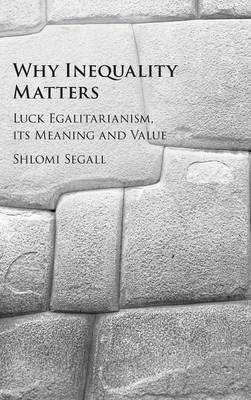
Why Inequality Matters
Luck Egalitarianism, its Meaning and Value
Seiten
2016
Cambridge University Press (Verlag)
978-1-107-12981-8 (ISBN)
Cambridge University Press (Verlag)
978-1-107-12981-8 (ISBN)
This book brings together discussions of the moral value of inequality with luck- or responsibility-sensitive accounts of distributive justice to explore and defend the view that inequality is intrinsically bad, and it is bad when and because it leaves some worse off than others through no fault or choice of their own.
Equality is a key concept in our moral and political vocabulary. There is wide agreement on its instrumental value and its favourable impact on many aspects of society, but less certainty over whether it has a non-instrumental or intrinsic value that can be demonstrated. In this project, Shlomi Segall explores and defends the view that it does. He argues that the value of equality is not reducible to a concern we might have for the worse off, or to ensuring that individuals do not fall into poverty and destitution; instead he claims that undeserved inequalities, wherever and whenever we might find them, are bad in themselves. Assessing the strength of competing accounts, such as sufficientarianism and prioritarianism, he brings together for the first time discussions of the moral value of equality with luck- or responsibility-sensitive accounts of distributive justice. His book will interest readers in political and moral philosophy.
Equality is a key concept in our moral and political vocabulary. There is wide agreement on its instrumental value and its favourable impact on many aspects of society, but less certainty over whether it has a non-instrumental or intrinsic value that can be demonstrated. In this project, Shlomi Segall explores and defends the view that it does. He argues that the value of equality is not reducible to a concern we might have for the worse off, or to ensuring that individuals do not fall into poverty and destitution; instead he claims that undeserved inequalities, wherever and whenever we might find them, are bad in themselves. Assessing the strength of competing accounts, such as sufficientarianism and prioritarianism, he brings together for the first time discussions of the moral value of equality with luck- or responsibility-sensitive accounts of distributive justice. His book will interest readers in political and moral philosophy.
Shlomi Segall is an associate professor at the Program in Politics, Philosophy, and Economics at the Hebrew University of Jerusalem. He is the author of Health, Luck, and Justice (2010) and Equality and Opportunity (2013).
Part I. Egalitarianism: 1. The variety of objections to equality; 2. Why inequality matters; 3. When does inequality matter?; 4. Who is inequality bad for?; Part II. Alternatives to Egalitarianism: 5. What is the point of sufficiency?; 6. Prioritarianism and the person-affecting view; 7. Prioritarianism and time; Part III. Chances and Choices: 8. Should egalitarians care about chances?; 9. The badness of voluntary inequalities.
| Erscheinungsdatum | 03.06.2016 |
|---|---|
| Zusatzinfo | 14 Tables, black and white |
| Verlagsort | Cambridge |
| Sprache | englisch |
| Maße | 159 x 237 mm |
| Gewicht | 540 g |
| Themenwelt | Geisteswissenschaften ► Philosophie ► Ethik |
| Recht / Steuern ► EU / Internationales Recht | |
| Sozialwissenschaften ► Politik / Verwaltung ► Politische Theorie | |
| Sozialwissenschaften ► Soziologie | |
| Wirtschaft ► Allgemeines / Lexika | |
| ISBN-10 | 1-107-12981-8 / 1107129818 |
| ISBN-13 | 978-1-107-12981-8 / 9781107129818 |
| Zustand | Neuware |
| Informationen gemäß Produktsicherheitsverordnung (GPSR) | |
| Haben Sie eine Frage zum Produkt? |
Mehr entdecken
aus dem Bereich


aus dem Bereich
Buch | Hardcover (2025)
Suhrkamp (Verlag)
CHF 32,15


