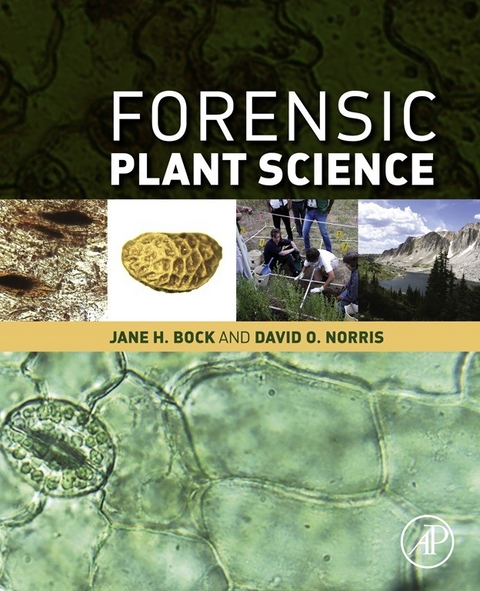
Forensic Plant Science (eBook)
226 Seiten
Elsevier Science (Verlag)
9780128015810 (ISBN)
Dr. Bock is a Professor emerita in biology at the University of Colorado, Boulder. She received her bachelor's degree from Duke University, master's degree from Indiana University and Ph.D. (1966) from the University of California at Berkeley. All her degrees are in Botany. She taught, carried out research and published scientific work in population ecology and forensic botany at Boulder for over 30 years. Officially retired from teaching, she continues to do research as a forensic botanist and serve as an expert witness for the defense or the prosecution in homicide cases. She also lectures and continues to publish regularly. She is a Fellow of the American Academy of Forensic Sciences, and was a founding member of both Necrosearch Ltd and the Ecology Section of the Botanical Society of America.
Forensic botany is the application of plant science to the resolution of legal questions. A plant's anatomy and its ecological requirements are in some cases species specific and require taxonomic verification; correct interpretation of botanical evidence can give vital information about a crime scene or a suspect or victim. The use of botanical evidence in legal investigations in North America is relatively recent. The first botanical testimony to be heard in a North American court concerned the kidnapping and murder of Charles Lindbergh's baby boy and the conviction of Bruno Hauptmann in 1935. Today, forensic botany encompasses numerous subdisciplines of plant science, such as plant anatomy, taxonomy, ecology, palynology, and diatomology, and interfaces with other disciplines, e.g., molecular biology, limnology and oceanography.Forensic Plant Science presents chapters on plant science evidence, plant anatomy, plant taxonomic evidence, plant ecology, case studies for all of the above, as well as the educational pathways for the future of forensic plant science. - Provides techniques, collection methods, and analysis of digested plant materials- Shows how to identify plants of use for crime scene and associated evidence in criminal cases- The book's companion website: http://booksite.elsevier.com/9780128014752, will host a microscopic atlas of common food plants
| Erscheint lt. Verlag | 17.11.2015 |
|---|---|
| Sprache | englisch |
| Themenwelt | Recht / Steuern ► EU / Internationales Recht |
| Recht / Steuern ► Strafrecht ► Kriminologie | |
| Sozialwissenschaften | |
| ISBN-13 | 9780128015810 / 9780128015810 |
| Informationen gemäß Produktsicherheitsverordnung (GPSR) | |
| Haben Sie eine Frage zum Produkt? |
 EPUB (Adobe DRM)
Kopierschutz: Adobe-DRM
Adobe-DRM ist ein Kopierschutz, der das eBook vor Mißbrauch schützen soll. Dabei wird das eBook bereits beim Download auf Ihre persönliche Adobe-ID autorisiert. Lesen können Sie das eBook dann nur auf den Geräten, welche ebenfalls auf Ihre Adobe-ID registriert sind.
Details zum Adobe-DRM
Dateiformat: EPUB (Electronic Publication)
EPUB ist ein offener Standard für eBooks und eignet sich besonders zur Darstellung von Belletristik und Sachbüchern. Der Fließtext wird dynamisch an die Display- und Schriftgröße angepasst. Auch für mobile Lesegeräte ist EPUB daher gut geeignet.
Systemvoraussetzungen:
PC/Mac: Mit einem PC oder Mac können Sie dieses eBook lesen. Sie benötigen eine
eReader: Dieses eBook kann mit (fast) allen eBook-Readern gelesen werden. Mit dem amazon-Kindle ist es aber nicht kompatibel.
Smartphone/Tablet: Egal ob Apple oder Android, dieses eBook können Sie lesen. Sie benötigen eine
Geräteliste und zusätzliche Hinweise
Buying eBooks from abroad
For tax law reasons we can sell eBooks just within Germany and Switzerland. Regrettably we cannot fulfill eBook-orders from other countries.
aus dem Bereich