


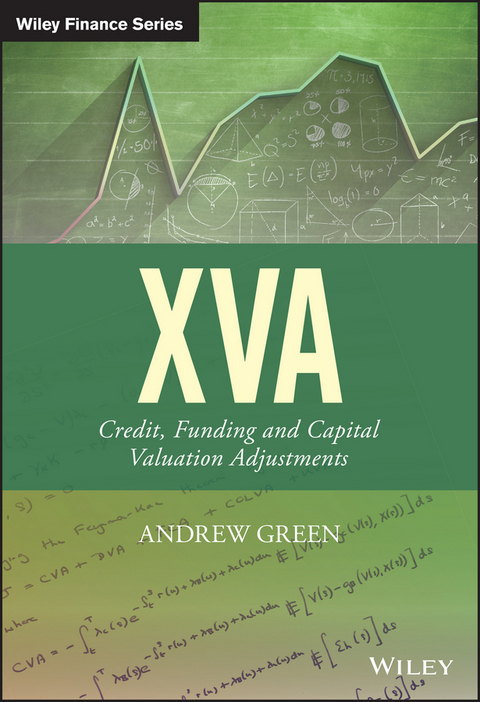
XVA (eBook)
John Wiley & Sons (Verlag)
978-1-118-55676-4 (ISBN)
Thorough, accessible coverage of the key issues in XVA
XVA - Credit, Funding and Capital Valuation Adjustments provides specialists and non-specialists alike with an up-to-date and comprehensive treatment of Credit, Debit, Funding, Capital and Margin Valuation Adjustment (CVA, DVA, FVA, KVA and MVA), including modelling frameworks as well as broader IT engineering challenges. Written by an industry expert, this book navigates you through the complexities of XVA, discussing in detail the very latest developments in valuation adjustments including the impact of regulatory capital and margin requirements arising from CCPs and bilateral initial margin.
The book presents a unified approach to modelling valuation adjustments including credit risk, funding and regulatory effects. The practical implementation of XVA models using Monte Carlo techniques is also central to the book. You'll also find thorough coverage of how XVA sensitivities can be accurately measured, the technological challenges presented by XVA, the use of grid computing on CPU and GPU platforms, the management of data, and how the regulatory framework introduced under Basel III presents massive implications for the finance industry.
- Explores how XVA models have developed in the aftermath of the credit crisis
- The only text to focus on the XVA adjustments rather than the broader topic of counterparty risk.
- Covers regulatory change since the credit crisis including Basel III and the impact regulation has had on the pricing of derivatives.
- Covers the very latest valuation adjustments, KVA and MVA.
- The author is a regular speaker and trainer at industry events, including WBS training, Marcus Evans, ICBI, Infoline and RISK
If you're a quantitative analyst, trader, banking manager, risk manager, finance and audit professional, academic or student looking to expand your knowledge of XVA, this book has you covered.
Thorough, accessible coverage of the key issues in XVA XVA Credit, Funding and Capital Valuation Adjustments provides specialists and non-specialists alike with an up-to-date and comprehensive treatment of Credit, Debit, Funding, Capital and Margin Valuation Adjustment (CVA, DVA, FVA, KVA and MVA), including modelling frameworks as well as broader IT engineering challenges. Written by an industry expert, this book navigates you through the complexities of XVA, discussing in detail the very latest developments in valuation adjustments including the impact of regulatory capital and margin requirements arising from CCPs and bilateral initial margin. The book presents a unified approach to modelling valuation adjustments including credit risk, funding and regulatory effects. The practical implementation of XVA models using Monte Carlo techniques is also central to the book. You'll also find thorough coverage of how XVA sensitivities can be accurately measured, the technological challenges presented by XVA, the use of grid computing on CPU and GPU platforms, the management of data, and how the regulatory framework introduced under Basel III presents massive implications for the finance industry. Explores how XVA models have developed in the aftermath of the credit crisis The only text to focus on the XVA adjustments rather than the broader topic of counterparty risk. Covers regulatory change since the credit crisis including Basel III and the impact regulation has had on the pricing of derivatives. Covers the very latest valuation adjustments, KVA and MVA. The author is a regular speaker and trainer at industry events, including WBS training, Marcus Evans, ICBI, Infoline and RISK If you're a quantitative analyst, trader, banking manager, risk manager, finance and audit professional, academic or student looking to expand your knowledge of XVA, this book has you covered.
ANDREW GREEN heads CVA/FVA Quantitative Research at Lloyds Banking Group. He leads a team of quantitative analysts and developers who are responsible for the design and implementation of models for derivative valuation adjustments. Andrew and his team also work extensively on the implication of regulatory change on derivatives. Andrew previously headed CVA Quantitative Research at Barclays Capital and during his career, has also worked on models for fixed income and equity derivative products as well as ALM. High performance computing is a central element of XVA model implementation and Andrew has extensive experience of the practical implementation of large scale Monte Carlo simulation models in IT systems. Andrew is a regular conference speaker and has co-authored a number of papers on various topics in XVA. He has a DPhil in Theoretical Physics and a BA in Physics from Oxford University, and Part III of the Mathematics Tripos from Cambridge University.
| Erscheint lt. Verlag | 8.10.2015 |
|---|---|
| Reihe/Serie | The Wiley Finance Series |
| Wiley Finance Series | Wiley Finance Series |
| Sprache | englisch |
| Themenwelt | Recht / Steuern ► EU / Internationales Recht |
| Recht / Steuern ► Wirtschaftsrecht ► Bank- und Kapitalmarktrecht | |
| Wirtschaft ► Betriebswirtschaft / Management ► Finanzierung | |
| Schlagworte | aftermath of the credit crisis • Andrew Green • banking manager • Basel III • capital charge • Counterparty Risk • credit and funding • credit and funding valuation • credit and funding valuation adjustment • Credit Crisis • Credit, Debit and Funding Valuation Adjustment • CVA • CVA DVA FVA • DVA • Finance & Investments • finance and audit professional • Finanz- u. Anlagewesen • Finanzwesen • FVA • issues in CVA, DVA and FVA • key issues in CVA, DVA and FVA • quantitative analyst • Risk manager • Trader • XVA • xVA – Credit, Funding and Capital Valuation Adjustments |
| ISBN-10 | 1-118-55676-3 / 1118556763 |
| ISBN-13 | 978-1-118-55676-4 / 9781118556764 |
| Informationen gemäß Produktsicherheitsverordnung (GPSR) | |
| Haben Sie eine Frage zum Produkt? |
 EPUB (Adobe DRM)
Kopierschutz: Adobe-DRM
Adobe-DRM ist ein Kopierschutz, der das eBook vor Mißbrauch schützen soll. Dabei wird das eBook bereits beim Download auf Ihre persönliche Adobe-ID autorisiert. Lesen können Sie das eBook dann nur auf den Geräten, welche ebenfalls auf Ihre Adobe-ID registriert sind.
Details zum Adobe-DRM
Dateiformat: EPUB (Electronic Publication)
EPUB ist ein offener Standard für eBooks und eignet sich besonders zur Darstellung von Belletristik und Sachbüchern. Der Fließtext wird dynamisch an die Display- und Schriftgröße angepasst. Auch für mobile Lesegeräte ist EPUB daher gut geeignet.
Systemvoraussetzungen:
PC/Mac: Mit einem PC oder Mac können Sie dieses eBook lesen. Sie benötigen eine
eReader: Dieses eBook kann mit (fast) allen eBook-Readern gelesen werden. Mit dem amazon-Kindle ist es aber nicht kompatibel.
Smartphone/Tablet: Egal ob Apple oder Android, dieses eBook können Sie lesen. Sie benötigen eine
Geräteliste und zusätzliche Hinweise
Buying eBooks from abroad
For tax law reasons we can sell eBooks just within Germany and Switzerland. Regrettably we cannot fulfill eBook-orders from other countries.


