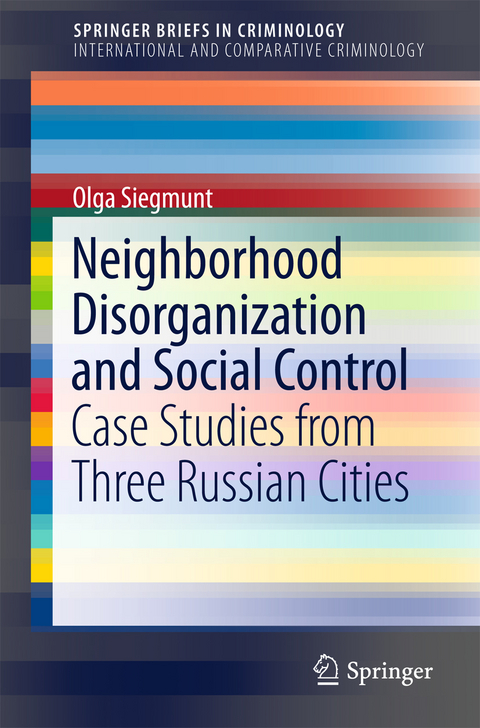
Neighborhood Disorganization and Social Control (eBook)
XIII, 82 Seiten
Springer International Publishing (Verlag)
978-3-319-21590-7 (ISBN)
This Brief presents a framework for understanding the role of school and neighborhood contexts in the development of self-control. Through the application of Gottfredson and Hirschi's general theory of crime and Shaw and McKay's social disorganization theory, the authors of this Brief examine the importance of family socialization and school and neighborhood for self-control of youth in three Russian cities, replicating results from an earlier study in Germany.
The cases presented in the Brief found that family socialization is important for self-control, but it interacts with school and neighbourhood contexts. According to the study, school social control as a structural characteristic can lead to less delinquency, even if students did not develop self-control. Self-control mediates parental supervision and attachment to parents on one hand, and juvenile delinquency on the other hand. However it was not found to mediate neighbourhood context characteristics.
The results of the study provide a research framework that can be applied to other international, comparative contexts. It will be of interest to researchers in Criminology and Criminal Justice, particularly Developmental and Life-Course Criminology, as well as related fields such as Public Policy and Social Work.
Olga Siegmunt is an associate professor at the HafenCity University in Hamburg and a consultant for criminology research methods at the State Office for Criminal Investigation of Lower Saxony, Hanover, Germany. She has been teaching and researching in criminology for 20 years in several Universities in Germany and Russia.
Her research interests include crime statistics, survey research, comparative studies, quantitative methods for social research, juvenile delinquency, and victimology. Dr. Siegmunt serves in the editorial board of the journal 'Legal Science and Law Enforcement Practice'. She has worked periodically for the first regular German Victim Survey, Victim Survey of Lower Saxony, since its beginning in 2012.
Olga Siegmunt is an associate professor at the HafenCity University in Hamburg and a consultant for criminology research methods at the State Office for Criminal Investigation of Lower Saxony, Hanover, Germany. She has been teaching and researching in criminology for 20 years in several Universities in Germany and Russia. Her research interests include crime statistics, survey research, comparative studies, quantitative methods for social research, juvenile delinquency, and victimology. Dr. Siegmunt serves in the editorial board of the journal “Legal Science and Law Enforcement Practice”. She has worked periodically for the first regular German Victim Survey, Victim Survey of Lower Saxony, since its beginning in 2012.
Introduction.- The General Theory of Crime.- The Neighborhood.- Context of School and Self-Control.- Theoretical Concepts and Hypotheses.- Methods, Procedures, Implementation of the Study, and Description of the Sample.- Variable Description and Descriptive Results: Aggregate Level.- Descriptive Results and Scale Analysis: Individual Level Variables.- Intraclass Correlation, Median Odds Ratio, and Ecological Reliability.- Results of Hypothesis Testing: Influences on the Family.- Results of Hypothesis Testing: Influences of the Neighborhood.- Results of Hypothesis Testing: Influences of the School.- Summary, Discussion, and Outlook.
| Erscheint lt. Verlag | 4.2.2016 |
|---|---|
| Reihe/Serie | International and Comparative Criminology |
| International and Comparative Criminology | |
| SpringerBriefs in Criminology | SpringerBriefs in Criminology |
| Zusatzinfo | XIII, 82 p. 17 illus., 16 illus. in color. |
| Verlagsort | Cham |
| Sprache | englisch |
| Themenwelt | Recht / Steuern ► Strafrecht |
| Schlagworte | Crime and Contexts • Criminology and Neighborhoods • Developmental and Life-Course Criminology • Juvenile Delinquency • Juvenile justice • Self-Control and Social Control • Situational Crime Prevention |
| ISBN-10 | 3-319-21590-6 / 3319215906 |
| ISBN-13 | 978-3-319-21590-7 / 9783319215907 |
| Informationen gemäß Produktsicherheitsverordnung (GPSR) | |
| Haben Sie eine Frage zum Produkt? |
 PDF (Wasserzeichen)
DRM: Digitales Wasserzeichen
Dieses eBook enthält ein digitales Wasserzeichen und ist damit für Sie personalisiert. Bei einer missbräuchlichen Weitergabe des eBooks an Dritte ist eine Rückverfolgung an die Quelle möglich.
Dateiformat: PDF (Portable Document Format)
Mit einem festen Seitenlayout eignet sich die PDF besonders für Fachbücher mit Spalten, Tabellen und Abbildungen. Eine PDF kann auf fast allen Geräten angezeigt werden, ist aber für kleine Displays (Smartphone, eReader) nur eingeschränkt geeignet.
Systemvoraussetzungen:
PC/Mac: Mit einem PC oder Mac können Sie dieses eBook lesen. Sie benötigen dafür einen PDF-Viewer - z.B. den Adobe Reader oder Adobe Digital Editions.
eReader: Dieses eBook kann mit (fast) allen eBook-Readern gelesen werden. Mit dem amazon-Kindle ist es aber nicht kompatibel.
Smartphone/Tablet: Egal ob Apple oder Android, dieses eBook können Sie lesen. Sie benötigen dafür einen PDF-Viewer - z.B. die kostenlose Adobe Digital Editions-App.
Buying eBooks from abroad
For tax law reasons we can sell eBooks just within Germany and Switzerland. Regrettably we cannot fulfill eBook-orders from other countries.
aus dem Bereich