


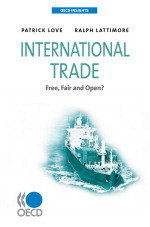
OECD Insights International Trade Free, Fair and Open? (eBook)
194 Seiten
OECD Publishing (Verlag)
978-92-64-10713-7 (ISBN)
"The OECD is a major source for insightful analyses of current trade issues. It also plays a role in disseminating skilfully the results of less accessible writings on trade. This short book is a valuable addition to the latter endeavour and should be on the shelf of policy makers."
-Jagdish Bhagwati, Columbia University
International trade affects the price and availability of practically everything we buy. It also plays a role in many other domains, including jobs, the environment and the fight against poverty. OECD Insights: International Trade argues that prosperity has rarely, if ever, been achieved or sustained without trade. Trade alone, however, is not enough. Policies targeting employment, education, health and other issues are also needed to promote well-being and tackle the challenges of a globalised economy. "e;The OECD is a major source for insightful analyses of current trade issues. It also plays a role in disseminating skilfully the results of lessaccessible writings on trade. This short book is a valuable addition tothe latter endeavour and should be on the shelf of policy makers."e; -Jagdish Bhagwati, Columbia University
1. Introduction
| International trade influences a whole range of activities including jobs, consumption and the fight against poverty. It also affects the environment and relations among countries. In turn, trade is shaped by a host of influences ranging from natural resources to fashion. Trade-related issues can give rise to strong feelings, and trade measures such as banning or limiting imports are often called for to respond to major economic problems. An understanding of the benefits and downsides of trade, and of what trade policy can and cannot achieve, will help us to form our own opinions on debates about international trade. |
By way of introduction…
Hershey’s chocolate bars are one of America’s best-known brands. The name comes from Milton S. Hershey, who founded the company, and it’s also the name of the town he had built in Pennsylvania for his factories and employees. In January 2007, the US Postal Service released a stamp to mark the 100th anniversary of Hershey’s Kisses, the first time a piece of chocolate was so honoured. But shortly after the stamp went on sale, the firm announced plans to cut its workforce by 1 500 by the end of the decade and close a third of its production lines. At the same time, it announced that a new plant was to be built in Monterrey, Mexico. Wages in Mexico are lower than in the US and Canada, and opponents of Hershey’s decision often cite this as the reason behind the company’s announcement. They also note that under the North American Free Trade Agreement (NAFTA), Hershey could import the candy made in Mexico back into the US. So it looks like a typical case of free trade driving down wages and costing jobs.
But if you look closer, several factors are involved. Trade is certainly one of them, but not just because NAFTA made it economically viable to import products from Mexico. For a manufacturer of chocolate and confectionary, sugar is a major part of the production budget. Sugar producers in the US are protected from foreign competition and prices are two to three times higher than on world markets. Factories in Mexico can buy sugar at world prices, and this is a huge incentive when some of your products are mostly made of sugar.
Innovation, investment and organisation are important, too. Hershey is in competition with other multinationals selling similar products on world markets. But many Hershey production lines could only produce one item, whereas rivals’ lines were flexible.
That said, moving production to Mexico clearly costs jobs in the US and Canada. You can look at this in several ways. One would be that: jobs were sacrificed to save money for the company. Or you could take a wider view, that jobs were created in Mexico, thus helping a trading partner to expand its economy and be better able to import goods and services. And as the US economy became more open to trade, employment increased. That may be true, but it’s not much consolation to the workers who got fired. These workers are more interested in quickly finding another job, even though there may be practical difficulties for those who move to another town, put their children in a new school or lose contact with friends and workmates. Still, a study of European workers showed that four-fifths of those who left a job moved straight into another one.
While some jobs are lost to trade, it’s not the main cause of unemployment. The share of jobs lost due to the internationalisation of production is less than the share of jobs lost through the normal turnover in the labour market through people voluntarily changing jobs or retiring.
Trade’s main impact on production, and thus employment, is to allow operations to be split into a number of different parts that can be done throughout the world and brought together to make the final products we buy. This aspect has allowed many countries outside the traditional industrial centres to enter world markets. In fact, the use of “industrialised” and “developing” to describe OECD and non-OECD countries is becoming meaningless. Industry contributes more to China’s GDP than it does to that of any OECD country, for instance, yet China is practically never referred to as an industrialised country.
Other countries are following China’s example, but do they get a fair deal from the international trading system? Trade gives a country access to markets, knowledge and financing that it would not have otherwise. If there was no trade, a country would have to depend on its own population and resources, and no country has ever done this for long and prospered. But this access to world markets is not the same for every country. It is conditioned by a country’s history, institutions, size and geographical position, as well as a number of more subjective factors such as culture and social structures.
Who sets the rules?
Trade is paradoxical in that it brings countries together, and often for their mutual benefit, while at the same time reinforcing competition between them. The philosopher Reinhold Niebuhr expressed this succinctly by saying that “a trading civilisation is involved in more bitter international quarrels than any civilisation in history”. In the past, these quarrels might have been physical conflicts. Nowadays they are more likely to be “trade disputes”, falling under the rules of the World Trade Organization (WTO) and trade agreements. These rules were determined in large part by the most advanced trading nations who initially set up the system (as the GATT in 1947) but are increasingly subject to influence from smaller, less developed economies.
The OECD defends the multilateral system as the best hope for equitable governance of international trade. Why? Basically because the two other options are not as just. One of these options is to have no rules at all, and every country does what it likes until a more powerful rival stops it. Nobody would claim that this is a fairer system than the present one. The other option is to have preferential trade agreements, usually called regional or bilateral agreements depending on the number of partners. Such agreements can occasionally feed into the multilateral system and they are certainly an improvement on a free-for-all. There is a risk however that the interests of larger partners prevail over those of smaller ones.
Large economies still dominate trade and hence the multilateral system. But they don’t get it all their own way. Smaller nations can form alliances within the multilateral system to make their voices heard, and a victory for one can bring benefits for others. This has been very much the case during the Doha Development Agenda (DDA) negotiations. Developing countries in particular have grouped and regrouped with some success around different issues, such as cotton subsidies or special treatment of the poorest countries.
Some people object to international trade on the grounds that it harms the environment and does little to encourage sustainable development. Two arguments are foremost in these objections. First, companies move abroad to so-called “pollution havens” to take advantage of weaker environmental controls. Second, transporting goods around the globe increases CO2 emissions and has other negative side-effects.
We’ll return to these shortly, but first let’s recall what sustainable development actually means. As emphasized by the title of another book in the Insights series, Sustainable Development: Linking Economy, Society, Environment, it’s not just about the environment. It costs money to provide enough food, clean water, health care, education and the other services we need to live fulfilled lives. A well-functioning social system capable of providing opportunities and managing conflict is essential, too. Neglecting one of the three “pillars” of sustainability will lead to unsustainable outcomes.
As for the strictly environmental concerns, there is little evidence in practice of a pollution haven effect. Also, one consequence of international production chains is a standardisation of equipment and practices. Respecting environmental norms is a very minor cost in setting up a factory anyway and sometimes it can actually save money in the longer run through lower fuel bills or fewer health and safety problems. So it makes little economic sense for a multinational firm to have a factory designed and built specifically to exploit an environmental “advantage”, especially given the risk that costly retrofitting of pollution control equipment may be needed later.
Transport certainly causes pollution, and analysis of food miles or the “carbon foodprint” has drawn attention to this. However, when asking if international trade is worse for the environment than producing locally, we have to look at the total impact. It can be more environmentally friendly to fly produce from a country that doesn’t need to use heated greenhouses, fertiliser or as many of the other damaging inputs as the importer might use. From a sustainability point of view, allowing producers in poorer countries access to rich markets can be more beneficial than excluding them in order to reduce carbon emissions. And poor people in rich countries are...
| Erscheint lt. Verlag | 17.6.2011 |
|---|---|
| Sprache | englisch |
| Themenwelt | Recht / Steuern ► EU / Internationales Recht |
| Sozialwissenschaften ► Politik / Verwaltung ► Europäische / Internationale Politik | |
| Wirtschaft ► Volkswirtschaftslehre ► Makroökonomie | |
| ISBN-10 | 92-64-10713-4 / 9264107134 |
| ISBN-13 | 978-92-64-10713-7 / 9789264107137 |
| Informationen gemäß Produktsicherheitsverordnung (GPSR) | |
| Haben Sie eine Frage zum Produkt? |
 EPUB (Adobe DRM)
Kopierschutz: Adobe-DRM
Adobe-DRM ist ein Kopierschutz, der das eBook vor Mißbrauch schützen soll. Dabei wird das eBook bereits beim Download auf Ihre persönliche Adobe-ID autorisiert. Lesen können Sie das eBook dann nur auf den Geräten, welche ebenfalls auf Ihre Adobe-ID registriert sind.
Details zum Adobe-DRM
Dateiformat: EPUB (Electronic Publication)
EPUB ist ein offener Standard für eBooks und eignet sich besonders zur Darstellung von Belletristik und Sachbüchern. Der Fließtext wird dynamisch an die Display- und Schriftgröße angepasst. Auch für mobile Lesegeräte ist EPUB daher gut geeignet.
Systemvoraussetzungen:
PC/Mac: Mit einem PC oder Mac können Sie dieses eBook lesen. Sie benötigen eine
eReader: Dieses eBook kann mit (fast) allen eBook-Readern gelesen werden. Mit dem amazon-Kindle ist es aber nicht kompatibel.
Smartphone/Tablet: Egal ob Apple oder Android, dieses eBook können Sie lesen. Sie benötigen eine
Geräteliste und zusätzliche Hinweise
Buying eBooks from abroad
For tax law reasons we can sell eBooks just within Germany and Switzerland. Regrettably we cannot fulfill eBook-orders from other countries.


