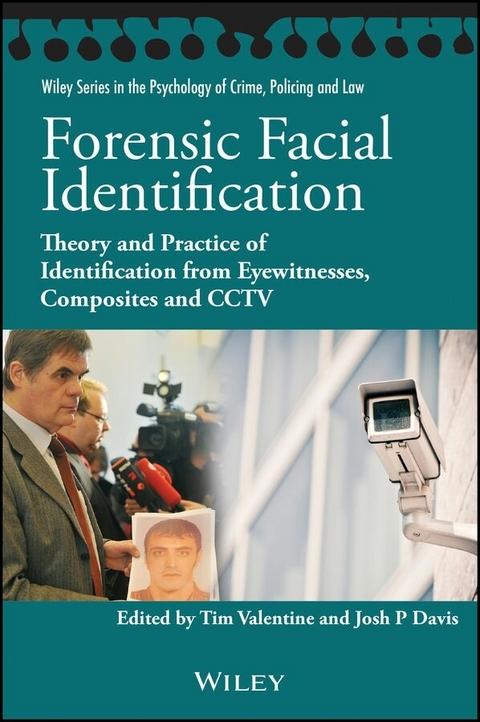
Forensic Facial Identification (eBook)
John Wiley & Sons (Verlag)
978-1-118-46957-6 (ISBN)
Forensic Facial Identification discusses the latest scientific and technical advancements in the field and their implications for practice in psychology, criminology, and law.
- Provides an up-to-date set of best practices for forensic facial identification
- Reviews current procedures for different facial identification methods and their reliability
- Covers eyewitness testimony, line-ups, facial composites, anthropological face reconstructions, CCTV images, and computerized automatic face recognition systems
- Incorporates case studies which put the latest research and technology in the proper legal context
Tim Valentine is Professor of Psychology at Goldsmiths, University of London. He received his PhD from the University of Nottingham and previously held academic posts at the Universities of Manchester and Durham. He is the author of more than 80 journal articles and book chapters on face recognition and eyewitness identification, and is co-editor of The Handbook of Psychology of Investigative Interviewing (Wiley-Blackwell, 2009) and Cognitive and Computational Aspects of Face Recognition (1995), as well as the co-author of The Cognitive Psychology of Proper Names (1996). He has also provided advice to the courts in many prominent criminal cases.
Josh P. Davis is Senior Lecturer in the Psychology and Counseling Department at the University of Greenwich, London. He received his PhD in Psychology from Goldsmiths, University of London. He has published many journal articles and book chapters on topics associated with face recognition and eyewitness identification.
Forensic Facial Identification A broad view of contemporary eyewitness research in both traditional and emerging areas. The international cast of contributors particularly highlights the interplay between law and research across countries with lessons for all. Steven D. Penrod, Distinguished Professor, John Jay College of Criminal Justice At an age where we are relying more than ever on facial identification to ensure public safety, this volume represents an important milestone in ensuring our decisions are informed by the latest developments in technology and science. International experts provide practitioners with an exhaustive review of the tools needed to identify and investigate cases relying on facial identification, be they terror suspects or victims of disaster. What is unique about this book is that experts are encouraged to learn from mistakes made in the past and to equip themselves with theory and science to enable them to best use identification evidence to avoid miscarriages of justice. An outstanding contribution to the field. Amina Memon, Professor of Psychology Royal Holloway, University of London Forensic Facial Identification provides an up-to-date set of best practices for professionals using eyewitness identification to solve crimes of all kinds. The book brings together a prominent group of contributors to discuss the latest scientific and technical advancements and their implications for practice. The contributors review current procedures for various facial identification methods and discuss their use and reliability. The chapters examine traditional forms of eyewitness identification, such as mugshots and line-ups, but also delve into newer technologies, such as facial identification using CCTV images and computerized automatic face recognition systems. Detailed case studies help put the latest research and technology in the proper legal context. Bridging the fields of psychology, criminology, and law, this essential volume, part of the Wiley Series in Crime, Policing and Law, is for those wishing to stay at the cutting-edge of this expanding and changing field.
Tim Valentine is Professor of Psychology at Goldsmiths, University of London. He received his PhD from the University of Nottingham and previously held academic posts at the Universities of Manchester and Durham. He is the author of more than 80 journal articles and book chapters on face recognition and eyewitness identification, and is co-editor of The Handbook of Psychology of Investigative Interviewing (Wiley-Blackwell, 2009) and Cognitive and Computational Aspects of Face Recognition (1995), as well as the co-author of The Cognitive Psychology of Proper Names (1996). He has also provided advice to the courts in many prominent criminal cases. Josh P. Davis is Senior Lecturer in the Psychology and Counseling Department at the University of Greenwich, London. He received his PhD in Psychology from Goldsmiths, University of London. He has published many journal articles and book chapters on topics associated with face recognition and eyewitness identification.
Contributors vii
Foreword by Elizabeth F. Loftus xi
Series Preface xv
Part 1 Introduction 1
1 Identification and Surveillance of Facial Images: Progress and Problems 3
Tim Valentine and Josh P. Davis
Part 2 Searching for Suspects and the Identification of Victims 15
2 Interviewing for Face Identification 17
Fiona Gabbert and Charity Brown
3 Facial Composites and Techniques to Improve Image Recognizability 43
Charlie Frowd
4 Searching for Suspects: Mugshot Files and Showups (Street Identifications) 71
Victoria Z. Lawson and Jennifer E. Dysart
5 Craniofacial Analysis and Identification 93
Caroline Wilkinson
Part 3 Identification by Eyewitnesses 127
6 Lineup Composition and Lineup Fairness 129
Steven E. Clark, Molly B. Moreland, and Ryan A. Rush
7 Estimator Variables and Memory for Faces 159
Hannah Ryder, Harriet Smith, and Heather D. Flowe
8 Confidence and Accuracy of Eyewitness Identification 185
James D. Sauer and Neil Brewer
Part 4 Identification from CCTV Images 209
9 Human Verification of Identity from Photographic Images 211
Josh P. Davis and Tim Valentine
10 Expert Analysis: Facial Image Comparison 239
Gary Edmond, Josh P. Davis, and Tim Valentine
11 Evaluating Automatic Face Recognition Systems with Human Benchmarks 263
Alice O'Toole and P. Jonathon Phillips
Part 5 Implications for Criminal Justice 285
12 Eyewitness Identification and Facial Image Comparison Evidence in Common Law Jurisdictions 287
Andrew Roberts
13 Forensic Facial Identification: A Practical Guide to Best Practice 323
Tim Valentine and Josh P. Davis
Index 000
"A superb edited volume... Forensic Facial Identification should be applauded for its heroic efforts to offer society a true sense of security. Hopefully its messages will be read by many who care about fairness, and how psychological science can help us achieve it." Elizabeth F. Loftus, Distinguished Professor, University of California, Irvine
"A broad view of contemporary eyewitness research in both traditional and emerging areas. The international cast of contributors particularly highlights the interplay between law and research across countries - with lessons for all." Steven D. Penrod, Distinguished Professor, John Jay College of Criminal Justice
"At an age where we are relying more than ever on facial identification to ensure public safety this volume represents an important milestone in ensuring our decisions are informed by the latest developments in technology and science. International experts provide practitioners with an exhaustive review of the tools needed to identify and investigate cases relying on facial identification be they terror suspects or victims of disaster. What is unique about this book is that experts are encouraged to learn from mistakes made in the past and to equip themselves with theory and science to enable them to best use identification evidence to avoid miscarriages of justice. An outstanding contribution to the field." Amina Memon, Professor of Psychology, Royal Holloway University of London
1
Identification and Surveillance of Facial Images: Progress and Problems
Tim Valentine and Josh P. Davis
Eyewitness testimony is older than the law. Even today, with sophisticated forensic science, eyewitness testimony forms the bedrock of many criminal cases. Whenever a witness gives testimony in court, jurors, judge(s) or magistrate(s) are faced with two basic questions: Is this witness giving an honest account? If so, can their account be relied upon as accurate? There are many reasons why a witness may deliberately give false testimony or identify a defendant they know to be innocent. The witness may be seeking revenge, have been intimidated into giving a false account, or be motivated to deflect blame away from the true culprit. Legal procedure is designed to expose a dishonest witness. In an adversarial system, for example in the UK, US, Canada, Australia and New Zealand, the defence have the right to test the testimony of prosecution witnesses through cross-examination. Equally the prosecution cross-examines witnesses for the defence. Cross-examination has been described as “the greatest legal engine ever invented for the discovery of truth”.1 It is intended as a method to expose a dishonest witness, but psychological science shows that cross-examination is ineffective in distinguishing reliable eyewitnesses from those who are honest but mistaken (e.g., Valentine & Maras, 2011; Zajac & Hayne, 2003, 2006).
Case Study
“George Davis is innocent” daubed on walls and bridges was a familiar sight around London in the late 1970s. The graffiti referred to a man convicted for an armed robbery, which targeted a wages delivery at the office of London Electricity Board (LEB), Ilford, on April 4, 1974. Acting on information received, two plain-clothed policemen were watching the building. Two guns were carried by the robbers, and as they made a desperate getaway, one of the policemen at the scene was shot in the leg, and several motorists were hijacked at gunpoint.
At trial in March 1975 the prosecution primarily relied upon identification evidence by the police officers at the scene, and by police and other witnesses at other locations as the robbers switched vehicles during a dramatic car chase. Blood samples, recovered from the scene of a crashed getaway car, did not match any of the defendants. George Davis was the only one of four defendants to be convicted. He was sentenced to 20 years in prison. The conviction was upheld by the Court of Appeal in December 1975.
There was a high-profile campaign against George Davis’ conviction, which involved much graffiti around London. The campaign gained notoriety when the Headingley cricket pitch was dug up during an England v. Australia test match, preventing play from continuing. In May 1976 the Home Secretary took the exceptional step of exercising the Royal Prerogative of Mercy to release Davis without referring the case back to the Court of Appeal. The Home Secretary deemed the conviction to be unsafe because of doubts over the police evidence, but Davis was not held to be innocent.
In 1977, George Davis was caught in the act of an armed robbery on the Bank of Cyprus. He pleaded guilty and was sentenced to 15 years in prison. He was released in 1984 but convicted of armed robbery for a third time in 1987.
George Davis’ conviction for the armed robbery of the LEB wages office was quashed by the Court of Appeal on May 24, 2011 – 37 years after the original conviction. The principal grounds were concerns about the reliability of the identification of Davis from a live identity parade (lineup) by the two police officers who witnessed the robbery. Most notably the prosecution had not disclosed that one officer, PC Grove, had previously identified a different man from police photographs. Prior to the identity parade in which George Davis was identified, the investigating officer had told PC Grove that he had been mistaken in his identification of the photograph. Confidential government papers are normally subjected to a 30-year embargo, after which the papers are held by the Public Record Office. In 2006 the embargo of the papers relating to the Home Secretary’s 1976 decision to free George Davis was extended by 20 years.
Sources:
Davis v R. (2011) EWCA Crim 1258 (24 May 2011). Retrieved from http://www.bailii.org/ew/cases/EWCA/Crim/2011/1258.html
Wikipedia entry for George Davis (robber). Retrieved from http://en.wikipedia.org/wiki/George_Davis_(robber)
Courts have long acknowledged that a mistaken eyewitness may give convincing identification evidence. The extraordinary case of Adolf Beck, twice wrongly convicted on the basis of mistaken eyewitness identification, described in the case study in Chapter 6, resulted in the Criminal Appeal Act (1907) which established the Court of Criminal Appeal in London (Bogan & Roberts, 2011). Widespread concern about the reliability of eyewitness identification evidence in a number of English cases during the 1970s led the British government to set up an enquiry into eyewitness identification evidence (Devlin, 1976; see case study). Despite legal reforms in the UK since the 1970s, studies of police identification procedures have shown that a third of all identifications from live parades (Valentine, Pickering, & Darling, 2003; Wright & McDaid, 1996) and 40% of all positive identifications from video lineups are known to be mistaken, as the witness selected an innocent volunteer foil or filler (Horry, Memon, Wright, & Milne, 2012). The Innocence Project (2013) in New York has produced incontrovertible evidence of the devastating impact of mistaken eyewitness identification in the US. Over the last 20 years more than 300 prisoners have been exonerated by DNA evidence that proved they were actually innocent of the crimes of which they were convicted. The crimes were serious, mostly rape and murder, because physical evidence from which a DNA profile can be obtained is most likely to be available and collected in serious violent crimes. Mistaken eyewitness identification was the leading cause of wrongful conviction, and occurred in nearly 75% of cases.
In addition to the strong evidence of the high risk of mistaken eyewitness identification, research also demonstrates that approximately 40% of witnesses fail to identify anyone from a lineup. In many cases the witness may not have an adequate memory of the culprit. It may be that in an unknown proportion of these cases, the culprit was not included and the witness was making the correct decision. However, justice is served by developing procedures that both reduce the likelihood of an innocent suspect being identified, and enhance the likelihood that the actual perpetrator will be identified. Identification failures may leave a guilty suspect free to offend again.
The problem of distinguishing accurate from inaccurate identification is at the heart of Forensic Facial Identification. In the chapters that follow, distinguished scholars grapple with the problems of identification of suspects by eyewitnesses, from CCTV imagery, and identification of deceased victims from reconstructions of their facial appearance in life.
In many criminal investigations, the first problem the police may face is to identify a suspect. This issue is addressed in Part 2. If an eyewitness is available, the first step will be to interview the witness and in the course of that interview obtain a description of the offender. In Chapter 2 Fiona Gabbert and Charity Brown evaluate the relationship between the completeness and accuracy of a witness’ description of the perpetrator and the likelihood that a subsequent identification from a lineup will be accurate. This is a difficult issue for the psychology of eyewitness identification because research findings are contradictory. Most researchers accept that, contrary to common-sense expectations, there is little relationship between the quality of a witness’ verbal description of the perpetrator and their identification accuracy. On balance, laboratory research shows that a witness who gives a detailed description is no more likely to be able to identify the offender than a witness who can provide only a brief description. From their analysis of the literature Gabbert and Brown show that it is the inclusion of incorrect details in a verbal description that adversely affects identification accuracy. Therefore interview procedures that produce detailed descriptions by encouraging witnesses to provide details of which they are unsure are likely to impair eyewitness memory for the perpetrator and may increase the risk of a mistaken identification. Informed by this analysis, Gabbert and Brown provide practical advice for the employment of appropriate procedures most likely to obtain accurate descriptions from witnesses. These guidelines should help to safeguard the quality of any subsequent eyewitness identification.
Having obtained a description of the offender(s), in the absence of other evidence, the police may ask a witness to create a facial composite or likeness from memory. The image can then be publicized in the hope that somebody will recognize it as an individual they know and will provide a name to the police. In Chapter 3, Charlie Frowd reviews the development of techniques and methods used to construct facial composite images. This field has shown remarkable development in recent years. In 2007 the best recognized images were facial sketches produced by skilled police artists,...
| Erscheint lt. Verlag | 10.4.2015 |
|---|---|
| Reihe/Serie | Wiley Series in Psychology of Crime, Policing and Law | Wiley Series in The Psychology of Crime, Policing and Law |
| Sprache | englisch |
| Themenwelt | Geisteswissenschaften ► Psychologie |
| Recht / Steuern ► Allgemeines / Lexika | |
| Recht / Steuern ► EU / Internationales Recht | |
| Recht / Steuern ► Strafrecht ► Kriminologie | |
| Sozialwissenschaften | |
| Schlagworte | Criminology • Eyewitness testimony, CCTV images, police lineups, mug shots, facial composites, computerized automatic face recognition systems, juror error, wrongful conviction, facial mapping, DNA exoneration, facial reconstruction, suspect identification • Forensic Psychology • Forensische Psychologie • Gesichtserkennung • Kriminologie • Law • Psychologie • Psychology • Rechtswissenschaft |
| ISBN-10 | 1-118-46957-7 / 1118469577 |
| ISBN-13 | 978-1-118-46957-6 / 9781118469576 |
| Informationen gemäß Produktsicherheitsverordnung (GPSR) | |
| Haben Sie eine Frage zum Produkt? |
 EPUB (Adobe DRM)
Kopierschutz: Adobe-DRM
Adobe-DRM ist ein Kopierschutz, der das eBook vor Mißbrauch schützen soll. Dabei wird das eBook bereits beim Download auf Ihre persönliche Adobe-ID autorisiert. Lesen können Sie das eBook dann nur auf den Geräten, welche ebenfalls auf Ihre Adobe-ID registriert sind.
Details zum Adobe-DRM
Dateiformat: EPUB (Electronic Publication)
EPUB ist ein offener Standard für eBooks und eignet sich besonders zur Darstellung von Belletristik und Sachbüchern. Der Fließtext wird dynamisch an die Display- und Schriftgröße angepasst. Auch für mobile Lesegeräte ist EPUB daher gut geeignet.
Systemvoraussetzungen:
PC/Mac: Mit einem PC oder Mac können Sie dieses eBook lesen. Sie benötigen eine
eReader: Dieses eBook kann mit (fast) allen eBook-Readern gelesen werden. Mit dem amazon-Kindle ist es aber nicht kompatibel.
Smartphone/Tablet: Egal ob Apple oder Android, dieses eBook können Sie lesen. Sie benötigen eine
Geräteliste und zusätzliche Hinweise
Buying eBooks from abroad
For tax law reasons we can sell eBooks just within Germany and Switzerland. Regrettably we cannot fulfill eBook-orders from other countries.
aus dem Bereich