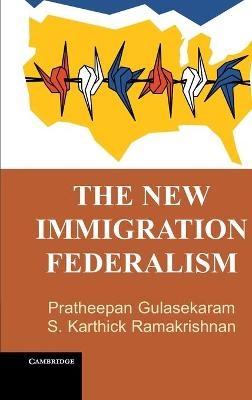
The New Immigration Federalism
Cambridge University Press (Verlag)
978-1-107-11196-7 (ISBN)
Since 2004, the United States has seen a flurry of state and local laws dealing with unauthorized immigrants. Though initially restrictionist, these laws have recently undergone a dramatic shift toward promoting integration. How are we to make sense of this new immigration federalism? What are its causes? And what are its consequences for the federal-state balance of power? In The New Immigration Federalism, Professors Pratheepan Gulasekaram and S. Karthick Ramakrishnan provide answers to these questions using a mix of quantitative, historical, and doctrinal legal analysis. In so doing they refute the popular 'demographic necessity' argument put forward by anti-immigrant activists and politicians. Instead, they posit that immigration federalism is rooted in a political process that connects both federal and subfederal actors: the Polarized Change Model. Their model captures not only the spread of restrictionist legislation but also its abrupt turnaround in 2012, projecting valuable insights for the future.
Pratheepan Gulasekaram is Associate Professor at Santa Clara University School of Law. He has published widely on immigration federalism and the constitutional rights of noncitizens both in popular media platforms and prominent legal journals including the New York University Law Review. Before entering academia, Gulasekaram clerked for the US Circuit Court of Appeals for the Fifth Circuit in New Orleans. He earned his BA at Brown University and his JD at Stanford Law School. S. Karthick Ramakrishnan is Professor of Political Science and Associate Dean of the School of Public Policy at the University of California, Riverside. He directs the National Asian American Survey and has written numerous books and articles on civic participation and immigration policy. Ramakrishnan is founding editor of the Journal of Race, Ethnicity, and Politics (JREP) and is an appointee to the California Commission on Asian and Pacific Islander American Affairs. He earned his BA at Brown University and his PhD at Princeton University.
1. Introduction; 2. Setting the stage for the new immigration federalism; 3. Rise of restrictive legislation and demographic arguments of 'vital necessity'; 4. A political theory of immigration federalism: the polarized change model and restrictive issue entrepreneurs; 5. A shifting tide in 2012: pro-integration activists gain the upper hand; 6. Implications for legal theory on federalism and immigration law; 7. Immigration federalism is here to stay; Appendix A: statistical analysis of restrictive local ordinances; Appendix B: statistical analysis of restrictive state laws; Appendix C: statistical analysis of state immigrant integration laws.
| Zusatzinfo | 11 Tables, unspecified; 2 Halftones, unspecified; 2 Line drawings, unspecified |
|---|---|
| Verlagsort | Cambridge |
| Sprache | englisch |
| Maße | 157 x 235 mm |
| Gewicht | 540 g |
| Themenwelt | Recht / Steuern ► EU / Internationales Recht |
| Recht / Steuern ► Öffentliches Recht ► Besonderes Verwaltungsrecht | |
| ISBN-10 | 1-107-11196-X / 110711196X |
| ISBN-13 | 978-1-107-11196-7 / 9781107111967 |
| Zustand | Neuware |
| Informationen gemäß Produktsicherheitsverordnung (GPSR) | |
| Haben Sie eine Frage zum Produkt? |
aus dem Bereich