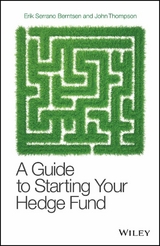
A Guide to Starting Your Hedge Fund (eBook)
John Wiley & Sons (Verlag)
978-1-119-06489-3 (ISBN)
Successful hedge fund investing begins with well-informed strategy
A Guide to Starting Your Hedge Fund is a practical, definitive 'how-to' guide, designed to help managers design and launch their own funds, and to help investors select and diligence new funds. The first book to examine the practical aspects of setting up and operating funds with a focus on energy commodity markets, this book scrutinises the due diligence process and comprehensively reviews the opportunities and risks of all energy commodity markets as hedge fund investments. Extensive planning and strategy advice prove invaluable to prospective fund managers and investors alike, and detailed discussion of the markets' constraints help inform procedural decisions. Readers gain insight into practical matters including legal and commercial structures, due diligence, fund raising, operations, and more, allowing them to construct a concrete investment plan before ever touching a penny.
Asset managers are looking to energy commodities to provide attractive uncorrelated – if volatile – returns. These high returns, however, are accompanied by high risk. Few investors have experience evaluating these investment opportunities, and few prospective fund managers understand the market fundamentals and their associated risks. This book provides the answers sorely lacking in hedge fund literature, giving investors and fund managers the background they need to make smarter decisions.
- Understand the markets' structures, opportunities, and risks
- Develop a comprehensive, well-informed investment strategy
- Conduct thorough due diligence with a detailed plan
- Examine the practical aspects of fund raising, legal and tax structure, and more
Oil has long been traded by hedge funds, but electricity, the fuels that generate electricity, and the environmental products like emissions allowances and weather derivatives have become the new 'hot' investment strategies. These high returns come with higher risk, but A Guide to Starting Your Hedge Fund ensures participants have essential information at their disposal.
Erik Serrano Berntsen is CEO of Stable Asset Management. Prior to Stable, he was a Consultant with Bain & Co., where he consulted on private equity deal studies as well as a broad spectrum of corporate engagements. During his time at Bain he was also an advisor to the Prince's Trust, including advising on the UK-wide Volunteer Strategy initiative. Erik holds a Bachelor of Arts in Politics, Philosophy and Economics from Keble College, University of Oxford, and a Masters of Business Administration with honours and a Concentration in Finance from the University of Chicago Booth School of Business.
John Thompson is Principal of Stable Asset Management. Prior to Stable, he was a senior executive of Enron Europe. He has held regulatory affairs and market operations management roles with Wintershall (BASF) and was regional financial coordinator for Milestone Petroleum (Burlington Resources). John began his energy career in the oil and gas fields of the Rocky Mountains and later as a well-site mud-logging engineer. John has held several Directorships, including Member of the Supervisory Board of the European Energy Exchange (EEX). John also holds a Masters of Business Administration from the University of Chicago Booth School of Business.
Stable Asset Management is a hedge fund seeding firm that backs top trading talent globally to build institutional quality asset management firms.
Successful hedge fund investing begins with well-informed strategy A Guide to Starting Your Hedge Fund is a practical, definitive "e;how-to"e; guide, designed to help managers design and launch their own funds, and to help investors select and diligence new funds. The first book to examine the practical aspects of setting up and operating funds with a focus on energy commodity markets, this book scrutinises the due diligence process and comprehensively reviews the opportunities and risks of all energy commodity markets as hedge fund investments. Extensive planning and strategy advice prove invaluable to prospective fund managers and investors alike, and detailed discussion of the markets' constraints help inform procedural decisions. Readers gain insight into practical matters including legal and commercial structures, due diligence, fund raising, operations, and more, allowing them to construct a concrete investment plan before ever touching a penny. Asset managers are looking to energy commodities to provide attractive uncorrelated if volatile returns. These high returns, however, are accompanied by high risk. Few investors have experience evaluating these investment opportunities, and few prospective fund managers understand the market fundamentals and their associated risks. This book provides the answers sorely lacking in hedge fund literature, giving investors and fund managers the background they need to make smarter decisions. Understand the markets' structures, opportunities, and risks Develop a comprehensive, well-informed investment strategy Conduct thorough due diligence with a detailed plan Examine the practical aspects of fund raising, legal and tax structure, and more Oil has long been traded by hedge funds, but electricity, the fuels that generate electricity, and the environmental products like emissions allowances and weather derivatives have become the new "e;hot"e; investment strategies. These high returns come with higher risk, but A Guide to Starting Your Hedge Fund ensures participants have essential information at their disposal.
Erik Serrano Berntsen is CEO of Stable Asset Management. Prior to Stable, he was a Consultant with Bain & Co., where he consulted on private equity deal studies as well as a broad spectrum of corporate engagements. During his time at Bain he was also an advisor to the Prince's Trust, including advising on the UK-wide Volunteer Strategy initiative. Erik holds a Bachelor of Arts in Politics, Philosophy and Economics from Keble College, University of Oxford, and a Masters of Business Administration with honours and a Concentration in Finance from the University of Chicago Booth School of Business. John Thompson is Principal of Stable Asset Management. Prior to Stable, he was a senior executive of Enron Europe. He has held regulatory affairs and market operations management roles with Wintershall (BASF) and was regional financial coordinator for Milestone Petroleum (Burlington Resources). John began his energy career in the oil and gas fields of the Rocky Mountains and later as a well-site mud-logging engineer. John has held several Directorships, including Member of the Supervisory Board of the European Energy Exchange (EEX). John also holds a Masters of Business Administration from the University of Chicago Booth School of Business. Stable Asset Management is a hedge fund seeding firm that backs top trading talent globally to build institutional quality asset management firms.
Acknowledgements ix
Part I Why This Book? 1
Chapter 1 Introduction 3
Why This Book? 3
The Big Picture and Energy Commodities 4
Case Study: Amaranth Advisors 5
Layout 6
The Beginning 7
Bibliography 7
Part II the Basics 9
Chapter 2 What Is a Hedge Fund? 11
I Already Know What a Hedge Fund Is 11
A Little Bit of History 12
So What Is a Hedge Fund? 13
Hedge Funds (Un)Defined 16
The Growth of the Hedge Fund Industry 18
Hedge Fund + Commodities = Commodities Corporation 19
Whither Energy and Commodity Hedge Funds? 20
Moving Forward 20
Bibliography 21
Chapter 3 What Are Energy Commodities? 23
Introduction 23
What Are Energy Commodities? 23
The Regionality of Electricity 25
Why Are Energy Commodities Attractive for Investors? 27
A Complex, Solvable Problem 30
Drivers of Complexity 31
Conditions for Solvability 36
Principal Sources of Opportunity and Risk 39
Bibliography 46
Chapter 4 Trading and Investing in Energy Commodities 47
Bottom-up and Top-down 48
Trading + Managing a Business = Successful Hedge Fund 49
The Edge? 50
Trading Energy Commodities 52
Basic Financial Knowledge for Commodities 55
Conclusion 56
Bibliography 59
Part III Starting the Journey 61
Chapter 5 The Business Plan: Implications and Applications 63
Introduction 63
Objectives and Uses of a Hedge Fund Business Plan 64
Conclusion 71
Bibliography 72
Chapter 6 Laws, Contracts, and Lawyers 73
Don't Kill Your Lawyer 73
Legal Basics for Funds 74
Master-Feeder Fund Structures 77
Side-Pocket Structures 81
The Firm 84
The Investment Advisory Agreement 86
Contents vii
Attributes and Variations of the Investment Management Enterprise 87
Structural Design Decisions 88
Case Study: Complex Tax Structuring 98
Be Nice To Your Lawyer 103
Bibliography 104
Chapter 7 Service Providers 105
Introduction 105
Long-Term Relationship: Service Providers and Marriage 106
Service Providers: Who and Where? 107
Negotiate, Negotiate, Negotiate 108
Service? 110
How to Choose? 112
Final Thoughts 113
Bibliography 113
Part IV Running the Business 115
Chapter 8 Fundraising 117
Strategic Investor Portfolio Design 118
Start-up Lifecycle Analysis and Investor Portfolio Development 127
Investor Acquisition - Marketing 130
Tools for Marketing and Key Marketing Documents 140
Marketing Documentation 143
Investor Maintenance - Investor Relations 152
Chapter 9 Operations and Infrastructure 155
Introduction 155
Infrastructure and Technology 158
Bibliography 160
Part V Final Thoughts 161
Chapter 10 Investing in Energy Commodity Hedge Funds 163
Asset Allocation: Portfolio Building Basics 163
Asset Allocation: Understanding Different Strategies 167
Checklist for Investing in Energy Commodity Hedge Funds 170
Bibliography 171
Chapter 11 Quo Vadis 173
Bibliography 179
Appendix A Sample Business Plan Outline 181
Appendix B Outline of a Confidential Explanatory Memorandum: Sample Offshore Feeder Ltd 183
Appendix C Sample Due Diligence Questionnaire Outline 189
Index 195
Chapter 1
Introduction
Beginning is half the journey.
Traditional Korean proverb
Why This Book?
When we launched our first hedge fund in 2006 we needed guidance. As a firm we had over three decades of experience in all facets of the energy industry as well as a background in management consulting and private equity. This rooted our approach in developing detailed business strategies and understanding the best practices for both young and mature businesses. What we did not have was an understanding of what it took to start and manage a hedge fund, especially a hedge fund focused on investing in energy and related commodities markets. As we looked for resources to help us fill our knowledge gap, we realized there was nothing out there.
Since those early days we have partnered with some of the best commodity traders and commodity investors to launch institutional quality asset managers. It has been a fascinating journey filled with a rollercoaster of events as varied as the 2008 Global Financial Crisis (GFC), the Bernard Madoff scandal, a day when we thought our investment bank clearers would go under, the end of Swiss banking secrecy, a deluge of new regulations, the exit of most banks from commodity trading, and a bunch of fantastic colleagues. We have also been blessed with great investors who we feel privileged to serve. Of course, along the way we have learned many lessons. Though some of these lessons came from success (or perhaps more accurately, serendipity), the majority of the lessons we have learned were the result of mistakes we made along the way.
As we reflected back on those days of perusing bookshelves for books to help us with launching our first hedge fund, we thought it might be worthwhile to distil some of the lessons that we had learned over the years and record them. We wanted to create the book that we wished we had when we started down this path.
It was a great idea. Unfortunately, like many projects of any worth, it took much longer than we had anticipated. Thankfully, after many years, we are grateful that we can finally present this book to you.
We do not pretend that this book is exhaustive. That said, we feel it will be a useful reference tool for hedge fund practitioners. Specifically both energy commodity hedge fund managers as well as investors in such hedge funds should find it particularly useful. At least that is our hope.
The Big Picture and Energy Commodities
The amount of capital invested in hedge funds is approaching USD 3 trillion. To put that in context, the amount of capital invested in hedge funds is greater than the individual nominal 2012 GDP of France (USD 2.6 trillion), the UK (USD 2.5 trillion), and Russia (USD 2 trillion). Even the combined nominal 2012 GDP of countries like Australia (USD 1.5 trillion) and South Korea (USD 1.1. trillion) does not equal the amount of capital invested in hedge funds. In fact, the USA, China, Japan, and Germany are the only countries that on an individual basis have a nominal 2012 GDP that surpasses the amount of capital invested in hedge funds. It is anticipated that more capital will flow to hedge funds, with total hedge fund assets under management to nearly double and hit USD 6 trillion by 2018.1
Undoubtedly, it is an interesting time to be involved in the alternative investments industry. From the end of World War II until the present day, we have seen the growth and institutionalization of corporate and national pensions, endowments, foundations, family offices, and other similar entities responsible for directing much of the approximately USD 3 trillion that is invested in hedge funds.
With the spectre of underfunded pension liabilities looming over many developed economies, alternative investments have emerged as a preferred asset class to help generate attractive, risk-adjusted returns that ideally have minimal correlation to traditional asset classes. Indeed, for many large pensions and other large pools of capital that are under liabilities pressure, ‘alternative investments’ have become an increasingly important part of portfolio construction.
Within this milieu, many investors in alternatives are looking to commodities and especially energy commodities to provide attractive, uncorrelated – if sometimes volatile – returns that form one component of a larger, diversified portfolio that likely includes both traditional and alternative investments. Oil has long been traded by hedge funds and other speculative capital pools. Electricity, the fuels for generating electricity, and so-called environmental products such as emissions credits and weather derivatives have become high-profile investment strategies offering the promise of potentially high uncorrelated returns.
These high returns, however, are accompanied by volatility and risk. Additionally, few investors have experience in evaluating these investment opportunities and few prospective hedge fund managers understand the market fundamentals and their associated risks. Many financial institutions and service providers have only begun to dedicate financial and intellectual capital to these rapidly growing investment strategies.
Case Study: Amaranth Advisors
For better or worse, the hedge fund that has become virtually synonymous with the volatility and risk related to energy commodities investing is Amaranth Advisors (‘Amaranth’). Amaranth's spectacular demise in 2006, however, belied its more modest beginnings as a multi-strategy hedge fund launched in Greenwich, CT, in 2000 that was focused on convertible arbitrage opportunities. As convertible arbitrage opportunities and related profits began declining, Amaranth transitioned to an investment strategy that focused on energy commodities. Eventually, energy investing accounted for approximately 80% of Amaranth's profits, with its main fund growing to over USD 9 billion dollars by August 2006. Unfortunately, that would be the peak of Amaranth's success.
In 2004, about two years before its implosion, Amaranth hired a natural gas trader named Brian Hunter. Hunter had worked as a natural gas futures trader for both a pipeline company and then for Deutsche Bank before joining Amaranth. In 2005, Hunter was so instrumental in helping generate USD 1 billion of profits for Amaranth that it was expected his bonus might be as high as USD 100 million. Hunter's natural gas trading strategy focused on spread trades using natural gas futures. In this strategy, traders enter into long and short positions in the same underlying and benefit from the difference in pricing over time, or the spread. In addition to natural gas futures, Hunter overlaid call and put options on the underlying natural gas future contracts as well as natural gas swap contracts that enhanced his core spread trade strategy using natural gas futures.
In early 2006, Hunter continued his spread trading strategy by buying natural gas futures contracts, options, and swaps for winter delivery, shorting non-winter-month gas futures, and entering similar positions via options and swaps. The maturity of these contracts ranged from 2006 until 2010. This strategy served Hunter and Amaranth well through the spring of 2006, when Amaranth's energy investments were up approximately USD 2 billion by April. In May, the long-dated natural gas future positions entered a period of volatility, although trouble was not immediately apparent.
After peaking at over USD 9 billion in August, Amaranth's main fund experienced a significant drawdown in September 2006 as the natural gas positions Hunter had taken started moving against him. By the middle of September, the fund had experienced a 50% drawdown and had a single day loss in September of USD 560 million. As the fund had difficulties meeting the ever-increasing size of margin calls, eventually market participants purchased large stakes of Amaranth's natural gas positions. The natural gas markets eventually stabilized towards the end of September 2006. Unfortunately, Amaranth's loss led to the closing of its doors and Amaranth and Hunter have been involved in a variety of regulatory investigations and legal actions since then. Amaranth, named after a flower meaning ‘unfading’ or ‘eternal’ in Greek, appears as though it will live up to its namesake, albeit for the wrong reasons.
Layout
With the hope of helping you launch a fund or invest in an energy commodities hedge fund that becomes an institutional quality asset manager and not another Amaranth, we have organized this book in a way that we think will allow it to be used as a reference guide as different issues or topics arise. Beyond this Introduction, comprising Part I, the book has four further parts and a series of appendices.
Part II provides the basics and background of hedge funds, energy commodities, and trading energy commodities. Part III delves into the key areas of starting a hedge fund with the focus on a sound business plan, the legal requirements of starting a hedge fund, and working with service providers such as prime brokers and administrators. Part IV focuses on the nuts and bolts of running an investment management firm by exploring topics of fundraising and operations. Part V concludes with points that hedge fund investors should consider when adding an energy commodity hedge fund to their portfolio, as well as thoughts we have had on the future of energy commodity hedge funds. The appendices include outlines of a sample business plan, an...
| Erscheint lt. Verlag | 3.3.2015 |
|---|---|
| Sprache | englisch |
| Themenwelt | Recht / Steuern ► Wirtschaftsrecht |
| Wirtschaft ► Betriebswirtschaft / Management ► Finanzierung | |
| Schlagworte | Energy Alpha Strategies, Ltd. • energy commodities due diligence • energy commodities investing • energy commodities markets • energy commodity markets characteristics • energy hedging • Enron • Erik Serrano Berntsen • Finance & Investments • Financial Engineering • Finanztechnik • Finanz- u. Anlagewesen • Finanzwesen • hedge fund design • hedge fund guide • hedge fund legal structure • hedge fund management • Hedge Funds • Hedge Fund Strategy • Investments & Securities • John P. Thompson • Kapitalanlagen u. Wertpapiere • starting a hedge fund • The Handbook of Energy Commodity Hedge Funds: A Practitioner's Guide to Starting Your Fund |
| ISBN-10 | 1-119-06489-9 / 1119064899 |
| ISBN-13 | 978-1-119-06489-3 / 9781119064893 |
| Informationen gemäß Produktsicherheitsverordnung (GPSR) | |
| Haben Sie eine Frage zum Produkt? |
 EPUB (Adobe DRM)
Kopierschutz: Adobe-DRM
Adobe-DRM ist ein Kopierschutz, der das eBook vor Mißbrauch schützen soll. Dabei wird das eBook bereits beim Download auf Ihre persönliche Adobe-ID autorisiert. Lesen können Sie das eBook dann nur auf den Geräten, welche ebenfalls auf Ihre Adobe-ID registriert sind.
Details zum Adobe-DRM
Dateiformat: EPUB (Electronic Publication)
EPUB ist ein offener Standard für eBooks und eignet sich besonders zur Darstellung von Belletristik und Sachbüchern. Der Fließtext wird dynamisch an die Display- und Schriftgröße angepasst. Auch für mobile Lesegeräte ist EPUB daher gut geeignet.
Systemvoraussetzungen:
PC/Mac: Mit einem PC oder Mac können Sie dieses eBook lesen. Sie benötigen eine
eReader: Dieses eBook kann mit (fast) allen eBook-Readern gelesen werden. Mit dem amazon-Kindle ist es aber nicht kompatibel.
Smartphone/Tablet: Egal ob Apple oder Android, dieses eBook können Sie lesen. Sie benötigen eine
Geräteliste und zusätzliche Hinweise
Buying eBooks from abroad
For tax law reasons we can sell eBooks just within Germany and Switzerland. Regrettably we cannot fulfill eBook-orders from other countries.
aus dem Bereich