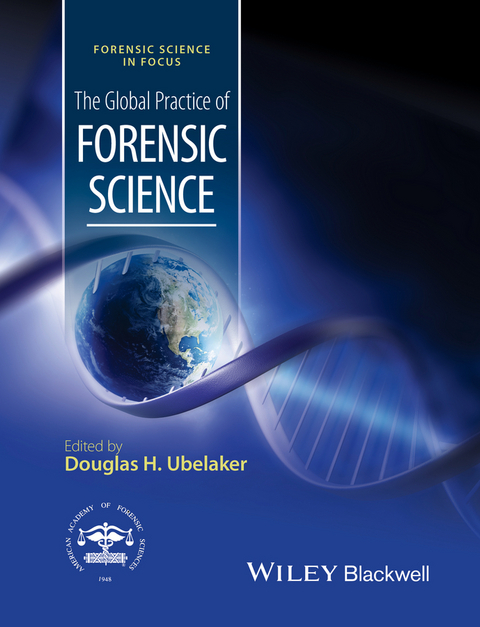
The Global Practice of Forensic Science (eBook)
John Wiley & Sons (Verlag)
978-1-118-72422-4 (ISBN)
Douglas H. Ubelaker is Senior Scientist specializing inforensic anthropology at the Smithsonian Institution in WashingtonD.C. He served as the 2011-2012 President of the AmericanAcademy of Forensic Sciences and has published extensively in thegeneral field of human skeletal biology with an emphasis onforensic applications.
The Global Practice of Forensic Science presents histories, issues, patterns, and diversity in the applications of international forensic science. Written by 64 experienced and internationally recognized forensic scientists, the volume documents the practice of forensic science in 28 countries from Africa, the Americas, Asia, Australia and Europe. Each country s chapter explores factors of political history, academic linkages, the influence of individual cases, facility development, types of cases examined, integration within forensic science, recruitment, training, funding, certification, accreditation, quality control, technology, disaster preparedness, legal issues, research and future directions. Aimed at all scholars interested in international forensic science, the volume provides detail on the diverse fields within forensic science and their applications around the world.
Douglas H. Ubelaker is Senior Scientist specializing in forensic anthropology at the Smithsonian Institution in Washington D.C. He served as the 2011-2012 President of the American Academy of Forensic Sciences and has published extensively in the general field of human skeletal biology with an emphasis on forensic applications.
About the editor vii
List of contributors ix
Foreword by Daniel A. Martell xxvii
Series preface xxix
1 Introduction 1
Douglas H. Ubelaker
2 The practice of forensic sciences in Argentina 5
Luis Fondebrider & Luis Bosio
3 Australia 13
Stephen Cordner & Alastair Ross
4 Forensic sciences in Canada 29
Anny Sauvageau & Graham R. Jones
5 The Chilean Forensic Medical Service 39
Patricio Bustos Streeter & Marisol Intriago Leiva
6 Forensic science in Colombia 49
Andres Rodríguez Zorro & Aída Elena
Constantín
7 Forensic science in Denmark 67
Niels Lynnerup & Steen Holger Hansen
8 The practice of forensic science in Egypt: a story of
pioneering 73
Dina A. Shokry
9 The practice of forensic science in Estonia 83
Marika Väli, Üllar Lanno & Ivar Prits
10 History and current status of forensic science and medicine
in Finland 95
Erkki Sippola & Pekka Saukko
11 Forensic medicine in France 105
Bertrand Ludes
12 Forensic medicine in Germany 115
W. Eisenmenger & O. Peschel
13 Forensic science in Hong Kong 121
Sheilah Hamilton & Philip Beh
14 The practice of forensic science in Hungary 135
Eva Keller Peter Sótonyi & Agnes Dósa
15 Forensic science in India 147
P.K. Chattopadhyay
16 Forensic sciences in Italy 155
Cristina Cattaneo Antonio Grande & Luigi Ripani
17 History and current status of forensic science in Japan
173
Hitoshi Maeda Takaki Ishikawa & Toshikazu Kondo
18 Forensic science in Korea 189
Heesun Chung Soong Deok Lee & Sikeun Lim
19 Forensic medicine in Libya 195
Fawzi Benomran
20 The practice of forensic science in Mexico 199
Mario Alva-Rodríguez & Rolando Neri-Vela
21 The Netherlands 217
Arian van Asten Wim Neuteboom Sijtze Wiersma & Zeno
Geradts
22 History and current status of forensic science in Singapore
231
George Paul & Paul Chui
23 The history and current status of forensic science in South
Africa 241
Herman Bernitz Michael Kenyhercz Burgert Kloppers Ericka
Nöelle L'Abbé Gérard Nicholas Labuschagne
Antonel Olckers Jolandie Myburgh Gert Saayman Maryna Steyn &
Kyra Stull
24 Forensic science practice in Spain 261
Angel Carracedo & Luis Concheiro
25 Legal medicine and forensic science in Switzerland 267
Patrice Mangin & Pierre Margot
26 Forensic medicine and sciences in Turkey 279
Mete Korkut Gulmen & Cengiz Haluk Ince
27 Forensic medicine in the United Arab Emirates 289
Fawzi Benomran
28 Forensic science practice in the United States 301
Joseph Peterson & Matthew Hickman
29 Legal medicine and forensic science in Uruguay 335
Hugo Rodríguez Almada
30 Conclusions: global common themes and variations 351
Douglas H. Ubelaker
Index 361
List of contributors
Hugo Rodríguez Almada MD is the Director of the Legal Medicine Department (School of Medicine in the University of the Republic, in Montevideo city, Uruguay). He has worked since 1993 in Legal Medicine as a forensic doctor, professor and researcher. He is currently employed by the public University of Uruguay and is head of the Department of Legal Medicine, where Uruguayan experts in forensic medicine are educated and trained. Dr Rodríguez Almada has also been a visiting professor of other Latin American universities and has been Adjunct Director of the virtual Master in Forensic Medicine of the University of Valencia, Spain, since 2002. He has published several scientific papers and books on various topics of forensic sciences, especially in the field he calls “Legal Medicine of women and children”. Much of his research is focused on sudden unexpected infant death. He has also served broadly as an editor or scientific adviser of several local and international journals and has been a member of their editorial boards or a peer reviewer. He is currently the editor in chief of the Uruguayan Medical Journal (RMU), the most widely spread biomedical journal in his country. Although he is not presently employed in the judicial system he is continually participating actively in several complex forensic investigations when requested by prosecutors or judges. Many of these cases are related to violations of human rights in the recent past committed during the civic–military dictatorship (1973–1985), some serial murders and several cases of medical malpractice. He is an honorary adviser of the National Institution of Human Rights and Uruguayan Ombudsman. He has been a representative of Uruguay in the Iberoamerican Network of Legal Medicine and Forensic Science Institutions since its beginnings in 2007. He has held several positions in national and international medical institutions. In 2000 he founded the Iberoamerican Society of Medical Law (SIDEME). In 2003, he was elected President of the Latin American and Caribbean Medical Confederation (CONFEMEL). More recently, he was elected by his colleagues as a member of the first Ethics Tribunal of the Medical Association of Uruguay (CMU), created by law in 2009.
Mario Alva-Rodríguez obtained his MD from the Military Medical School of Mexico and was a Postgraduate in Human Morphology at the Anatomical Institute in Münster, Westphalia, Germany. He has been Chief of the Department of Anatomy at the Military Medical School, Chief of the Department of Anatomy at the School of Medicine of the Anahuac University, General Subdirector of the Medical Services of Mexico City, Director of the El Rosario General Hospital in Mexico City, Subdirector of the Medical Military School, Chief of the Criminalistics Laboratory of the Attorney General Office in Mexico City, Subdirector of the Postgraduate Military Medical School, Founder and Chief of the Mastership in Forensic Medicine at the Postgraduate Military Medical School, Director of the School of Medicine at the Anahuac University, Chief of Forensic Medicine at the Attorney General Office of the Mexican Republic, General Director of the Medical Examiner Office of Mexico City, Founder and Chief of the Specialty in Forensic Medicine at the Medical Examiner Office of Mexico City, General Director of the Forensic Sciences Department at the Attorney General Office of the Mexican Republic, Director of Behavior Promotion at the National Institute of Drugs Enforcement, Coordinator of Criminalistics and Forensic Medicine at the National Institute of Penal Sciences, Director of the Educational Department at the National Institute of Penal Sciences, Coordinator of the Academic Committee of Legal Medicine at the Postgraduate Division of the Medicine Faculty of the National Autonomous University of Mexico and a Fellow of the Mexican Society of Criminology, Mexican Academy of Penal Sciences, Mexican Academy of Surgery, Mexican Academy of Bioethics, Mexican Council of Legal and Forensic Medicine, and the American Academy of Forensic Sciences.He participated in many Courses, Congresses and Symposia as org- anizer, teacher, lecturer or adviser for undergraduate and postgraduate personnel of medicine, law, criminalistics and police. He had a number of articles and books published: Basic Forensic Medicine, Atlas of Forensic Medicine and Compendium of Forensic Medicine.
Philip Beh MD graduated from the Faculty of Medicine at the University of Hong Kong in 1981. He has worked in the area of forensic medicine ever since. He is currently a Clinical Associate Professor at the Department of Pathology, the University of Hong Kong. He works with many professional bodies including the ICRC and UNODC. He is an Honorary Advisor to Rain-Lily, Hong Kong's first multidisciplinary rape crisis center. He is also a member of the Editorial Board on several international forensic medical journals. He was Vice-President of the International Association of Forensic Sciences (2002–2005) and President of World Police Medical Officers (2005–2008).
Fawzi Benomran MB ChB, DCH, MSc, MD is the director of Forensic Medicine and Senior Forensic Consultant at the Department of Forensic Medicine in Dubai Police General Headquarters in Dubai, UAE, where he has been employed for the past 16 years. His experience in Forensic Medicine and Forensic Pathology goes back to 1980 when he started his training in the Department of Forensic Medicine in Glasgow University. After he had finished his training in Glasgow, he returned to his home country, Libya, where he worked in Benghazi from 1983 to 1997. In August 1997 he joined the Dubai Police and started to develop the department in a progressive manner. He also has extensive teaching experience though teaching medical students as well as lawyers and policemen from 1983 till now. During his time in Libya, and in addition to his job with the Justice Department, he held the post of Head of the Department of Forensic Medicine and Toxicology and an Associate Professor of Forensic Medicine. In Dubai, he teaches at the Dubai Medical College where he is currently a full Professor of Forensic Medicine and also teaches at the Dubai Police Academy. He is an adjunct Professor with the Faculty of Medicine and the Faculty of Dentistry in Sharja and Ajman Universities, and a Visiting Professor and external examiner in several medical schools in Libya. Dr Benomran has written four books in the Arabic language, one about forensic medicine, two about medical ethics and responsibility and the fourth was a general knowledge book, a translation of its title from Arabic being Book of the Dead. He has had 22 scientific articles published in peer reviewed journals in forensic medicine and science. He has also written extensively for Arabic journals on general knowledge and literature, which, put together, exceed 300 articles. In addition, his work has been published extensively on many Arabic websites. Dr Benomran received his Bachelors degree in Medicine (MB ChB) from the University of Benghazi, his DCH degree from the University College of Dublin (Ireland), his MSc (Forensic Medicine) from the University of Glasgow and his doctorate degree (MD) in Forensic Medicine from the University of Colombo. He is also a member of several local and international professional societies and organizations.
Herman Bernitz is a private dental practitioner and Senior Stomatologist in the Department of Oral Pathology and Oral Biology in the School of Dentistry, University of Pretoria, South Africa. Professor Bernitz completed his BChD in 1978, his MSc (Odont) cum laude in Oral Pathology in 1996, a Dip Odont cum laude in Forensic Odontology in 1998 and a PhD in Forensic Dentistry in 2004. He lectures in both Oral Pathology and Forensic Dentistry and is the manager of Forensic Dental Research. He was the International President of IOFOS (International Organisation for Forensic Odonto-Stomatology) from 2005 to 2011. He is presently the Vice-President of IOFOS. He is a member of the scientific committee of the International Academy of Legal Medicine. He was the Chairman of the “bite mark” working group in Lillihamer, Norway, where international standards were set for bite mark analysis. Since 1998 he has acted as forensic consultant during which time he has been involved in all aspects of Forensic Dentistry, which have included the Air Kenya disaster in Douala, Cameroon, Sundance mining air disaster in Brazzaville, Congo, and the ammunition explosion in Maputo, Mozambique. He has acted as an expert witness in both the Pretoria and Johannesburg Supreme Courts as well as circuit courts around South Africa in bite mark, identification and age estimation cases. He has lectured extensively on four continents on forensic odontology related subjects. He is a member of the Editorial Board of the Journal of Forensic Odonto-Stomatology and online Forensic Journal.
Luis Bosio MD of the Forensic Medical Corps, Buenos Aires, Argentina, is a forensic doctor, who spent 20 years as a forensic doctor at the Cuerpo Medico Forense (CMF) de la Corte Suprema de Justicia de la Nación, Argentina. He was head of the CMF (2008–2010) and is now retired and is an independent consultant. He teaches at the Faculty of Medicine of the University of Buenos Aires.
Angel Carracedo is a Professor at the University of Santiago de Compostela, Spain, Director of the Inst- itute of Forensic Science (USC), Director of the Galician Foundation of Genomic Medicine (SERGAS, Galician Service of Health), Director of the Spanish National Genotyping...
| Erscheint lt. Verlag | 24.12.2014 |
|---|---|
| Reihe/Serie | Forensic Science in Focus |
| Forensic Science in Focus | Forensic Science in Focus |
| Sprache | englisch |
| Themenwelt | Naturwissenschaften ► Biologie |
| Naturwissenschaften ► Chemie | |
| Recht / Steuern ► Strafrecht ► Kriminologie | |
| Sozialwissenschaften | |
| Technik | |
| Schlagworte | Africa • Analytische Chemie / Forensik • Applications • Australia • Biowissenschaften • Chemie • Chemistry • Countries • Criminology • Documents • experienced • Explores • Forensics • Forensic Science • Forensic Scientists • Forensik • Global • international forensic • internationally • Kriminologie • Law • Life Sciences • Medical Law & Ethics • Medical Science • Medizin • Medizinrecht u. Ethik • Pathologie • Political • Practice • presents histories • Rechtswissenschaft • Science • Volume |
| ISBN-10 | 1-118-72422-4 / 1118724224 |
| ISBN-13 | 978-1-118-72422-4 / 9781118724224 |
| Informationen gemäß Produktsicherheitsverordnung (GPSR) | |
| Haben Sie eine Frage zum Produkt? |
 EPUB (Adobe DRM)
Kopierschutz: Adobe-DRM
Adobe-DRM ist ein Kopierschutz, der das eBook vor Mißbrauch schützen soll. Dabei wird das eBook bereits beim Download auf Ihre persönliche Adobe-ID autorisiert. Lesen können Sie das eBook dann nur auf den Geräten, welche ebenfalls auf Ihre Adobe-ID registriert sind.
Details zum Adobe-DRM
Dateiformat: EPUB (Electronic Publication)
EPUB ist ein offener Standard für eBooks und eignet sich besonders zur Darstellung von Belletristik und Sachbüchern. Der Fließtext wird dynamisch an die Display- und Schriftgröße angepasst. Auch für mobile Lesegeräte ist EPUB daher gut geeignet.
Systemvoraussetzungen:
PC/Mac: Mit einem PC oder Mac können Sie dieses eBook lesen. Sie benötigen eine
eReader: Dieses eBook kann mit (fast) allen eBook-Readern gelesen werden. Mit dem amazon-Kindle ist es aber nicht kompatibel.
Smartphone/Tablet: Egal ob Apple oder Android, dieses eBook können Sie lesen. Sie benötigen eine
Geräteliste und zusätzliche Hinweise
Buying eBooks from abroad
For tax law reasons we can sell eBooks just within Germany and Switzerland. Regrettably we cannot fulfill eBook-orders from other countries.
aus dem Bereich