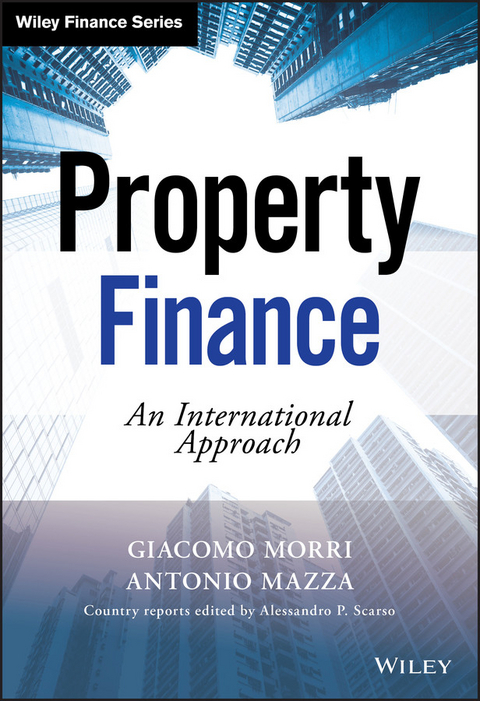
Property Finance (eBook)
John Wiley & Sons (Verlag)
978-1-118-76438-1 (ISBN)
Property Finance is an authoritative guide to both the financial and legal issues surrounding real estate financing. Unique in its exclusive focus on the topic, this book builds from a solid theoretical foundation to provide practical tools and real-world solutions. Beginning with a discussion of the general issues encountered in real estate finance from an international perspective, the authors delve into country-specific information and set out the legal peculiarities of eight important countries (Germany, France, Italy, Spain, China, India, England and Wales) by asking questions of relevance to the leading local law firms specializing in real estate financing. The reader may thus consider in greater depth the problems relating to any given country and compare and contrast the positions under different legal systems.
Examples with numerical calculations and contract excerpts enhance the explanations presented, and are immediately followed by practical case studies that illustrate the mechanisms at work. The companion website features downloadable spreadsheets used in the examples, power point presentations, as well as real estate news and more.
Property financing entails many sources of capital, including both debt and equity resources as well as hybrid forms like preferred equity and mezzanine debt. Knowing how to work with these avenues is important to ensuring financial sustainability in real estate assets. Property Finance covers the most common issues encountered, helping readers prepare for and find a way around possible roadblocks.
- Consider the issues surrounding real estate lending at an international level
- Compare and contrast the positions under different legal systems
- Develop an international perspective on cash flows and financing agreements
- Use powerful tools to structure financing and gauge its effects on property financing
The success of a real estate investment is dependent upon optimal financing, and a mere bird's eye view of the topic does not fully prepare investors for issues ahead: Property Finance provides a knowledge-based approach to real estate investment, detailed information and powerful tools.
A unique, international approach to optimal real estate financing Property Finance is an authoritative guide to both the financial and legal issues surrounding real estate financing. Unique in its exclusive focus on the topic, this book builds from a solid theoretical foundation to provide practical tools and real-world solutions. Beginning with a discussion of the general issues encountered in real estate finance from an international perspective, the authors delve into country-specific information and set out the legal peculiarities of eight important countries (Germany, France, Italy, Spain, China, India, England and Wales) by asking questions of relevance to the leading local law firms specializing in real estate financing. The reader may thus consider in greater depth the problems relating to any given country and compare and contrast the positions under different legal systems. Examples with numerical calculations and contract excerpts enhance the explanations presented, and are immediately followed by practical case studies that illustrate the mechanisms at work. The companion website features downloadable spreadsheets used in the examples, power point presentations, as well as real estate news and more. Property financing entails many sources of capital, including both debt and equity resources as well as hybrid forms like preferred equity and mezzanine debt. Knowing how to work with these avenues is important to ensuring financial sustainability in real estate assets. Property Finance covers the most common issues encountered, helping readers prepare for and find a way around possible roadblocks. Consider the issues surrounding real estate lending at an international level Compare and contrast the positions under different legal systems Develop an international perspective on cash flows and financing agreements Use powerful tools to structure financing and gauge its effects on property financing The success of a real estate investment is dependent upon optimal financing, and a mere bird's eye view of the topic does not fully prepare investors for issues ahead: Property Finance provides a knowledge-based approach to real estate investment, detailed information and powerful tools.
GIACOMO MORRI, Ph.D., MRICS, is Senior Professor in the Accounting, Control, Corporate Finance and Real Estate Department at SDA Bocconi School of Management and Lecturer in Real Estate Finance at Bocconi University. He is Past-president and Board Member of the European Real Estate Society. He also sits on the board of several real estate companies and works as freelance advisor. www.giacomomorri.info ANTONIO MAZZA is Teaching Fellow at SDA Bocconi School of Management. He has been working for almost 25 years in the real estate market for both Italian and foreign banks and he is currently General Manager of "Aareal Bank AG" Italy and board member of several Italian companies within the "Aareal Group". He is Professional Member of the Royal Institution of Chartered Surveyors and a member of several Italian Banking Association. www.morri-mazza.com
Chapter 1
Introduction to Property Financing
The concept of financing, understood in its broad sense, embraces all sources of capital investment and, as such, the definition covers both debt and equity indiscriminately. The term financing is indeed taken to apply to any form of capital which may be used to finance an investment project, ranging from the more traditional forms to those which are more innovative, and including both the use of equity capital as well as the various forms of debt capital.1
The procedures for investment financing are extremely important since they make it possible to improve the investment's ultimate economic result due to the lower cost of the invested capital when debt is used. Moreover, in order to undertake a profitable investment, it must also be financially sustainable, e.g. it must be possible to secure the necessary resources. Eventually, this must all occur in a balanced manner in order to ensure that there is not an excessive financial risk due to the fixed cost of interest payment.2 Indeed, were the latter to exceed a certain threshold, it would reduce the economic benefit of lower capital costs and, at the same time, make the investment overly complex due to the excessive restrictions imposed by lenders.3
1.1 Forms of financing: debt and equity
The various forms of capital used to finance an investment can be arranged along a continuum ranging from the two extremes of (pure) debt and (pure) equity. In order to understand where best to place each form of financing it may be of assistance to define some of the main characteristics of these two main forms.
1.1.1 Debt
Debt capital is characterized by:
- an explicit cost defined under contract;
- the absence of any link between its cost (e.g. leading to different remuneration for the lender) and the actual return of the investment financed;
- tax deductibility in most cases.
The cost of debt is explicit since it depends upon a contractual agreement between the borrower4 and the lender. This cost is precise and defined and (subject to certain limits such as in cases of default) is independent of the actual return of the investment financed since a set amount of money must be paid. Furthermore, the procedures and maturity dates for repayment are determined in advance and specified under contract.
Moreover, under most tax regimes, interests on debt are tax deductible,5 thereby contributing to enhance the equity's return by reducing the tax burden. Although the financial advantage of using debt6 results from this characteristic, debt financing continues to be used for various reasons, even where there are no tax benefits, such as:
- capital rationing (lack of equity capital);
- risk diversification;
- increase in projected earnings (in return for a greater risk);
- greater control over management.
Real estate investments, due to their large size, usually involve a significant debt-financing element. In fact, most operators work under capital rationing constraints, since they do not have access to all the capital which is necessary in order to implement all value creating projects with positive net present value (NPV). In particular, the real estate market is not efficient enough to swiftly allocate resources to projects with positive NPVs which therefore often cannot be implemented due to the lack of adequate financing. In addition, for many investors the recourse to debt financing is fundamental since they may wish to distribute their equity capital over several investments in order to reduce the concentration of risk within the portfolio as a whole. This is often the case of tax exempt investors, that notwithstanding the absence of tax shield benefit, use leverage in order to have a better diversified property portfolio.7
In other cases, such as for opportunistic funds, the quest for a high return results in the financial risk8 being added to the (sometimes already significant) operating risk, without however directly creating value (in the sense of generating a higher NPV), since the higher return (greater cash flow to equity) is counterbalanced by a higher risk (equity expected return or consequently a higher discount rate).
Finally, whilst it may be less relevant for real estate investments, the need to service the debt limits management's discretion and facilitates investor control, as agency costs.9
Properties are apparently well suited to be financed with high amounts of debt because they can easily be provided as security as they cannot be concealed, their value is quantifiable with a fair degree of precision, and they represent sound collateral thanks to the possibility of mortgage guarantees. Moreover, the bankruptcy cost10 is lower than that registered in other sectors (such as manufacturing or services) because the value of a property,11 especially if it already exists or is already generating income, is less influenced by the owner and hence by the company going concern. The situation is different for companies in which the disposal value of individual assets is often irrelevant compared to the operating value of the company. However, complexity may increase significantly even in the real estate sector, and in particular in development projects, leading to an increase in the bankruptcy costs when the developer's role becomes fundamental for the successful completion of the operation.
The possibility of guaranteeing the debt by mortgaging the properties in respect of which the loan is granted apparently reduces the exposure of lenders to the risks generally associated with these type of investments, and therefore disposes them more favourably towards financing these operations. However, the value of guarantees12 is heavily influenced by the legislative regime and the time-scales for enforcement procedures which enable them to be effectively implemented.
Real estate financing agreements may come in many different forms, and are specifically tailored to the characteristics of the individual operation, the parties involved, and market conditions.13
Within a sector which has undergone significant changes over time, lenders also play a significant role in promoting the use of more advanced techniques, such as mezzanine and private equity financing,14 instead of traditional bank financing instruments alone. Depending upon the level of risk which lenders decide to accept, they may accordingly receive a share of the profits and play a more significant role in the capital structure.
Existing financing methodologies may be subdivided into two main categories:
- financing instruments identifying a specific contractual form (such as mortgage loans, financial leases, or ordinary shares);
- financing techniques which specify financing methods made up of multiple instruments (such as hybrid mezzanine financing with a mortgage loan and an equity kicker).
The financing technique therefore assumes that various financing instruments will be used in conjunction with one another in order to best satisfy more complex and detailed requirements.
1.1.2 Equity
The definition of equity includes all forms of capital contributed by shareholders and any money pertaining to such contributions. In addition to paid-in capital or contributed capital, equity also includes retained earnings and treasury stock, if any. Equity is characterized by:
- an implicit opportunity cost;
- a remuneration which depends upon actual economic performance, and is payable after all other investors;
- non-tax deductibility.
Contrary to the position for debt financing, equity is characterized by the lack of a maturity date for repayment, or indeed of any formal obligation to repay. Expected remuneration will depend mainly on the perception of the overall risk, including the operational risk (investment type, procedure, and sector) and the financial risk (amount of capital with higher seniority than equity).
Finally, there is also a form of mixed capital, consisting in mezzanine financing or preferred equity, which covers all hybrid forms which cannot be classified either as debt, or as equity capital (for example profit participating loans, convertible bonds, and subordinated loans), since they share the characteristics of both.15
1.2 A different approach to property financing
A different way of conceptualizing financing is to consider the two parties, the shareholder (equity) and the bank (debt), simply as two partners which contribute capital to the same investment in different ways. The equity contribution will grant entitlement to control or manage the transaction16 and to a residual payment after the partner bank has been remunerated. The bank, by contrast, on the one hand has less control (or even indirect control through covenants and guarantees), but nonetheless has a priority right to payment.
However, it must be recalled that taxes play an important role within the capital structure,17 since the weight of the capital provided by the two partners has a different effect on the net result. Essentially, a high investment by the bank partner (e.g. the presence of a high level of debt financing) has an effect on taxes (since interests are deductible) and hence on the net remuneration of the other partner providing equity capital.
When analysing a real estate financing deal it is appropriate to put oneself in the shoes of the sponsor18 of the initiative (usually the equity investor)...
| Erscheint lt. Verlag | 6.11.2014 |
|---|---|
| Reihe/Serie | The Wiley Finance Series |
| Wiley Finance Series | Wiley Finance Series |
| Sprache | englisch |
| Themenwelt | Recht / Steuern ► Wirtschaftsrecht |
| Wirtschaft ► Betriebswirtschaft / Management ► Finanzierung | |
| Wirtschaft ► Betriebswirtschaft / Management ► Rechnungswesen / Bilanzen | |
| Betriebswirtschaft / Management ► Spezielle Betriebswirtschaftslehre ► Immobilienwirtschaft | |
| Schlagworte | Antonio Mazza • China Real Estate • European property finance • European real estate markets • Finance & Investments • Finanz- u. Anlagewesen • Finanzwesen • France real estate • Germany real estate • Giacomo Morri • India Real Estate • international property finance • international property investment • International Real Estate • Italy real estate • Property Finance: An International Approach • property finance cash flows • property finance examples • property finance issues • property finance theory • property finance tools • property finance website • property lending capital • Real Estate Development • real estate financial models • real estate lending • Spain real estate • UK real estate |
| ISBN-10 | 1-118-76438-2 / 1118764382 |
| ISBN-13 | 978-1-118-76438-1 / 9781118764381 |
| Informationen gemäß Produktsicherheitsverordnung (GPSR) | |
| Haben Sie eine Frage zum Produkt? |
 EPUB (Adobe DRM)
Kopierschutz: Adobe-DRM
Adobe-DRM ist ein Kopierschutz, der das eBook vor Mißbrauch schützen soll. Dabei wird das eBook bereits beim Download auf Ihre persönliche Adobe-ID autorisiert. Lesen können Sie das eBook dann nur auf den Geräten, welche ebenfalls auf Ihre Adobe-ID registriert sind.
Details zum Adobe-DRM
Dateiformat: EPUB (Electronic Publication)
EPUB ist ein offener Standard für eBooks und eignet sich besonders zur Darstellung von Belletristik und Sachbüchern. Der Fließtext wird dynamisch an die Display- und Schriftgröße angepasst. Auch für mobile Lesegeräte ist EPUB daher gut geeignet.
Systemvoraussetzungen:
PC/Mac: Mit einem PC oder Mac können Sie dieses eBook lesen. Sie benötigen eine
eReader: Dieses eBook kann mit (fast) allen eBook-Readern gelesen werden. Mit dem amazon-Kindle ist es aber nicht kompatibel.
Smartphone/Tablet: Egal ob Apple oder Android, dieses eBook können Sie lesen. Sie benötigen eine
Geräteliste und zusätzliche Hinweise
Buying eBooks from abroad
For tax law reasons we can sell eBooks just within Germany and Switzerland. Regrettably we cannot fulfill eBook-orders from other countries.
aus dem Bereich