Detecting Deception (eBook)
John Wiley & Sons (Verlag)
978-1-118-50982-1 (ISBN)
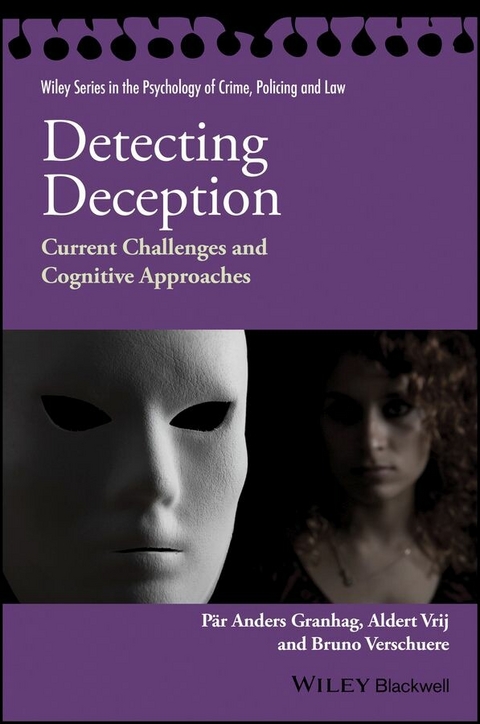
Detecting Deception offers a state-of-the-art guide to the detection of deception with a focus on the ways in which new cognitive psychology-based approaches can improve practice and results in the field.
- Includes comprehensive coverage of the latest scientific developments in the detection of deception and their implications for real-world practice
- Examines current challenges in the field - such as counter-interrogation strategies, lying networks, cross-cultural deception, and discriminating between true and false intentions
- Reveals a host of new approaches based on cognitive psychology with the potential to improve practice and results, including the strategic use of evidence, imposing cognitive load, response times, and covert lie detection
- Features contributions from internationally renowned experts
Pär Anders Granhag is Professor of Psychology at the University of Gothenburg, Sweden. He has published over 200 scientific reports on topics relating to deception detection and is the Founding Director of the Research Unit for Criminal, Legal and Investigative Psychology.
Aldert Vrij is Professor of Applied Social Psychology at the University of Portsmouth, UK. He is the author of Detecting Lies and Deceit: Pitfalls and Opportunities (2008).
Bruno Verschuere is Associate Professor of Forensic Psychology at the University of Amsterdam, The Netherlands. He is a Founding Member of the European consortium of Psychological Research on Deception Detection, and co-editor of Memory Detection: Theory and Application of the Concealed Information Test.
Detecting Deception offers a state-of-the-art guide to the detection of deception with a focus on the ways in which new cognitive psychology-based approaches can improve practice and results in the field. Includes comprehensive coverage of the latest scientific developments in the detection of deception and their implications for real-world practice Examines current challenges in the field - such as counter-interrogation strategies, lying networks, cross-cultural deception, and discriminating between true and false intentions Reveals a host of new approaches based on cognitive psychology with the potential to improve practice and results, including the strategic use of evidence, imposing cognitive load, response times, and covert lie detection Features contributions from internationally renowned experts
Pär Anders Granhag is Professor of Psychology at the University of Gothenburg, Sweden. He has published over 200 scientific reports on topics relating to deception detection and is the Founding Director of the Research Unit for Criminal, Legal and Investigative Psychology. Aldert Vrij is Professor of Applied Social Psychology at the University of Portsmouth, UK. He is the author of Detecting Lies and Deceit: Pitfalls and Opportunities (2008). Bruno Verschuere is Associate Professor of Forensic Psychology at the University of Amsterdam, The Netherlands. He is a Founding Member of the European consortium of Psychological Research on Deception Detection, and co-editor of Memory Detection: Theory and Application of the Concealed Information Test.
Contributors vii
Series Preface xi
Introduction xv
Acknowledgements xix
SECTION I: Deception Detection: Established Approaches
1
1 Verbal Lie Detection Tools: Statement Validity Analysis,
Reality Monitoring and Scientific Content Analysis 3
Aldert Vrij
2 New Findings in Non-Verbal Lie Detection 37
Charles F. Bond, Timothy R. Levine, and Maria Hartwig
3 The Polygraph: Current Practice and New Approaches 59
Ewout H. Meijer and Bruno Verschuere
4 Forensic Application of Event-Related Brain Potentials to
Detect Guilty Knowledge 81
William G. Iacono
5 Deception Detection Using Neuroimaging 105
Giorgio Ganis
SECTION II: Current Challenges 123
6 Exploring the Nature and Origin of Beliefs about Deception:
Implicit and Explicit Knowledge among Lay People and Presumed
Experts 125
Maria Hartwig and Pär Anders Granhag
7 Discriminating between True and False Intentions 155
Erik Mac Giolla, Pär Anders Granhag, and Aldert
Vrij
8 Cross-Cultural Deception Detection 175
Paul J. Taylor, Samuel Larner, Stacey M. Conchie, and Sophie van
der Zee
SECTION III: Improving Lie Detection: New Approaches
203
9 A Cognitive Approach to Lie Detection 205
Aldert Vrij
10 The Strategic Use of Evidence Technique: A Conceptual
Overview 231
Pär Anders Granhag and Maria Hartwig
11 Investigating Deception and Deception Detection with Brain
Stimulation Methods 253
Giorgio Ganis
12 Detecting Deception Through Reaction Times 269
Bruno Verschuere, Kristina Suchotzki, and Evelyne Debey
13 Suspects' Verbal Counter-Interrogation Strategies:
Towards an Integrative Model 293
Pär Anders Granhag, Maria Hartwig, Erik Mac Giolla, and
Franziska Clemens
14 Covert Detection of Deception 315
Eitan Elaad
Index 339
"All practitioners, researchers, and consumers could benefit from reading this book. It is an excellent reference for most all items covered. As alternative technologies develop and improve, it behooves us to stay abreast and open-minded... I highly recommend this book to all examiners interested in improving their knowledge on cognitive approaches to interviewing, ethical interrogative strategies and avoiding false confessions." Mark Handler, American Polygraph Association Magazine, 2015
You may think you can tell if someone is lying, but Detecting
Deception will make you think again. This thorough and
accomplished collection of chapters by leading experts in the field
brings together the science of "truthfulness", and
tells us what it means for psychologists, law enforcement, and all
who care about justice.--Elizabeth F. Loftus, Ph.D,
Distinguished Professor, University of California-Irvine
Granhag, Vrij, and Verschuere do the research and practitioner
communities a great service by providing a multi-faceted, current
(and into the future) account of cognitive and social approaches to
detecting deception. The book's strength lies in its
world-recognized contributors, balanced presentation of supported
and unsupported ideas, theoretical and applied perspectives, and a
broad spectrum of approaches.--Dr Ronald P. Fisher, Florida
International University
Fundamental to the objectives of both investigative
interviewing in the law-enforcement domain and interrogations
conducted to support intelligence needs is the requirement to
objectively assess the credibility of the individual under
questioning. For far too long, practitioners have rendered such
conclusions based wholly on intuitive judgments often shaped by
bias, unchallenged assumptions, and misinformed supposition. In
this vital work, an exceptionally impressive array of scholars and
researchers offers a rational path toward a more definitive and
evidence-based approach to gauging veracity. Rather than purely
theoretical abstractions, the authors present practitioners with a
comprehensive framework of strategies, methods, and metrics that
lends itself to immediate application in the real-world. In no
small measure, this book takes a monumental step toward chipping
away at the myth of interrogation as purely an art and replacing it
with the promise of interrogation as a systematic, science-based
process for eliciting meaningful information in support of justice
and enlightened public policy.--Colonel Steven M. Kleinman,
U.S. Air Force (Retired), Career human intelligence
officer
| Erscheint lt. Verlag | 28.10.2014 |
|---|---|
| Reihe/Serie | Wiley Series in Psychology of Crime, Policing and Law | Wiley Series in The Psychology of Crime, Policing and Law |
| Sprache | englisch |
| Themenwelt | Geisteswissenschaften ► Psychologie |
| Recht / Steuern ► Strafrecht ► Kriminologie | |
| Sozialwissenschaften | |
| Schlagworte | Criminology • Deception, lying, deception detection, polygraph, lie detection, lying networks, interrogation, interrogation techniques, psychology, counter-interrogation strategies, true and false intentions, cross-cultural deception, cognitive psychology, covet lie detection • Forensic Psychology • Forensische Psychologie • Kriminologie • Law • Psychologie • Psychology • Rechtswissenschaft |
| ISBN-10 | 1-118-50982-X / 111850982X |
| ISBN-13 | 978-1-118-50982-1 / 9781118509821 |
| Informationen gemäß Produktsicherheitsverordnung (GPSR) | |
| Haben Sie eine Frage zum Produkt? |
 PDF (Adobe DRM)
Kopierschutz: Adobe-DRM
Adobe-DRM ist ein Kopierschutz, der das eBook vor Mißbrauch schützen soll. Dabei wird das eBook bereits beim Download auf Ihre persönliche Adobe-ID autorisiert. Lesen können Sie das eBook dann nur auf den Geräten, welche ebenfalls auf Ihre Adobe-ID registriert sind.
Details zum Adobe-DRM
Dateiformat: PDF (Portable Document Format)
Mit einem festen Seitenlayout eignet sich die PDF besonders für Fachbücher mit Spalten, Tabellen und Abbildungen. Eine PDF kann auf fast allen Geräten angezeigt werden, ist aber für kleine Displays (Smartphone, eReader) nur eingeschränkt geeignet.
Systemvoraussetzungen:
PC/Mac: Mit einem PC oder Mac können Sie dieses eBook lesen. Sie benötigen eine
eReader: Dieses eBook kann mit (fast) allen eBook-Readern gelesen werden. Mit dem amazon-Kindle ist es aber nicht kompatibel.
Smartphone/Tablet: Egal ob Apple oder Android, dieses eBook können Sie lesen. Sie benötigen eine
Geräteliste und zusätzliche Hinweise
Buying eBooks from abroad
For tax law reasons we can sell eBooks just within Germany and Switzerland. Regrettably we cannot fulfill eBook-orders from other countries.
aus dem Bereich