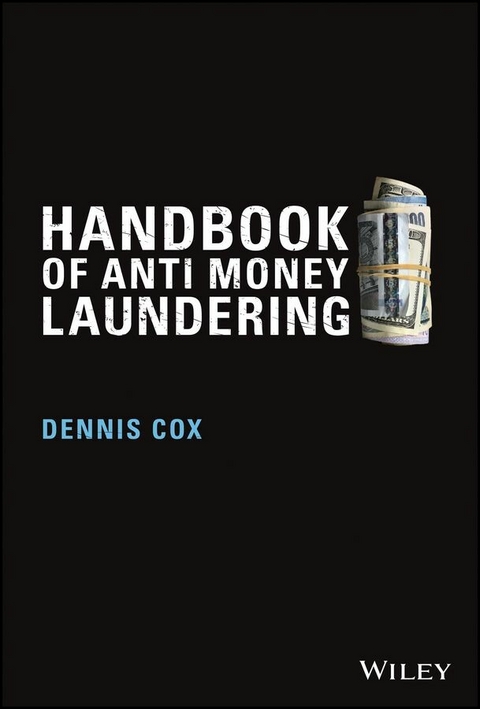
Handbook of Anti-Money Laundering (eBook)
John Wiley & Sons (Verlag)
978-0-470-68527-3 (ISBN)
Handbook of Anti-Money Laundering details the most up-to-date regulations and provides practical guidance toward implementation. While most books focus on the regulations themselves, this useful guide goes further by explaining their meaning to bank operations, and how the rules apply to real-life scenarios. The international perspective provides a broader understanding of the anti-money laundering controls that are in place worldwide, with certain country-specific details discussed in-depth. Coverage includes the Wolfsberg Principles, Financial Action Task Force guidance, the U.S. Patriot Act, and the latest from both the EU and Bank for International Settlements.
The IMF estimates that two to five per cent of the global GDP – $590 billion to $1.5 trillion – is laundered every year. Globally, banks and other financial institutions have been required to put in place specific arrangements to prevent and detect money laundering and the criminal activity that underlies it. This book provides the latest regulations and guidance toward application.
- Understand what money laundering regulations mean in practice
- Reference international and country-specific rules and regulations
- Get up to speed on the most current regulations and practices
- Implement the most effective anti-money laundering measures
In response to the increased monitoring and regulation, money launderers have become more sophisticated at disguising the source of their funds. Financial institutions' employees must be ever more aware of what they're facing, and how to deal with it, making actionable guidance a critical companion to any regulatory information. For financial institutions seeking more thorough understanding and practical advice, the Handbook of Anti-Money Laundering is a comprehensive guide.
DENNIS COX is CEO of Risk Reward Limited, a strategy and risk consultancy for the financial services industry, and he serves as a director for a number of other companies. He is a leading specialist in financial services risk management and has held senior management positions at top banking and accountancy firms, including HSBC and Prudential. Dennis has authored several publications, including An Introduction to Money Laundering Deterrence and Frontiers of Risk Management.
Effectively implement comprehensive anti-money laundering regulations Handbook of Anti-Money Laundering details the most up-to-date regulations and provides practical guidance toward implementation. While most books focus on the regulations themselves, this useful guide goes further by explaining their meaning to bank operations, and how the rules apply to real-life scenarios. The international perspective provides a broader understanding of the anti-money laundering controls that are in place worldwide, with certain country-specific details discussed in-depth. Coverage includes the Wolfsberg Principles, Financial Action Task Force guidance, the U.S. Patriot Act, and the latest from both the EU and Bank for International Settlements. The IMF estimates that two to five per cent of the global GDP $590 billion to $1.5 trillion is laundered every year. Globally, banks and other financial institutions have been required to put in place specific arrangements to prevent and detect money laundering and the criminal activity that underlies it. This book provides the latest regulations and guidance toward application. Understand what money laundering regulations mean in practice Reference international and country-specific rules and regulations Get up to speed on the most current regulations and practices Implement the most effective anti-money laundering measures In response to the increased monitoring and regulation, money launderers have become more sophisticated at disguising the source of their funds. Financial institutions' employees must be ever more aware of what they're facing, and how to deal with it, making actionable guidance a critical companion to any regulatory information. For financial institutions seeking more thorough understanding and practical advice, the Handbook of Anti-Money Laundering is a comprehensive guide.
DENNIS COX is CEO of Risk Reward Limited, a strategy and risk consultancy for the financial services industry, and he serves as a director for a number of other companies. He is a leading specialist in financial services risk management and has held senior management positions at top banking and accountancy firms, including HSBC and Prudential. Dennis has authored several publications, including An Introduction to Money Laundering Deterrence and Frontiers of Risk Management.
Introduction 1
1 What is Money Laundering? 5
2 The Process of Money Laundering 15
3 International Money-laundering Regulation - The Role of the Financial Action Task Force 21
4 The EC Money Laundering Directives 59
5 UN Resolutions 79
6 The UK Regulatory Framework 83
7 How Money-laundering-deterrence Regulations are Applied in the UK - The Joint Money Laundering Steering Group 93
8 The Wolfsberg Principles 111
9 The US Regulatory Framework 127
10 Financial Sanctions 139
11 Risk Management and Money-laundering Deterrence 149
12 The Role of the Money Laundering Reporting Officer 159
13 Know Your Customer 169
14 Money Laundering Training 181
15 Retail Customer Identification 189
16 Corporate Customer Identification 199
17 Politically Exposed Persons 207
18 Non-face-to-face Customers 217
19 Suspicious Conduct and Transactions 225
20 Unusual Transactions 235
21 Investigating Suspicions 241
22 Ongoing Monitoring 253
23 Tipping Off 261
24 Correspondent Banking 265
25 Record-keeping 271
26 Money-laundering-deterrence Software 277
27 Country Profiles 285
27.1 Country Profile: Albania 286
27.2 Country Profile: Argentina 298
27.3 Country Profile: Australia 308
27.4 Country Profile: Bahamas 322
27.5 Country Profile: Barbados 335
27.6 Country Profile: Brazil 348
27.7 Country Profile: British Virgin Islands 355
27.8 Country Profile: Canada 367
27.9 Country Profile: Cayman Islands 384
27.10 Country Profile: China 396
27.11 Country Profile: Denmark 405
27.12 Country Profile: Finland 416
27.13 Country Profile: France 428
27.14 Country Profile: Germany 436
27.15 Country Profile: Guernsey 443
27.16 Country Profile: Hong Kong 458
27.17 Country Profile: India 473
27.18 Country Profile: Isle of Man 484
27.19 Country Profile: Japan 496
27.20 Country Profile: Jersey 503
27.21 Country Profile: Kenya 516
27.22 Country Profile: Liechtenstein 529
27.23 Country Profile: Malaysia 539
27.24 Country Profile: Mexico 552
27.25 Country Profile: Monaco 563
27.26 Country Profile: Morocco 575
27.27 Country Profile: Nigeria 584
27.28 Country Profile: Poland 593
27.29 Country Profile: Russia 604
27.30 Country Profile: Singapore 615
27.31 Country Profile: South Africa 625
27.32 Country Profile: South Korea ("Republic of Korea") 638
27.33 Country Profile: Switzerland 651
27.34 Country Profile: UAE 663
27.35 Country Profile: Ukraine 677
27.36 Country Profile: United States of America 687
27.37 Country Profile: Vietnam 700
Appendix: Transparency International 2013 Corruption Perceptions Index 713
Index 719
"... a must-have for banking employees involved in compliance / other ML activities" (Financial Expert, May 2015)
INTRODUCTION
This book sets out to be a handbook for financial crime experts within companies. It seeks to provide them with sufficient information to enable them to understand the key issues that relate to two of the largest problems faced by financial institutions today: money laundering and terrorist financing.
This is an intermediate text, providing detailed information to enable the key issues to be understood and the regulatory framework appreciated. Since the market for money laundering and terrorist financing is, by its nature, global, so is this text. Consequently, whilst different rules and regulations are implemented into local legislation, it is the global standards which underpin all of these local requirements. Therefore, such global standards as exist at the time of writing this text are included within the book.
We have also provided summary guidance on the financial crime and terrorist finance rules and regulations operating in all of the major global financial centres. In the case of Europe, due to the similarity of the regulations based upon the relevant directives, which are discussed in this work, we have not provided an analysis for every country. As always, this material can only be up to date as at the date that the book has gone to print. If you require detailed rules and regulations regarding a specific market, then you should refer to the actual rule book or local legal advice to provide final guidance. This book will, however, provide you with the outline information that you will require for the majority of issues you face on a day-to-day basis.
Money laundering is one of the few growth industries that seem to be prospering at present. As a consequence of this, the regulatory structures have been developing globally and the quality of investigation improving. Offshore financial centres have been under the spotlight not just due to their data secrecy requirements but also since they have historically been used by the unscrupulous to hide income from local taxation authorities, thereby avoiding tax.
As a consequence of the increased investigation of these areas, the number of prosecutions has increased. Throughout this book we do provide examples of cases where prosecutions have been successful, and indeed these are included within the country profiles which form the majority of this book. Since it is clearly important that any case referred to has completed its legal pathway, cases can only be used after their conclusion, which can take a number of years.
The following are some examples of recent prosecutions:
Example 1: Wisconsin (USA) Restaurant Owner Sentenced to 48 Months for Structuring Financial Transactions (2009)
In Madison, Wisconsin, the owner of a restaurant was sentenced to 48 months in prison for money-laundering offences related to the structuring of financial transactions.
According to court documents, the restaurant owner borrowed $616,726 from a regular customer of his restaurant. He instructed the customer to write the cheques in small amounts so that he could use them to pay food distributors. However, in practice, rather than using these funds to pay suppliers, he actually negotiated the cheques for cash. To reduce the chance of being detected, the restaurant owner drove to multiple banks and multiple branches of the same bank to deposit the cash. This was undertaken to avoid US regulatory reporting, since if a cash transaction of more than $10,000 was received, the bank would have been required to generate a transaction report.
This demonstrates one of the key issues with money-laundering detection. The rules are designed to attempt to identify inappropriate transactions, but the unscrupulous then identify ways to avoid detection. Another approach taken by the restaurant owner was to make use of associates to cash cheques on his behalf and then return the funds to him.
In this case, the criminal activity is actually fraud. The restaurant owner is seeking to use the financial systems to enable him to make full use of the monies. In money laundering there is always some form of criminal activity – who would need to disguise legitimate funds? Often it is the nature of the funds which determines the approach that is likely to be adopted. Here, we have a fraudster using multiple bank accounts to attempt to disguise the source of funds. As we shall see in subsequent chapters, this is but one of many possible criminal activities, and there are also many forms of money laundering, although they all do have similar properties.
(Source: http://www.fbi.gov/milwaukee/press-releases/2009/mw092209-1.htm)
Sometimes the investigations undertaken by the crime agencies can result in successful prosecution, as shown by the following press release from the United Kingdom's Serious Organised Crime Agency (SOCA), which, in 2013, became the National Crime Agency (NCA):
Example 2: Suspected Heroin Trafficker Captured in the Netherlands (2009)
SOCA reported that a forty-four-year-old had been arrested by Amsterdam Regional Police at a petrol station in Almere on the outskirts of Amsterdam. He was believed to have been the head of an organised crime gang responsible for the importation of hundreds of kilos of heroin into the UK. He was captured following an operation involving both SOCA and the Dutch police.
Details of his status as a wanted fugitive had been publicised through Crimestoppers “Operation Captura”, something which the suspected trafficker alluded to when arrested. He commented that he had felt unsafe in Spain knowing that he was wanted there, and so had moved to the Netherlands. He added that, now that he had been arrested, he was glad that it was all over. The case highlights a number of matters. Firstly, that organised crime is often involved with money laundering, since there are funds whose source will need to be disguised. Secondly, there is the importance of international cooperation. A single investigator in a single jurisdiction is unlikely to see the totality of the criminal activity, since this will often use multiple jurisdictions and financial institutions. Finally, in this case publicity caused the fugitive to change his pattern of behaviour and ultimately resulted in his being apprehended.
A SOCA spokesman said: “This arrest is a massive endorsement for Crimestoppers Operation Captura and its reputation in the criminal community. SOCA and our international partners, working together with Crimestoppers and the general public, are having a real impact on UK fugitives abroad – making sure they realise that, at any moment, there could be a knock on the door followed by the clink of handcuffs.”
Clearly, international contacts are also required to detect major money-laundering rings. Another press release from the UK's Serious Organised Crime Agency highlights this clearly:
Example 3: International Money Launderer Arrested (2009)
NJ, the subject of a long-term investigation by SOCA and international partners, was arrested in New Delhi, India. NJ is alleged to have controlled a worldwide money-laundering system that, at its height, was capable of moving $2.2 billion a year.
NJ, who is banned from entering the UK, was originally arrested in Dubai in 2007 by Dubai police as part of a year-long joint investigation between SOCA, the Dubai police and the Italian Guardia di Finanza, but fled to India while awaiting trial. SOCA subsequently worked closely with the Dubai and Indian authorities to assist with their enquiries. NJ is currently in custody in India and SOCA is liaising with both Indian and Dubai police on the next steps.
Commenting on the arrest, SOCA Deputy Director Ian Cruxton said:
“This operation is part of SOCA's long-term strategy targeting specialist money launderers based overseas. The illegal money transfer systems they use provide the infrastructure to launder cash for organised crime groups whose activities directly impact on the United Kingdom.
These networks pay no attention to cultural or geographical barriers. They launder money for organised crime groups from any ethnic background or criminal business, particularly UK, Pakistani and Turkish nationals based in the UK and mainland Europe involved in drugs trafficking.
SOCA continues to share intelligence and work with international partners to create a hostile environment for criminals both domestically and internationally.”
This book aims to provide all bank employees with the basic information that they need to be part of the global attempt to identify and prosecute those involved in money laundering or terrorist financing, whilst explaining the key terms and associated risks. It should be part of an education and awareness campaign conducted throughout the financial institution to raise people's knowledge of key requirements and expectations, ensuring that each firm complies with the local rules and regulations promulgated in their jurisdiction by their relevant authority. In the course of the following chapters we shall explain some of the approaches that a bank needs to adopt to deter money laundering and to enable terrorist financing to be identified.
Where possible or appropriate we have included references to relevant rules and regulations within the body of the book, where the reader may find additional information if required.
In writing any book the author needs a good team around them. In this case, my colleagues at Risk Reward Limited and, in particular, Gurmeet Rathor and Grant Duranti have provided both content and assistance throughout the development of this...
| Erscheint lt. Verlag | 23.10.2014 |
|---|---|
| Sprache | englisch |
| Themenwelt | Recht / Steuern ► EU / Internationales Recht |
| Recht / Steuern ► Strafrecht ► Kriminologie | |
| Recht / Steuern ► Wirtschaftsrecht ► Bank- und Kapitalmarktrecht | |
| Sozialwissenschaften | |
| Wirtschaft ► Betriebswirtschaft / Management ► Finanzierung | |
| Betriebswirtschaft / Management ► Spezielle Betriebswirtschaftslehre ► Bankbetriebslehre | |
| Schlagworte | Bank for International Settlements • BIS money laundering • Dennis Cox • EU money laundering • FATF guidance • Finance & Investments • Financial Action Task Force • Financial regulation • Finanz- u. Anlagewesen • fraud detection • Fraud Management • Geldwäsche • Geldwäsche • global money laundering • Handbook of Anti-Money Laundering • implementing money laundering regulations • International Money Laundering • money laundering compliance • money laundering guide • money laundering regulations • Risk Reward Limited • US money laundering rules • US Patriot Act • Wolfsberg Principles |
| ISBN-10 | 0-470-68527-1 / 0470685271 |
| ISBN-13 | 978-0-470-68527-3 / 9780470685273 |
| Informationen gemäß Produktsicherheitsverordnung (GPSR) | |
| Haben Sie eine Frage zum Produkt? |
 EPUB (Adobe DRM)
Kopierschutz: Adobe-DRM
Adobe-DRM ist ein Kopierschutz, der das eBook vor Mißbrauch schützen soll. Dabei wird das eBook bereits beim Download auf Ihre persönliche Adobe-ID autorisiert. Lesen können Sie das eBook dann nur auf den Geräten, welche ebenfalls auf Ihre Adobe-ID registriert sind.
Details zum Adobe-DRM
Dateiformat: EPUB (Electronic Publication)
EPUB ist ein offener Standard für eBooks und eignet sich besonders zur Darstellung von Belletristik und Sachbüchern. Der Fließtext wird dynamisch an die Display- und Schriftgröße angepasst. Auch für mobile Lesegeräte ist EPUB daher gut geeignet.
Systemvoraussetzungen:
PC/Mac: Mit einem PC oder Mac können Sie dieses eBook lesen. Sie benötigen eine
eReader: Dieses eBook kann mit (fast) allen eBook-Readern gelesen werden. Mit dem amazon-Kindle ist es aber nicht kompatibel.
Smartphone/Tablet: Egal ob Apple oder Android, dieses eBook können Sie lesen. Sie benötigen eine
Geräteliste und zusätzliche Hinweise
Buying eBooks from abroad
For tax law reasons we can sell eBooks just within Germany and Switzerland. Regrettably we cannot fulfill eBook-orders from other countries.
aus dem Bereich