


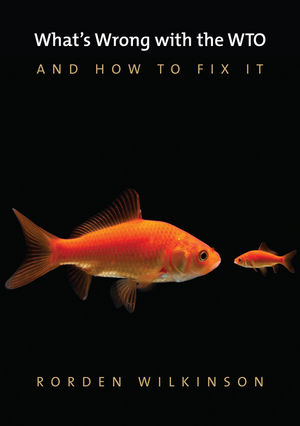
What's Wrong with the WTO and How to Fix It (eBook)
John Wiley & Sons (Verlag)
978-0-7456-8644-8 (ISBN)
So far only piecemeal solutions have been offered to refine this flawed system. Radical proposals that seek to fundamentally alter trade governance or reorient its purposes around more socially progressive and egalitarian goals are thin on the ground. Yet we eschew deeper reform at our peril. In What's Wrong with the World Trade Organization and How to Fix It Rorden Wilkinson argues that without global institutions fit for purpose, we cannot hope for the kind of fine global economic management that can put an end to major crises or promote development-for-all. Charting a different path he shows how the WTO can be transformed into an institution and a form of trade governance that fulfils its real potential and serves the needs of all.
Rorden Wilkinson is Professor of Global Political Economy and Head of the Department of International Relations at the University of Sussex.
We need a world trade organization. We just don't need the one that we have. By pitching unequally matched states together in chaotic bouts of negotiating the global trade governance of today offers - and has consistently offered - developed countries more of the economic opportunities they already have and developing countries very little of what they desperately need. This is an unsustainable state of affairs to which the blockages in the Doha round provide ample testimony. So far only piecemeal solutions have been offered to refine this flawed system. Radical proposals that seek to fundamentally alter trade governance or reorient its purposes around more socially progressive and egalitarian goals are thin on the ground. Yet we eschew deeper reform at our peril. In What's Wrong with the World Trade Organization and How to Fix It Rorden Wilkinson argues that without global institutions fit for purpose, we cannot hope for the kind of fine global economic management that can put an end to major crises or promote development-for-all. Charting a different path he shows how the WTO can be transformed into an institution and a form of trade governance that fulfils its real potential and serves the needs of all.
Rorden Wilkinson is Professor of Global Political Economy and Head of the Department of International Relations at the University of Sussex.
About the Author viii
Acknowledgments ix
Tables xiii
Abbreviations xiv
Introduction: Starting from here 1
Part I Problems
1 Why we govern trade in the way that we do 19
2 Bargaining among unequals 45
3 Talking trade 79
Part II Solutions
4 Thinking differently? 107
5 Trade for all 132
6 Getting from here to there 160
Conclusion: Moving beyond the state we are in 181
Notes 188
References 191
Index 211
This thought-provoking, well-written book makes a passionate
case for reforming global trade governance to do more to realise
global social goods. The author asks an important question that
needs more public debate: what do we need the WTO for? I hope the
book will help stimulate such debate.
Bernard Hoekman, European University Institute
Wilkinson's book compels us to think differently about the
World Trade Organization. I have no hesitation in recommending this
book to academic observers, NGOs and trade diplomats in search of
new ideas and approaches to reform the WTO.
Faizel Ismail, Ambassador Permanent Representative of South
Africa to the WTO
Introduction: Starting from here
As I write this book new trade initiatives are being negotiated in the Asia Pacific – in the form of the Trans-Pacific Partnership agreement (TPP) – and the North Atlantic – by way of a trade and investment agreement between the European Union and the United States known as the Transatlantic Trade and Investment partnership (TTIP). Despite noted controversies in which these negotiations have occasionally become mired – not least the Edward Snowden whistle-blowing affair and the October 2013 US government ‘shutdown’ (see Luce, 2013) – and the ‘successful’ conclusion of the World Trade Organization’s (WTO) December 2013 Bali ministerial conference, much of the commentary in academic journals and the broadsheet media has heralded these mega-regional endeavours as either (and sometimes both) a breakthrough in a global trade politics that has been encased in deadlock since the WTO’s Doha round stuttered to a halt in July 2006, or else as a threat to the very existence of the multilateral trading system itself (Guardian, 2013; Flowers, 2013). The agreement of a small package of measures covering three broad areas (trade facilitation, agriculture and special and differential treatment for least-developed countries) at the Bali conference has done little to temper these binary perceptions (see Barysch and Heise, 2014; Alden, 2013).
At one level, it matters not that these views are the latest instalment in a cycle of ‘received’ wisdom about the multilateral trading system that has been heard many times before and which continues to dog the post-Bali WTO (see Lamy, 2013). At another level, they illustrate much that is wrong with the way we think about global trade. They are despairing nonetheless. These views are despairing because they take the Pacific and Atlantic negotiations as proxies for something to which they do not actually relate. In the more optimistic version, the prospect of either a TPP or TTIP – irrespective of whether they are likely to be concluded – is celebrated more out of a relief that trade talks actually seem to be occurring than because of a genuine desire to applaud the positive contributions that each agreement might make to global prosperity (if indeed trade agreements make any difference at all– see Rose, 2004; and Bagwell and Staiger, 2002 for contrasting views). Whereas the more pessimistic variant suggests that the Pacific and Atlantic negotiations provide further evidence of the slow but certain demise of the multilateral trading system. And it speaks more to a familiar way of talking and thinking about trade politics – that any political development other than forward movement in a WTO trade round must be a threat to the wider system – than it does to clear evidence that a causal relationship exists between the rise of regional arrangements and the downfall of that system.
What is particularly despairing is that both of these views encourage us to seek quick fixes to the ills of the multilateral trading system in a way that privileges expediency over contemplation and root-and-branch reform. Rather than encouraging us to stand back and ask ‘just what is wrong with the way we organize global trade?’ and come up with measured responses based on serious reflection and debate, we are compelled by both views to get the system working, to do so quickly and at almost any cost. Those who celebrate the TPP and TTIP inevitably underline the role that these mega-regional agreements can have as stepping stones to system-wide liberalization while at the same time cautioning of the importance of not losing sight of the multilateral game and encouraging us to redouble our efforts to get the Doha round moving building on the momentum the Bali ministerial has generated. Likewise, more pessimistic accounts of the rise of regional initiatives point to the necessity of concerted and continued action on the multilateral front, lest the system fall into atrophy.
Yet, we know that getting the system working by putting into place short-term measures at successive crisis points across the history of the multilateral trading system has done little for its smooth functioning or to ensure that it acts as a mechanism for promoting trade-led growth and prosperity for all (see Wilkinson, 2006a). We persist nonetheless. This is akin to George Orwell’s famous quip that ‘we are all capable of believing things which we know to be untrue’ but acting as if they were regardless (1946). As Orwell remarked ‘[t]o see what is in front of one’s nose needs a constant struggle’. We seem determined to eschew that struggle. We know better; we know that we should look up, ‘see’ and think harder about how to govern global trade so that it serves our collective interests better; but we do not. Instead, we trot out the same tired and hackneyed ‘commonsense’ that we have since before the system was created whenever we talk about trade and fall back on the same old tired solutions when the system does not function as we imagine it should.
It is not just debate about the threat or not of regional initiatives, or our rush to tinker with a system whose problems we seldom stand back and dwell upon that is frustrating. Equally problematic is the way that any potentially positive movement forward in WTO politics is set up to fail. This is the case with the election of a new WTO Director-General (DG) as it is in the debate that unfolds ahead of the organization’s biennial ministerial conference. In both cases, hope soon gives way to despair as the cold light of national interests and entrenched positions come into focus, leaving the capacity of successive DGs to make a difference nullified and the average likely outcome of a ministerial conference practically nil or else the agreement reached rendered impracticable from the off – to which the elections of Mike Moore (1999–2002), Supachai Panitchpakdi (2002–5), Pascal Lamy (2005–13) and Roberto Carvalho de Azevêdo (2013–), and ministerial circuses that have been Geneva (1998), Seattle (1999), Cancún (2003), Hong Kong (2005), Geneva again (2009, 2011) and Bali (2013), amply testify. We choose to persevere nonetheless.
Problematic still is the way that ‘threats’ to the multilateral trading system are crafted around the ‘rise’ of new powers. This is equally the case with the rise, during the 1960s, of a reconstructing Europe, of Japan in the 1970s and 1980s, and China since (see Krause, 1963; Evans, 1971; Mansfield, 1989; Scott and Wilkinson, 2013a). What has often started out as a uniquely US debate played out periodically whenever challenges to American supremacy are perceived – in global trade as well as elsewhere– has subsequently spread to draw other countries and commentators into the speculation and hyperbole that accompanies successive ‘waves’ of ‘rising’ powers. It is rare, for instance, to find a contemporary high-level policy discussion anywhere in the world – including those attended by foreign visitors in China – that does not fall at some level back on debating China’s rise/ threat/challenge/intentions and/or that of the other major BRICS (Brazil, Russia, India, China, South Africa) powers. This was also the case during the 1980s with regard to Japan and the 1960s and 1970s with regard to the European Economic Community (EEC).
What is despairing about the way rising threats are constructed is their use as a means of smuggling in and legitimizing discriminatory measures into debates about trade. What is also unique about this kind of politics is the way that it is connected to the pursuit of grand trade measures – often in the form of mega-regional initiatives – designed, in part, to gain leverage over (or at worst isolate) third-party states. During the Uruguay round (1986–94) the negotiation of the North American Free Trade Agreement (NAFTA) was intended, in part, to be a leveraging device vis-à-vis the EEC and to a lesser extent Japan (see, for instance, Bhagwati, 1993). Likewise, both the TPP and TTIP negotiations are seen as ways of isolating and undermining the potential might (collective or otherwise) of the BRICS in the Doha round (see, for example, Pilling, 2011; Lehmann, 2013). The current plurilateral renaissance in the WTO is similarly constructed.
The point here is that all too often our commentary on the state of the round and on the WTO more broadly unfolds in ways that are knowable, circular and ultimately hopeless, whether they speak to the examples above or are manifest elsewhere. It is no longer sufficient simply to show that the logic and reality of these and other arguments about trade are flawed. We have to draw a line in the sand and find ways of moving beyond these familiar arguments wherein almost nothing new is offered and towards those which are better able to contribute to a world order wherein enduring poverty, destitution, easily curable disease, insecurity, un- and under-employment cease to be the life experiences of most of the planet’s population. We need to stand back and observe the problems of the WTO in a longer and wider view and be willing to think critically about what we think we know to be ‘true’ about the format and consequences of the way we govern trade; and we need to think about wider social values to which we ought to attach global trade governance rather than come up with quick fixes when we consider what we should do now – whether...
| Erscheint lt. Verlag | 7.10.2014 |
|---|---|
| Reihe/Serie | PWWS - Polity Whats Wrong series |
| PWWS - Polity Whats Wrong series | What's Wrong? |
| Sprache | englisch |
| Themenwelt | Recht / Steuern ► EU / Internationales Recht |
| Sozialwissenschaften ► Politik / Verwaltung ► Europäische / Internationale Politik | |
| Sozialwissenschaften ► Politik / Verwaltung ► Vergleichende Politikwissenschaften | |
| Wirtschaft ► Volkswirtschaftslehre ► Makroökonomie | |
| Schlagworte | Global Governance • International Economy • Internationale Politische Ãkonomie • Internationale Politische Ökonomie • International Political Economy • international relations, economics, politics, development, Doha, international organizations • International Trade • Political Science • Politikwissenschaft • Trade • World Trade Organisation |
| ISBN-10 | 0-7456-8644-3 / 0745686443 |
| ISBN-13 | 978-0-7456-8644-8 / 9780745686448 |
| Informationen gemäß Produktsicherheitsverordnung (GPSR) | |
| Haben Sie eine Frage zum Produkt? |
 EPUB (Adobe DRM)
Kopierschutz: Adobe-DRM
Adobe-DRM ist ein Kopierschutz, der das eBook vor Mißbrauch schützen soll. Dabei wird das eBook bereits beim Download auf Ihre persönliche Adobe-ID autorisiert. Lesen können Sie das eBook dann nur auf den Geräten, welche ebenfalls auf Ihre Adobe-ID registriert sind.
Details zum Adobe-DRM
Dateiformat: EPUB (Electronic Publication)
EPUB ist ein offener Standard für eBooks und eignet sich besonders zur Darstellung von Belletristik und Sachbüchern. Der Fließtext wird dynamisch an die Display- und Schriftgröße angepasst. Auch für mobile Lesegeräte ist EPUB daher gut geeignet.
Systemvoraussetzungen:
PC/Mac: Mit einem PC oder Mac können Sie dieses eBook lesen. Sie benötigen eine
eReader: Dieses eBook kann mit (fast) allen eBook-Readern gelesen werden. Mit dem amazon-Kindle ist es aber nicht kompatibel.
Smartphone/Tablet: Egal ob Apple oder Android, dieses eBook können Sie lesen. Sie benötigen eine
Geräteliste und zusätzliche Hinweise
Buying eBooks from abroad
For tax law reasons we can sell eBooks just within Germany and Switzerland. Regrettably we cannot fulfill eBook-orders from other countries.


