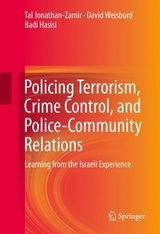
Policing Terrorism, Crime Control, and Police-Community Relations (eBook)
XII, 172 Seiten
Springer International Publishing (Verlag)
9783319081267 (ISBN)
This timely and important work takes a critical look at the shifting role of police, who are becoming increasingly responsible for handling terrorism threats on top of their regular responsibilities. With an unprecedented empirical study, the authors of this book examine whether this increased focus on security-related threats may come at the expense of addressing 'classic' police responsibilities, such as fighting crime and dealing with local, day-to-day community problems. They also examine whether this shift has had a detrimental effect on police-community relationships and perceptions of police legitimacy, as their role changes from 'service' to 'suspicion.' Through a four-year, multi-method study specifically focused on the Israel National Police, the authors of this work have examined the effects of this shifting role on a number of key areas of policing concern, namely: police effectiveness at fighting crime and police legitimacy, drawing conclusions applicable to any democratic police force. The results of the study provide a number of concrete recommendations for maintaining effectiveness and community relationships of the police, with increasing responsibilities, challenges, and limited resources. This work will be of interest for researchers in criminology and criminal justice, particularly with a focus on police studies and counter-terrorism; police administrators; and researchers in related disciplines, such as sociology and public administration.
Tal Jonathan-Zamir received her B.A. in Social Sciences from Bar-Ilan University in 2002, and her M.Sc. in 'Psychology and Investigations' from the Center for Investigative Psychology at the University of Liverpool, UK, in 2003. After returning to Israel, Tal began her doctoral studies at the Institute of Criminology, the Hebrew University of Jerusalem, under the supervision of Prof. David Weisburd. In 2010 Tal began her post-doc as a Fulbright research affiliate at George Mason University, Virginia. In September 2011 Tal began her appointment as a lecturer at the Institute of Criminology. Her main research interests include police-community relationships and public attitudes toward the police, legitimacy and procedural justice, policing terrorism and its implications, and Systematic Social Observations. David Weisburd is the Walter E. Meyer Professor of Law and Criminal Justice and Director of the Institute of Criminology, and Distinguished Professor of Criminology, Law and Society at George Mason University. He is also a Senior Fellow at the Police Foundation, and Chair of its Research Advisory Committee. Professor Weisburd is an elected Fellow of the American Society of Criminology and of the Academy of Experimental Criminology. Professor Weisburd is editor of the Journal of Quantitative Criminology (Springer) and serves on a number of journal editorial boards including Criminology, the Journal of Crime and Delinquency, and the Journal of Quantitative Criminology. In 2010 Professor Weisburd was the recipient of the Stockholm Prize in Criminology, and also the Minister's Prize for Distinguished Immigrant Scientists.
Tal Jonathan-Zamir received her B.A. in Social Sciences from Bar-Ilan University in 2002, and her M.Sc. in "Psychology and Investigations" from the Center for Investigative Psychology at the University of Liverpool, UK, in 2003. After returning to Israel, Tal began her doctoral studies at the Institute of Criminology, the Hebrew University of Jerusalem, under the supervision of Prof. David Weisburd. In 2010 Tal began her post-doc as a Fulbright research affiliate at George Mason University, Virginia. In September 2011 Tal began her appointment as a lecturer at the Institute of Criminology. Her main research interests include police-community relationships and public attitudes toward the police, legitimacy and procedural justice, policing terrorism and its implications, and Systematic Social Observations. David Weisburd is the Walter E. Meyer Professor of Law and Criminal Justice and Director of the Institute of Criminology, and Distinguished Professor of Criminology, Law and Society at George Mason University. He is also a Senior Fellow at the Police Foundation, and Chair of its Research Advisory Committee. Professor Weisburd is an elected Fellow of the American Society of Criminology and of the Academy of Experimental Criminology. Professor Weisburd is editor of the Journal of Quantitative Criminology (Springer) and serves on a number of journal editorial boards including Criminology, the Journal of Crime and Delinquency, and the Journal of Quantitative Criminology. In 2010 Professor Weisburd was the recipient of the Stockholm Prize in Criminology, and also the Minister's Prize for Distinguished Immigrant Scientists.
Introduction and Study Context.- Terrorist Threats and Police Performance.- Police Involvement in Counterterrorism and Public Attitudes Toward the Police.- The Effects of Security Threats on the Antecedents of Police Legitimacy.- How Do Majority Communities View the Potential Costs of Policing Terrorism.- Policing Terrorism from the Perspective of the Arab Minority.- How Does the Israel National Police Perceive Its Role in Counterterrorism and the Potential Outcomes.- Summary and Conclusions.
| Erscheint lt. Verlag | 14.8.2014 |
|---|---|
| Zusatzinfo | XII, 172 p. 21 illus. |
| Verlagsort | Cham |
| Sprache | englisch |
| Themenwelt | Recht / Steuern ► Strafrecht |
| Schlagworte | Counterterrorism Research • Homeland Security • Police Organization and Administration • Police Studies • Policing and Democracy • Policing in Israel |
| ISBN-13 | 9783319081267 / 9783319081267 |
| Informationen gemäß Produktsicherheitsverordnung (GPSR) | |
| Haben Sie eine Frage zum Produkt? |
 PDF (Wasserzeichen)
DRM: Digitales Wasserzeichen
Dieses eBook enthält ein digitales Wasserzeichen und ist damit für Sie personalisiert. Bei einer missbräuchlichen Weitergabe des eBooks an Dritte ist eine Rückverfolgung an die Quelle möglich.
Dateiformat: PDF (Portable Document Format)
Mit einem festen Seitenlayout eignet sich die PDF besonders für Fachbücher mit Spalten, Tabellen und Abbildungen. Eine PDF kann auf fast allen Geräten angezeigt werden, ist aber für kleine Displays (Smartphone, eReader) nur eingeschränkt geeignet.
Systemvoraussetzungen:
PC/Mac: Mit einem PC oder Mac können Sie dieses eBook lesen. Sie benötigen dafür einen PDF-Viewer - z.B. den Adobe Reader oder Adobe Digital Editions.
eReader: Dieses eBook kann mit (fast) allen eBook-Readern gelesen werden. Mit dem amazon-Kindle ist es aber nicht kompatibel.
Smartphone/Tablet: Egal ob Apple oder Android, dieses eBook können Sie lesen. Sie benötigen dafür einen PDF-Viewer - z.B. die kostenlose Adobe Digital Editions-App.
Buying eBooks from abroad
For tax law reasons we can sell eBooks just within Germany and Switzerland. Regrettably we cannot fulfill eBook-orders from other countries.
aus dem Bereich