


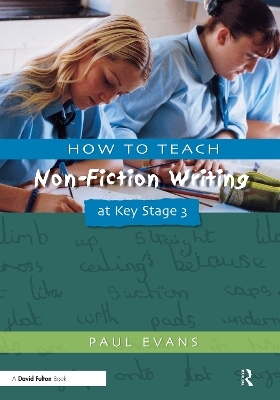
How to Teach Non-Fiction Writing at Key Stage 3
Seiten
2002
David Fulton Publishers Ltd (Verlag)
978-1-85346-859-9 (ISBN)
David Fulton Publishers Ltd (Verlag)
978-1-85346-859-9 (ISBN)
A practical manual to help teachers of 11-14 year-olds to focus on key aspects of developing pupils' non-fiction writing. The book presents a clear teaching sequence which emphasises the link between reading and writing, and can raise pupils' attainment levels in both areas.
How to Teach Non-Fiction Writing at Key Stage 3 is a practical manual to help teachers of 11-14 year-olds to focus on key aspects of developing their pupil's non-fiction writing. The book presents a clear teaching sequence that emphasizes the link between reading and writing, and can raise pupil's attainment levels in both areas. Practical writing workshops focus on the six main types of non-fiction as defined in the NLS Framework for Year 7: information, recount, explanation, instruction, persuasion and discussion texts.
Each workshop includes photocopiable sample texts, instructions for teachers, and tasks for pupils to complete.
With advice on how to make best use of a writing journal, and how to progress in sentence construction - how to make sentences more flexible and better adapted to purpose - the book is a practical and immediately useful resource for KS3 teachers.
How to Teach Non-Fiction Writing at Key Stage 3 is a practical manual to help teachers of 11-14 year-olds to focus on key aspects of developing their pupil's non-fiction writing. The book presents a clear teaching sequence that emphasizes the link between reading and writing, and can raise pupil's attainment levels in both areas. Practical writing workshops focus on the six main types of non-fiction as defined in the NLS Framework for Year 7: information, recount, explanation, instruction, persuasion and discussion texts.
Each workshop includes photocopiable sample texts, instructions for teachers, and tasks for pupils to complete.
With advice on how to make best use of a writing journal, and how to progress in sentence construction - how to make sentences more flexible and better adapted to purpose - the book is a practical and immediately useful resource for KS3 teachers.
Paul Evans has taught in primary, middle and secondary schools. He has worked with the National Literacy Strategy since it began.
Chapter 1 Investigating information texts; Chapter 2 Investigating recount texts; Chapter 3 Investigating explanation texts; Chapter 4 Investigating instruction texts; Chapter 5 Investigating persuasion texts; Chapter 6 Investigating discursive texts;
| Erscheint lt. Verlag | 3.5.2002 |
|---|---|
| Verlagsort | London |
| Sprache | englisch |
| Maße | 210 x 297 mm |
| Gewicht | 150 g |
| Themenwelt | Schulbuch / Wörterbuch |
| Recht / Steuern ► EU / Internationales Recht | |
| Sozialwissenschaften ► Pädagogik ► Schulpädagogik / Sekundarstufe I+II | |
| ISBN-10 | 1-85346-859-2 / 1853468592 |
| ISBN-13 | 978-1-85346-859-9 / 9781853468599 |
| Zustand | Neuware |
| Informationen gemäß Produktsicherheitsverordnung (GPSR) | |
| Haben Sie eine Frage zum Produkt? |
Mehr entdecken
aus dem Bereich
aus dem Bereich
Buch | Softcover (2025)
Verlag an der Ruhr
CHF 34,95
Buch | Softcover (2025)
Don Bosco Medien (Verlag)
CHF 11,90


