


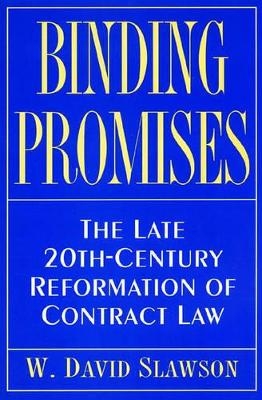
Binding Promises
The Late 20th-Century Reformation of Contract Law
Seiten
1996
Princeton University Press (Verlag)
978-0-691-04415-6 (ISBN)
Princeton University Press (Verlag)
978-0-691-04415-6 (ISBN)
- Titel ist leider vergriffen;
keine Neuauflage - Artikel merken
This text looks at the role of judges in bringing to an end the classical period of contract law in America around 1960. It demonstrates that reforms were accomplished by the judiciary and scholars as opposed to the legislative process.
During its classical period, American contract law had three prominent characteristics: nearly unlimited freedom to choose the contents of a contract, a clear separation from the law of tort (the law of civil wrongs), and the power to make contracts without regard to the other party's ability to understand them. Combining incisive historical analysis with a keen sense of judicial politics, W. David Slawson shows how judges brought the classical period to an end about 1960 with a period of reform that continues to this day. American contract law no longer possesses any of the prominent characteristics of its classical period. For instance, courts now refuse to enforce standard contracts according to their terms; they implement the consumer's reasonable expectations instead. Businesses can no longer count on making the contracts they want: laws for certain industries or for businesses generally set many business obligations regardless of what the contracts say. A person who knowingly breaches a contract and then tries to avoid liability is subject to heavy penalties. As Slawson demonstrates, judges accomplished all these reforms, although with some help from scholars.
Legislation con
During its classical period, American contract law had three prominent characteristics: nearly unlimited freedom to choose the contents of a contract, a clear separation from the law of tort (the law of civil wrongs), and the power to make contracts without regard to the other party's ability to understand them. Combining incisive historical analysis with a keen sense of judicial politics, W. David Slawson shows how judges brought the classical period to an end about 1960 with a period of reform that continues to this day. American contract law no longer possesses any of the prominent characteristics of its classical period. For instance, courts now refuse to enforce standard contracts according to their terms; they implement the consumer's reasonable expectations instead. Businesses can no longer count on making the contracts they want: laws for certain industries or for businesses generally set many business obligations regardless of what the contracts say. A person who knowingly breaches a contract and then tries to avoid liability is subject to heavy penalties. As Slawson demonstrates, judges accomplished all these reforms, although with some help from scholars.
Legislation con
W. David Slawson is Torrey H. Webb Professor of Law at the University of Southern California. He is the author of The New Inflation: The Collapse of Free Markets (Princeton).
| Erscheint lt. Verlag | 28.7.1996 |
|---|---|
| Verlagsort | New Jersey |
| Sprache | englisch |
| Maße | 197 x 254 mm |
| Gewicht | 539 g |
| Themenwelt | Recht / Steuern ► EU / Internationales Recht |
| Recht / Steuern ► Privatrecht / Bürgerliches Recht | |
| ISBN-10 | 0-691-04415-5 / 0691044155 |
| ISBN-13 | 978-0-691-04415-6 / 9780691044156 |
| Zustand | Neuware |
| Informationen gemäß Produktsicherheitsverordnung (GPSR) | |
| Haben Sie eine Frage zum Produkt? |
Mehr entdecken
aus dem Bereich



aus dem Bereich
Textausgabe mit einer Einführung von Prof. em. Dr. Roland Bieber
Buch | Softcover (2024)
Nomos (Verlag)
CHF 27,85
Gesetz über das Verfahren in Familiensachen und in den …
Buch | Softcover (2025)
dtv Verlagsgesellschaft
CHF 29,25


