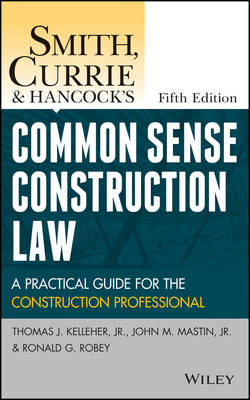
Smith, Currie and Hancock's Common Sense Construction Law
John Wiley & Sons Inc (Verlag)
9781118858103 (ISBN)
- Titel erscheint in neuer Auflage
- Artikel merken

Cut through the legalese to truly understand construction law Smith, Currie & Hancock's Common Sense Construction Law is a guide for non-lawyers, presenting a practical introduction to the significant legal topics and questions affecting the construction industry. Now in its fifth edition, this useful guide has been updated to reflect the most current developments in the field, with new information on Public Private Partnerships, international construction projects, and more. Readers will find full guidance toward the new forms being produced by the AIA, AGC, and EJDC, including a full review, comparison to the old forms, areas of concern, and advice for transitioning to the new forms. The companion website features samples of these documents for ease of reference, and end of chapter summaries and checklists help readers make use of the concepts in practice. The updated instructor support material includes scenario exercises, sample curriculum, student problems, and notes highlighting the key points student responses should contain.
Construction is one of the nation's single largest industries, but its fractured nature and vast economic performance leave it heavily dependent upon construction law for proper functioning. This book is a plain-English guide to how state and federal law affects the business, with practical advice on avoiding disputes and liability.
Understand construction law without wading through legal theory
Get information on an emerging method of funding large-scale projects
Parse the complexities presented by international and overseas projects
Migrate to the new AIA, AGC, and EJDC forms smoothly and confidently
This book doesn't cover legal theory or serve as a lawyer's guide to case law and commentary – its strength is the clear, unaffected common-sense approach that caters to the construction professional's perspective. For a better understanding of construction law, Smith, Currie & Hancock's Common Sense Construction Law is an efficient reference.
THOMAS J. KELLEHER, JR. is Senior Counsel with Smith, Currie & Hancock LLP. JOHN M. MASTIN, JR. is a Partner with Smith, Currie & Hancock LLP. RONALD G. ROBEY is a Partner with Smith, Currie & Hancock LLP. All three attorneys are in the firm's Atlanta, Georgia, office and are members of its Construction Litigation and Government Contracts practice groups.
Preface xxvii
Author Biographies xxix
1 The Legal Context of Construction 1
I. Introduction 1
II. Contract Law 1
III. Evolution of Construction Law 4
IV. Torts 5
V. Statutory and Regulatory Laws Affecting the Business of Construction 8
2 Interpreting the Contract 12
I. The Importance of Contract Interpretation 12
II. What Is a “Contract”? 12
III. The Goal of Contract Interpretation 13
IV. Defining Contract Terms 14
V. Interpreting the Contract’s Wording 15
VI. The Facts and Circumstances Surrounding Contract Formation 17
VII. Resolving Ambiguities 20
VIII. Implied Contractual Obligations 21
IX. Contractual Obligations Arising by Operation of Law 26
3 Alternative Contracting Methods 28
I. Traditional Approach to Construction: Advantages and Disadvantages 29
II. Multiprime Contracting and Fast-Tracking 30
III. Construction Management 32
IV. Design-Build Contracting: What Works to Avoid Disputes 36
V. Design-Build Aspects of Traditional Construction 46
VI. Contractor Liability Issues 50
VII. Engineer-Procure-Construct 52
VIII. Building Information Modeling 56
4 Public-Private Partnerships 61
I. The P3 Alternative 63
II. P3 Project Participants 71
III. P3 Financing Strategies 76
IV. P3 Risk Allocation 82
V. Conclusion 85
5 International Construction Contracts 87
I. Unique Issues 87
II. Project Delivery Methods and Contract Forms 89
III. Dispute Resolution 102
6 Working in a New State: Pre-proposal and Performance Considerations 108
I. Qualifying to Do Business 108
II. State Registration Requirements: Bonds to Secure Payment of Taxes 110
III. State Licensing and Qualifications 110
IV. State and Local Laws Governing Construction 112
V. Public-Sector Construction (State, Local, and Federally Funded State and Local Projects) 114
VI. State Statutes and Policies Affecting Contractual Relationships and Terms 117
VII. Preservation of LienBond Rights 123
VIII. Project Risk Assessment—“Foreign States” 126
IX. Information Sources 127
Appendix 6.1 Checklist: Projects in “Foreign States” 129
7 Competing for the Contract 133
I. Introduction: Transition from Sealed Bids to Negotiated Best-Value Awards 133
II. Key Concepts in Traditional Public Competitive Bids—Responsiveness and Responsibility 134
III. The “Lowest and Best” Bidder 140
IV. Negotiated “Best Value” Selection Process 143
V. Electronic Bids 145
VI. Reverse Auctions 147
VII. General Considerations When Competing on Private Contracts 148
VIII. Effect of Past Performance Evaluations on Award Process 149
IX. Contractor Bid Mistakes 157
X. Bid Protests on State or Local Government Contracts 162
XI. Bid Bonds 165
XII. “Bid Shopping”: What Is the Obligation of the Prime Contractor to the Subcontractor Submitting the Lowest Price? 167
XIII. Holding Subcontractors and Vendors to Their Bids 170
XIV. Statute of Frauds Issues 173
XV. Damages 174
8 The Uniform Commercial Code and the Construction Industry 177
I. Applicability to Construction Projects—Purchasing Equipment and Materials 177
II. Determining When Article 2 Applies 178
III. Modifying U.C.C. Obligations 179
IV. Contract Formation under the U.C.C. 179
V. Risk of Loss 183
VI. Inspection, Acceptance, Rejection, and Revocation of Acceptance 184
VII. Warranties under the U.C.C. 188
VIII. Statute of Limitations and Commencement of the Warranty Period 190
IX. Performance Issues 192
9 Authority and Responsibility of the Design Professional 199
I. Overview 199
II. Standard of Care, Professional Responsibility, and Liability 200
III. Authority of the Design Professional 208
IV. Administrative Functions of the Design Professional 211
V. Other Duties of the Design Professional 224
VI. The Design Professional’s Liability to the Contractor and Third Parties 225
VII. Statutes of Repose 232
VIII. Effects of Contractual Limitations on Design Professional Liability 234
IX. Assumption of Design Liability by the Contractor 238
X. Shared Responsibility and Risk 241
XI. The Design Professional’s Copyright for Design Documents 243
10 Subcontract Administration and Dispute Avoidance 248
I. Dispute Avoidance Begins at the Bidding Stage 248
II. Preparation of the Subcontract Agreement 254
III. Should Subcontractors Be Bonded? 277
IV. Dispute Avoidance by Diligent Project Administration 278
11 Contract Changes 291
I. What Is a Changes Clause? 291
II. Recovery under the Changes Clause 297
III. Who Is Authorized to Order Changes? 300
IV. Written Documentation of Changes 303
V. Constructive Changes 308
VI. Cardinal Changes 314
VII. The Impact of Numerous Changes on Unchanged Work 316
VIII. Impossibility Impracticability 317
12 Differing Site Conditions 320
I. “Differing Site Condition” Defined 320
II. Responsibility for Differing Site Conditions 320
III. Standard Industry Differing Site Conditions Clauses 321
IV. Comparison of DSC Provisions 330
V. Operation of the Differing Site Conditions Clause 332
VI. Stumbling Blocks to Recovery 343
VII. Relief in the Absence of a Contract Provision 351
Appendices—Site Investigation Checklists 356
I. General Notes 356
Appendix 12.1 Project Checklist: Qualifying the Site 357
Exhibit A: Site Investigation Record 358
Appendix 12.2 Pre-Bid Environmental Considerations 360
13 Schedules, Delays, and Acceleration 362
I. Allocating the Risk of Performance Time in the Contract 363
II. Use of Schedules in Project Management 369
III. Analysis of Project Delay 372
IV. Typical Causes of Compensable Delay 375
V. Concurrent Delay 382
VI. Excusable but Noncompensable Delays 383
VII. Acceleration 385
VIII. Contractual Limitations to Recovery for Delays 388
IX. Owner Claims for Delay 391
X. Delay Claims and the Use of CPM Schedules 392
XI. Documentation to Support Delay Claims 394
14 Inspection, Acceptance, Warranties, and Commissioning 399
I. Inspection 400
II. Acceptance 413
III. Contractual Warranties 420
IV. Project Commissioning and Post-Acceptance Facility Operations 425
15 Management Techniques to Limit Risks and Avoid Disputes 431
I. Construction: A Risk-Prone Business 431
II. Qualifying the Project and the Participants 432
III. Defining Rights, Responsibilities, and Risks: Parties and Their Contracts 439
IV. Contract Framework 441
V. Avoiding and Preparing for Disputes through Proper Management and Documentation 445
VI. Prudent and Responsible Estimating 446
VII. Establish Standard Operating Procedures 447
VIII. Establish Lines of Communication 447
IX. Project Documentation 448
X. Electronic Communications on Construction Projects 455
XI. Cost Accounting Records 459
XII. Monitoring the Work through Scheduling 460
XIII. Preserving Electronically Stored Information 461
XIV. Conclusion 462
Appendix 15.1 Consensus Docs 221—Contractor’s Statement of Qualifications for a Specific Project 465
Appendix 15.2 Logs and Forms 475
Appendix 15.2A Format for Notice Checklist 476
Appendix 15.2B Sample Partial Notice Checklists 478
Appendix 15.2C Forms 482
Appendix 15.2D Request for Information 487
Appendix 15.2E Telephone Conversation Memorandum 488
Appendix 15.2F Sample Daily Report 489
Appendix 15.2G Notice of Backcharge 490
Appendix 15.2H Field Order Status Chart 491
Appendix 15.2I Log: Incoming Correspondence 492
Appendix 15.2J Log: Outgoing Correspondence 493
16 Payment Bonds 494
I. Payment Bonds Required by Statute 495
II. Payment Bonds on Private Projects 501
III. Who Is Protected by Payment Bonds 501
IV. Work Qualifying for Payment Bond Coverage 507
V. Recovery under Payment Bonds for Extra Work, Delay Damages, or Lost Profits, and Other Costs 510
VI. Distinguishing between Payment Bond Claims and Performance Bond Claims 513
VII. Procedural Requirements 513
VIII. Effect of Payment Bonds on Lien Rights 517
IX. The Surety’s Defenses to Payment Bond Liability 518
17 Performance Bonds and Terminations 522
I. Surety Performance Bonds 522
II. Termination 540
18 Proving Costs and Damages 558
I. Basic Damage Principles 558
II. Methods of Pricing Claims 565
III. Contractor Damages 568
IV. Owner Damages 584
19 An Overview of Environmental and Safety Concerns on the Construction Site 593
I. Sources of Environmental Regulation and Liability 593
II. Minimizing Environmental Risks Prior to Contracting 603
III. Management Techniques for Environmental Risks during Contract Performance 609
IV. Mold: Developing a Program to Limit Liability 611
V. Environmentally Friendly Construction: Green Buildings 613
VI. Construction Safety 617
20 Construction Insurance 627
I. Importance of Insurance Planning 627
II. Introduction to the Language of Insurance Policies 628
III. Types of Insurance 630
IV. Contract Requirements for Insurance 637
V. Prompt Action to Protect Potential Coverage 640
VI. Insurer’s Response to Claims 641
VII. Routine Coverage Issues 643
VIII. Concurrent Causes 650
IX. Construction Insurance and Mold Claims 651
21 Labor and Employment Issues Affecting the Construction Industry 658
I. Immigration Issues 658
II. Employee Safety and Health 664
III. Wage and Hour Requirements 665
IV. Employee Benefits: ERISA 676
V. Employment Discrimination 677
VI. Family and Medical Leave Act 687
VII. Union Activity 689
VIII. Utilizing Employee Background Investigations 693
IX. Workers’ Compensation—Exclusive Remedy Assertions 695
22 Bankruptcy in the Construction Setting 698
I. Introduction 698
II. The Players 698
III. Key Terms 699
IV. Bankruptcy Code 701
V. Status of the Debtor’s Contracts 710
VI. Status of Materials and Equipment 715
VII. Status of Contract Funds 718
VIII. Other Sources of Funds 723
23 Resolution of Construction Disputes 730
I. Early Claim Recognition and Preparation 731
II. Early Involvement of Experts and Attorneys 732
III. Demonstrative Evidence 734
IV. Contemporaneous Records 735
V. Components of a Well-Prepared Claim Document 736
VI. Calculating and Proving Damages 738
VII. Pursuing Negotiation and Settlement 739
VIII. Arbitration 743
IX. Litigation 755
24 Federal Government Construction Contracting—An Overview 764
I. Introduction: The Key Differences 764
II. Contractor Selection 770
III. Social-Economic Policies 778
IV. Resolution of Contract Disputes 800
V. Standards of Conduct for Contractors 811
Appendix A Basic Internet Resources and References—Federal Government Construction Contracts 818
I. System for Award Management (SAM) 818
II. Fed Biz Opps 818
III. Information on Regulations and Agencies 818
Reference Materials 819
Index 821
| Erscheint lt. Verlag | 20.2.2015 |
|---|---|
| Verlagsort | New York |
| Sprache | englisch |
| Maße | 152 x 236 mm |
| Gewicht | 1338 g |
| Themenwelt | Recht / Steuern ► Allgemeines / Lexika |
| Recht / Steuern ► EU / Internationales Recht | |
| Technik ► Architektur | |
| Technik ► Bauwesen | |
| ISBN-13 | 9781118858103 / 9781118858103 |
| Zustand | Neuware |
| Informationen gemäß Produktsicherheitsverordnung (GPSR) | |
| Haben Sie eine Frage zum Produkt? |
aus dem Bereich