


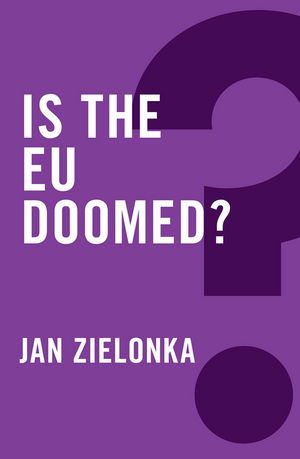
Is the EU Doomed? (eBook)
John Wiley & Sons (Verlag)
978-0-7456-8400-0 (ISBN)
In this compelling essay, leading scholar of European politics, Jan Zielonka argues that although the EU will only survive in modest form - deprived of many real powers - Europe as an integrated entity will grow stronger. Integration, he contends, will continue apace because of European states' profound economic interdependence, historic ties and the need for political pragmatism. A revitalized Europe led by major cities, regions and powerful NGOs will emerge in which a new type of continental solidarity can flourish.
The EU may well be doomed, but Europe certainly is not.
Jan Zielonka is professor of European politics at St Antony's College, Oxford.
The European Union is in crisis. Crippled by economic problems, political brinkmanship, and institutional rigidity, the EU faces an increasingly uncertain future. In this compelling essay, leading scholar of European politics, Jan Zielonka argues that although the EU will only survive in modest form - deprived of many real powers - Europe as an integrated entity will grow stronger. Integration, he contends, will continue apace because of European states profound economic interdependence, historic ties and the need for political pragmatism. A revitalized Europe led by major cities, regions and powerful NGOs will emerge in which a new type of continental solidarity can flourish. The EU may well be doomed, but Europe certainly is not.
Jan Zielonka is professor of European politics at St Antony's College, Oxford.
Prologue ix
Acknowledgements xv
1 Crisis 1
2 Disintegration 21
3 Reintegration 49
4 Vision 73
5 Practising Polyphony 101
Further Reading 115
Notes 119
"Zielonka offers a new and refreshing vision of Europe's future -
one that chimes perfectly with the EU's motto 'United in
Diversity'."
Giuliano Amato, former Prime Minister of Italy
"A provocative and thoughtful book which comes at a critical moment
for European integration."
Lionel Barber, Financial Times
"Jan Zielonka is one of the most original and sophisticated
observers of European politics. So when he expresses disillusion
with both the EU and its Member States we should pay attention to
where he thinks we are heading. This lucid and incisive book is a
key source for understanding the current impasse."
Christopher Hill, University of Cambridge
"The EU may be not doomed but it is in deep crisis. In this
provocative book Jan Zielonka offers an original and controversial
proposal for a radically different model of European
integration. Challenging conventional views he considers the
prospects of a 'neo-medieval' Europe composed of networks of
cities, regions and ONG's where a 'polyphony' among actors will
replace the current cacophony of the centres."
Josep Borrell Fontelles, former President of the European
Parliament and former President of the European University
Institute
"Jan Zielonka has written a punchy, incisive and devastating
account of the EU and its malaise after the financial crisis. He
combines his plea to move away from 'sanctimonious protestant
preaching' with a convincing sketch of how a more chaotic pattern
of networks between cities, provinces but also a wide range of
social and corporate institutions might produce a more durable,
effective and also legitimate governance. The treatment is
eloquent but also wise."
Harold James, Princeton University
"A fascinating and thought-provoking book that will change our view
of the EU as neither a true state nor an ever-changing cacophony of
nations."
Josef Joffe, Stanford University and Editor of Die
Zeit
"Jan Zielonka's brilliant analysis of European disintegration is
packed with big ideas that are elegantly expressed. It acts as an
original and iconoclastic challenge to both the euro-sceptic and
the euro-federalist discourses on the crisis. This is a must-read
book for anyone who cares about the future of Europe."
Mark Leonard, Director of the European Council on Foreign
Relations
"Whether or not you agree with Jan Zielonka's arguments, you will
find this book a stimulating read. I'm sure it will provoke much
discussion about the future development of the European
Union."
Lord Patten of Barnes CH, Chancellor of the University of Oxford
and former European Commissioner for External Affairs
"A brilliant and profoundly original analysis of the European
Crisis. A work of optimism, as well!"
William Pfaff, Author and Syndicated Columnist
"Zielonka is an intellectual provocateur in the best sense of the
word...this book will stimulate debate on Europe's continuing
multinational experiment."
Foreign Affairs
2
Disintegration
Germany’s Chancellor, Angela Merkel, has repeatedly declared that the plunge of the euro would mean the collapse of Europe.1 In 2011, Poland’s then Finance Minister, Jacek Rostowski, added that war could well be the outcome of this scenario.2 None of this has happened and in the summer of 2013 some analysts began to suggest that the euro-zone’s eighteen-month-long recession might be over. Who is right: the pessimists or the optimists? Nobody knows – with the possible exception of a few fortune tellers and astrologers. The Habsburg Empire was said to be mad, bad and unfit to rule, and yet it persisted for over six hundred years. The Soviet Union was said to be remarkably stable, and yet it collapsed with little advance notice, to the embarrassment of Western Kremlin watchers. But are these cases particularly helpful for understanding the rise and fall of the EU, which is said to be sui generis? The problem is that EU experts have written a lot about the rise of the EU, but virtually nothing about its possible downfall. We have many theories of European integration, but practically none of European disintegration. It is even difficult to say what disintegration would imply. If Cyprus leaves the euro-zone or the UK successfully renegotiates its terms of EU membership, does this suggest disintegration or merely a legal adjustment? If EU member states vote against each other in the United Nations Security Council, does this denote a routine legitimate disagreement or disintegration? If the euro-zone integrates further, but those EU member states that are unable or unwilling to adopt the euro are left in limbo, is this integration or disintegration? Is disintegration reversible? Is it a product or a process? How much time has to pass before we can conclude whether or not disintegration has actually happened: a month, a year or a decade? And what could be the broader economic, political and international implications of European disintegration? Clearly, it is a struggle to try to address these increasingly pertinent questions.
The problem is compounded by the numerous and fuzzy definitions of integration. Some scholars argue that integration is merely about increased economic and social interactions, but others suggest that it is about building a European super-state. Some see integration as a uni-directional movement from one European treaty to another, but others would like to see a tangible shift of political loyalties to the new European centre before we can talk about it. If we do not really know what integration implies, how can we define the opposite process? And is integration the opposite of disintegration, as democracy is of autocracy? Can the single market project progress despite the fall of the single currency or disintegration in the field of Justice and Home Affairs? Can the ‘North Sea Alliance’ integrate while ‘Club Med’ is disintegrating? There is no point in multiplying these kinds of tortuous questions, yet we need to search for a minimum degree of intellectual clarity or else face onerous practical consequences.
At least three possible scenarios of disintegration require scrutiny. The first sees Europe’s leaders losing control over the unfolding financial or political events. The second suggests that they try to address problems, but end up making things worse. The third scenario envisages a benign-neglect policy with not so benign implications. As Ivan Krastev suggested: ‘The EU’s disintegration need not be the result of a victory by anti-EU forces over pro-EU forces. If it happens, it will probably be an unintended consequence of the Union’s paralysis, compounded by the elites’ misreading of national political dynamics.’3
Scenarios of disintegration
At the peak of the euro crisis, an economic avalanche beyond anybody’s control was seen as the most likely scenario of disintegration. The term ‘avalanche’, rather than ‘tsunami’, suggests that disintegration could be man-made: for instance, by pushing Greece out of the euro-zone. In 2012 such a step may have sounded like a reasonable response to public opinion in Germany, France or Holland, but policy-makers clearly feared that it could prompt an unmanageable sequence of events. At the time, some analysts predicted that the Greek exit, or ‘Grexit’ as it was called in financial circles, could trigger a 50 per cent fall in euro stocks, while others estimated the costs of the Greek default to be similar to those inflicted by the Lehman Brothers failure. Mutual accusations, retaliations and recriminations would surely follow such disastrous economic developments, generating political chaos. Germany would be the prime suspect in the ensuing blame game. Some countries would create a bandwagon behind Germany; others would try to form a counter-alliance to balance it. Since chaos is heaven for populist politics, nationalism would thrive. The politics of territorial claims and financial recriminations would ensue. Some argued that the end result would be the rise of the Fourth Reich, while others predicted a return to Westphalia. Needless to say, Ms Merkel was very keen to avoid either scenario, but some of her country’s politicians were happy to endorse the ‘Grexit’, nevertheless. Luckily for Merkel, the German Constitutional Court stopped short of judging the Greek bailout unconstitutional, and her cautious policy prevailed.
Each time the financial markets stopped hammering the euro, the abrupt scenario of disintegration seemed less credible. However, it is too early to say that the euro is safe and well. A 2013 study of possible scenarios for the euro-zone in the year 2020 prepared by the Friedrich-Ebert-Stiftung still argues that the ‘euro house’ can fall apart.4 Moreover, the EU may again find itself in trouble owing to the pressure of external shocks that have little to do with the euro as such. Consider, for instance, the economic implications for Europe of a possible crisis in China. China is by far the EU’s biggest source of imports, and has also become one of its fastest growing export markets. The EU has also become China’s biggest source of imports. China and Europe now trade well over €1 billion a day. China also has large holdings of the euro. The situation in Europe’s backyards, from Tripoli and Cairo to Pristina, Minsk and Kiev, is also not comforting. A cocktail of internal and external shocks can produce a spiral of events that would be beyond anybody’s control. Europe’s leaders have numerous instruments to cope with economic and political shocks, but it is naïve to think that they are always able to steer the rapidly evolving course of events. Besides, regardless of intentions, their policies may make the situation worse rather than better.
Reforms may sometimes spark dramatic unintended outcomes, which brings us to another possible scenario of disintegration. The Soviet Union collapsed after Mikhail Gorbachev began introducing economic and democratic reforms. Historians point to reforms of the Habsburg Empire that accelerated its demise. The so-called ‘Austro-Hungarian Compromise’ of 1867, which led to the creation of a dual monarchy with two separate parliaments and prime ministers in Budapest and Vienna, provides a good example. At present the 2012 Fiscal Compact is said to be driving the Union apart because it imposes excessively rigid, counter-productive policies on the debtor states which some have also considered unjust. Plans to create a more ambitious economic and political union as a response to the euro crisis could have even more profound negative implications.
A political and economic union of many distinct entities, however interdependent, would be at pains to identify a set of common interests that could guide its policies. It would only work if composed of a few like-minded and similar-looking European states. Such a core Europe would create a new divide across the continent, raising fear and suspicion. Some EU member states would be worried about being excluded, while others would fear that joining would subject them to domination by other core members. In other words, a jump into a fully fledged union is likely to destabilize relations among European states, and break cooperative arrangements. A federation, however light, may well be attempted with the intention of saving integration, but in reality it may well prompt disintegration.
Disintegration may also be caused by the reforms to the EU advocated by the UK under David Cameron. The official aim of the proposed reforms is certainly noble: making the EU more flexible, competitive, and taking account of the changes within the euro-zone. This is why Cameron can rely on the support of several EU partners who have become impatient with Brussels’ rigidity and immobility. However, the form of orchestrating the reforms through the process of renegotiating the existing treaties is likely to generate conflicts and diplomatic deadlocks. Cameron himself contemplates not merely universal reforms, but also specific UK opt-outs from EU employment law, social policies, criminal law and regional funding structures. Cameron’s allies will all have different individual opt-outs in mind as well, and it is far from certain that they will agree on the overall blueprint of universal reforms. The fact that the outcome of treaty renegotiations is subject to national referenda in some countries leaves little room for pragmatic solutions. Moreover,...
| Erscheint lt. Verlag | 5.6.2014 |
|---|---|
| Reihe/Serie | Global Futures |
| Global Futures | Global Futures |
| Sprache | englisch |
| Themenwelt | Recht / Steuern ► EU / Internationales Recht |
| Sozialwissenschaften ► Politik / Verwaltung ► Europäische / Internationale Politik | |
| Sozialwissenschaften ► Politik / Verwaltung ► Vergleichende Politikwissenschaften | |
| Wirtschaft ► Volkswirtschaftslehre ► Makroökonomie | |
| Schlagworte | Economics • Europäische Union • Europäische Union /Politische Theorie, Geschichtsschreibung • Europäische Union • Europäische Union /Politische Theorie, Geschichtsschreibung • European politics • Eurozone, Europe, crisis, Angela Merkel, European politics, politics, international relations, crisis, integration • Internationale Ãkonomie u. internationaler Handel • International Economics & Trade • Internationale Ökonomie u. internationaler Handel • Internationale Politische Ãkonomie • Internationale Politische Ökonomie • International Political Economy • Political Science • Politik / Europa • Politikwissenschaft • Volkswirtschaftslehre |
| ISBN-10 | 0-7456-8400-9 / 0745684009 |
| ISBN-13 | 978-0-7456-8400-0 / 9780745684000 |
| Informationen gemäß Produktsicherheitsverordnung (GPSR) | |
| Haben Sie eine Frage zum Produkt? |
 EPUB (Adobe DRM)
Kopierschutz: Adobe-DRM
Adobe-DRM ist ein Kopierschutz, der das eBook vor Mißbrauch schützen soll. Dabei wird das eBook bereits beim Download auf Ihre persönliche Adobe-ID autorisiert. Lesen können Sie das eBook dann nur auf den Geräten, welche ebenfalls auf Ihre Adobe-ID registriert sind.
Details zum Adobe-DRM
Dateiformat: EPUB (Electronic Publication)
EPUB ist ein offener Standard für eBooks und eignet sich besonders zur Darstellung von Belletristik und Sachbüchern. Der Fließtext wird dynamisch an die Display- und Schriftgröße angepasst. Auch für mobile Lesegeräte ist EPUB daher gut geeignet.
Systemvoraussetzungen:
PC/Mac: Mit einem PC oder Mac können Sie dieses eBook lesen. Sie benötigen eine
eReader: Dieses eBook kann mit (fast) allen eBook-Readern gelesen werden. Mit dem amazon-Kindle ist es aber nicht kompatibel.
Smartphone/Tablet: Egal ob Apple oder Android, dieses eBook können Sie lesen. Sie benötigen eine
Geräteliste und zusätzliche Hinweise
Buying eBooks from abroad
For tax law reasons we can sell eBooks just within Germany and Switzerland. Regrettably we cannot fulfill eBook-orders from other countries.


