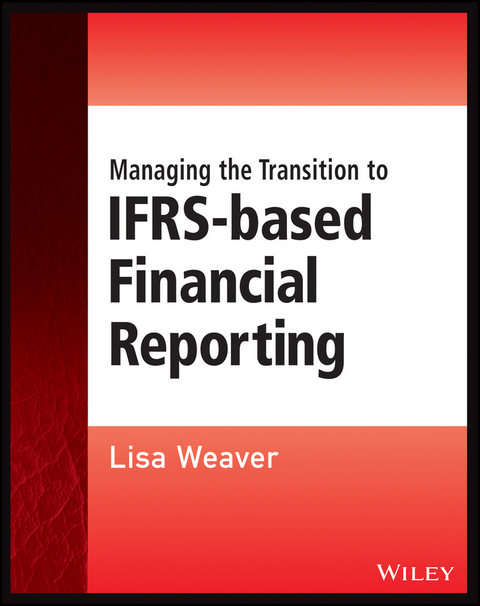
Managing the Transition to IFRS-Based Financial Reporting (eBook)
John Wiley & Sons (Verlag)
978-1-118-64412-6 (ISBN)
Since 2005, all EU listed companies have been reporting under IFRS in their group accounts. The UK’s Accounting Standards Board is proposing that in the next few years all UK companies, other than the smallest, will move to some form of IFRS-based financial reporting. The US is also undergoing a transition to IFRS, as are many other countries such as India and Japan.
This book will cover the most common accounting issues involved in a move to IFRS, and deal with the specific accounting and disclosure requirements in the first year of IFRS reporting. Crucially, however, the book will also focus on how to plan and manage the transition, fully exploring the non-accounting implications based on the experience of companies that have already gone through the transition.
The book:
- Provides a clear summary of the main IFRS accounting requirements which are specific to IFRS transition
- Focusses on planning and managing the IFRS transition project
- Emphasises the non-accounting implications of IFRS transition
- Considers how to best communicate and educate about the IFRS transition
- Includes case studies of companies that have gone through the IFRS transition
Managing the transition to IFRS-based financial reporting does not focus on any specific country, instead offering advice which can be applied in all jurisdictions. This international appeal, coupled with its holistic approach, makes it the one-stop guide to managing this vital transition.
The one-stop guide to transitioning to IFRS financial reporting The International Financial Reporting Standards (IFRS) have already been adopted in Europe, and plans are in place to transition to IFRS reporting in the UK, India, Japan, and other major economies. The US is deliberating the nature of its convergence with IFRS and US entities will need to understand the implications of transition. This means all finance managers and financial controllers will be responsible, not only for understanding IFRS, but for making the transition and dealing with implications. Managing the Transition to IFRS-Based Financial Reporting is a one-stop resource for navigating this major change. Case studies and project management advice help move smoothly from GAAP to IFRS principles and requirements. Managing the Transition to IFRS-Based Financial Reporting is the only book on the market that focuses on both the accounting and non-accounting implications of IFRS transition. This complete approach will guide you from the history and conceptual basis of IFRS through each stage of the transition process, ensuring expert change management and fluid communication from start to finish. Takes a holistic approach, covering non-accounting implications like educating and communicating IFRS requirements Provides case studies to illustrate best practices for moving to the new international standards Provides a framework for planning and executing the entire IFRS transition project With nearly two decades of financial training experience, author Lisa Weaver is imminently qualified to deliver clear, concise, and understandable content. In addition, the reference material and other resources in Managing the Transition to IFRS-Based Financial Reporting will help you simplify the transition and take advantage of all the benefits IFRS reporting confers.
LISA WEAVER, is a professionally qualified accountant and a Fellow of the Institute of Chartered Accountants in England and Wales. After working in audit for several years, she moved into training and education and has lectured on financial reporting, audit and governance topics in the UK and Ireland, the Caribbean, and in Hong Kong and China. She is currently a Teaching Fellow in Accounting at Aston Business School, part of Aston University in the UK.
List of Tables vii
List of Figures ix
List of Case Studies xi
Foreword xiii
Preface xv
Disclaimer xvii
Acknowledgements xix
About the Author xxi
Introduction xxiii
I: Understanding the Framework of Performing a Transition to
IFRS-based Financial Reporting 1
1 International Financial Reporting in Context 3
2 The Conceptual Framework of IFRS, Accounting Policies and the
Presentation of Financial Statements 25
3 IFRS 1 First-time Adoption of IFRS 43
II: Planning and Implementing a Transition Project 67
4 Establishing the IFRS Transition Project 69
5 Assessing the Accounting Impacts of IFRS Transition 105
6 Wider Transitional Issues - Systems, Internal Audit and
the Audit Committee, and Commercial Implications 129
7 Training, Communication and Change Management 163
III: The Way Forward - Developments in Selected
Countries 187
8 The Transition to New UK GAAP 189
9 The Way Forward - The Move Towards IFRS in the US and
Selected Other Countries 207
Appendix 1: IASB Standards 223
Appendix 2: Useful Reference Material and Further Reading
225
Appendix 3: Summary of IFRS Transition Planning Considerations
229
Bibliography 231
Index 237
INTRODUCTION
SCOPE AND KEY THEMES OF THE BOOK
The transition to International Financial Reporting Standards (IFRS) has been an increasingly significant feature of financial reporting across the globe in the last few years. At the time of writing, more than 120 countries and jurisdictions require or permit the use of IFRS, or financial reporting standards substantially based on, or converged with, IFRS, by some or all of their reporting entities. The International Accounting Standards Board (IASB), the body charged with setting IFRSs, is confident that the use of IFRS, or national accounting standards that are based on IFRS, will grow in the next decade. Hans Hoogervorst, the IASB Chair, stated recently that there is almost universal support for IFRS as the single set of global accounting standards (Hoogervorst, 2013), and organisations including the World Bank, the G20 and the International Organization of Securities Commissions (IOSCO) support the concept of harmonisation of corporate reporting.
Thousands of companies, public sector entities and other organisations have gone through a transition to IFRS-based reporting in the last decade, and many more thousands will do so in the next few years. The huge advantage that relatively late adopters of IFRS-based reporting have is that they can learn from the experience of those that have already gone through the transition. It is fair to say that for reporting entities that were early adopters, there was a significant learning curve for all involved, and one of the aims of this book is to capture some of those experiences of early adopters and explain how to capitalise on them in terms of developing an appropriate transition strategy.
In short, the book aims to show how to apply project management principles to the transition, ensuring that all possible benefits are accrued and that the transition is as smooth as possible. Poorly planned transitions can be inefficient and incur unnecessary costs, and turn into a process of survival rather than an appropriately managed business transformation.
Some transitions are very complex and take years to plan and execute. In transitions like these there may be a large number of material adjustments made to the financial statements on the first-time application of IFRS. Other transitions are much simpler and require minimal restatements of financial information. The key issue is that no two transitions are the same, even for entities of a similar size operating in the same industry, so a bespoke planning and implementation process is needed. All transitions need to be carefully planned for. The planning phase may well justify that only a small number of accounting adjustments are needed, but the time must be spent to perform that detailed impact analysis to prove that that is the case.
The transition should be approached as a significant business project, as it has potentially far-reaching consequences and is definitely not “just an accounting issue”. Many entities that have gone through transition report that they significantly underestimated the time that it would take, the amount of planning that was required, the wider implications away from the accounting function, and the importance of training and of an effective communication strategy. The transition project, therefore, needs to be viewed holistically and should involve personnel from a range of business functions. The involvement of external consultants should also be considered.
This book focuses on the requirements and principles of the IFRSs as issued by the IASB. However, it is important to note that in many jurisdictions it is not strictly the IFRSs as issued by the IASB that are required or permitted for use. In many cases, national or regional authorities make amendments to IFRSs before endorsing them for use. An example is in the European Union, where the IFRSs go through a due process of endorsement before being adopted for use in the EU, and sometimes changes are made to the standards to reflect local conditions. In other jurisdictions IFRSs are not adopted per se; instead, national financial reporting standards are converged with IFRS, so that while based on similar principles, reasonably significant differences remain between local GAAP and IFRS. Due to the generic nature of this book it is not possible to discuss the amendments made to IFRS by a multitude of local authorities or to consider the variety of local GAAPs that have been converged with IFRS. The term IFRS-based financial reporting is used to cover situations ranging from the wholesale adoption of IFRSs as issued by the IASB to the convergence of national GAAP with the principles of IFRS. In any eventuality, for reporting entities moving from previous GAAP to IFRS-based reporting, there needs to be careful planning of the transition to ensure that all impacts have been identified and appropriate decisions made.
It should be noted that not all transitions to IFRS-based financial reporting are complex or difficult. In jurisdictions where there is minimal difference between previous GAAP and IFRS there are less likely to be major adjustments to make to the financial statements or accounting systems. However, even where transitions on first glance would seem not to be problematical, there is still a need for detailed planning, particularly of accounting impacts, because unexpected transitional implications can arise. It is sometimes necessary to conduct a detailed impact assessment just to demonstrate that there are no significant impacts.
AN OVERVIEW OF THE BOOK
The book is in three parts. The first part puts IFRS into context, providing a framework for approaching a transition-planning project. The first chapter contains a discussion of the history of global financial reporting standards and the status of IFRS, the relevant regulatory framework, and the reasons behind international harmonisation, including benefits and drawbacks. The IFRS standard-setting process is summarised, and the current position of convergence around the world, focusing on major economies, is also included. A short section covers the IFRS for Small and Medium-sized Entities, which is relevant to a large number of companies.
Chapter 2 provides an introduction to the fundamental principles of IFRS in terms of the presentation of financial information and the key factors that should be considered in developing IFRS-compliant accounting policies, outlining key concepts such as the qualitative characteristics and the elements of the financial statements. This chapter looks at the key elements of financial statements and their presentation under IFRS.
The third chapter focuses on the specific requirements of IFRS 1 First-time Adoption of IFRS, a detailed accounting standard, which has to be applied in the first financial statements of a company that are prepared and presented under IFRS. This chapter provides a discussion of the measurement and presentation rules, the specific disclosure requirements for the notes to the financial statements, and the exemptions that are available in preparing the first IFRS financial statements. Case studies are used to illustrate the accounting and disclosure issues relevant to first-time adoption of IFRS. This is the most technical chapter in the book, and IFRS transition planning tips are included at regular intervals to bring the technical discussion back to the main theme of the book; in other words, how to plan and manage the transition.
The second part of the book deals with planning and executing the transition to IFRS-based financial reporting. This is a practical section containing suggestions on matters such as project management techniques, devising a communications strategy, dealing with IT changes and recruitment and training issues, as well as accounting implications. Chapter 4 contains a discussion of the potential scale of the IFRS transition project and why project management techniques need to be used to manage and coordinate the project. This chapter introduces the key concept that IFRS transition is not just an accounting issue but involves many different areas of a business, so planning and coordination is essential to ensure a smooth and cost-effective transition. This chapter outlines the main tasks in establishing the transition project and considers the personnel that are typically involved in planning and implementing IFRS transition, and how to bring the team together. The stages of the transition project are outlined, and some of the impact assessments that should be performed are introduced, such as assessing the impact on financial reporting, the need for changes in systems and controls, the non-financial aspects such as legal and stakeholder education, and how the project will be resourced. A potential action plan is suggested to show how the project can be scoped out with realistic milestones put in place.
Some companies will not have the resources to plan and implement the project in-house and will rely on external advisors such as auditors, systems designers and tax advisors. This chapter explores the ways that external advisors may be able to provide much of the resource needed to plan and carry out the IFRS transition. The problems of relying on external advisors are explored, with issues including cost, loss of control of the project, and ethical issues if the company's auditor is asked to help with the transition. The typical costs that are incurred in the transition are discussed and the importance of budgeting is emphasised. The IFRS transition project can be very costly. Chapter 4 analyses the typical costs involved and considers how best to plan for these costs based on the experience of companies that have already gone through the...
| Erscheint lt. Verlag | 16.5.2014 |
|---|---|
| Reihe/Serie | Wiley Regulatory Reporting |
| Wiley Regulatory Reporting | Wiley Regulatory Reporting |
| Sprache | englisch |
| Themenwelt | Recht / Steuern ► Wirtschaftsrecht |
| Wirtschaft ► Betriebswirtschaft / Management ► Rechnungswesen / Bilanzen | |
| Wirtschaft ► Betriebswirtschaft / Management ► Unternehmensführung / Management | |
| Schlagworte | Accounting • Accounting Principles • Case Studies • Change Management • Europe • finance managers • Financial Accounting • financial controllers • Financial Reporting • financial reporting system • financial training • Finanzbuchhaltung • GAAP • IFRS • IFRS reporting • IFRS requirements • IFRS transition • India • International Accounting • Internationales Rechnungswesen • International finance • International Financial Reporting Standards • International standards • Japan • Lisa Weaver • Managing the Transition to IFRS-Based Financial Reporting • non-accounting implications • Project Management • Rechnungswesen • UK • US |
| ISBN-10 | 1-118-64412-3 / 1118644123 |
| ISBN-13 | 978-1-118-64412-6 / 9781118644126 |
| Informationen gemäß Produktsicherheitsverordnung (GPSR) | |
| Haben Sie eine Frage zum Produkt? |
 EPUB (Adobe DRM)
Kopierschutz: Adobe-DRM
Adobe-DRM ist ein Kopierschutz, der das eBook vor Mißbrauch schützen soll. Dabei wird das eBook bereits beim Download auf Ihre persönliche Adobe-ID autorisiert. Lesen können Sie das eBook dann nur auf den Geräten, welche ebenfalls auf Ihre Adobe-ID registriert sind.
Details zum Adobe-DRM
Dateiformat: EPUB (Electronic Publication)
EPUB ist ein offener Standard für eBooks und eignet sich besonders zur Darstellung von Belletristik und Sachbüchern. Der Fließtext wird dynamisch an die Display- und Schriftgröße angepasst. Auch für mobile Lesegeräte ist EPUB daher gut geeignet.
Systemvoraussetzungen:
PC/Mac: Mit einem PC oder Mac können Sie dieses eBook lesen. Sie benötigen eine
eReader: Dieses eBook kann mit (fast) allen eBook-Readern gelesen werden. Mit dem amazon-Kindle ist es aber nicht kompatibel.
Smartphone/Tablet: Egal ob Apple oder Android, dieses eBook können Sie lesen. Sie benötigen eine
Geräteliste und zusätzliche Hinweise
Buying eBooks from abroad
For tax law reasons we can sell eBooks just within Germany and Switzerland. Regrettably we cannot fulfill eBook-orders from other countries.
aus dem Bereich