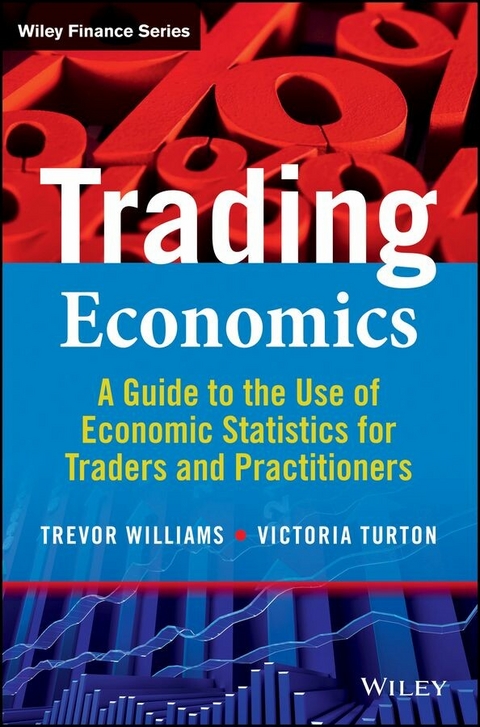
Trading Economics (eBook)
John Wiley & Sons (Verlag)
978-1-118-76638-5 (ISBN)
The recent global financial crisis stressed the need for economists who understand how key economic and market statistics drive financial market trends and how to mitigate the risks for businesses that those trends affect. Trading Economics provides guidance for navigating key market figures in a convenient and practical format. Emphasizing the link between economic data and market movements, this book analyzes surveys, economic growth statistics, inflation, labor markets, international trade, monetary and fiscal indicators, and their relevance in financial markets. It bypasses complex terminology to offer a hands-on, accessible introduction to financial statistics and how to profit from them.
- Offers clear illustrations and an easy-to-read layout to teach you how to trade profitably in financial markets and minimizes risk for your business
- Written Trevor Williams and Victoria Turton, authoritative public figures with experience working on the New York Stock Exchange
- Includes a website featuring a blog and new surveys as they develop accompanies the book
Complete with worked examples and updated information, Trading Economics is an essential, comprehensive guide to understanding every aspect of financial market trends and how to navigate them to your advantage.
Trevor Williams joined Lloyds Banking Group from the UK Civil Service after doing some lecturing. Trevor is currently the Chief Economist at Lloyds Bank, Commercial Banking. He regularly writes articles for publications and appears in the financial press and on television to represent economic views. Trevor is a member of the Institute for Economic Affairs Shadow Monetary Policy Committee, made up of City economists and academics. This is the oldest ‘shadow’ MPC, set up two months after the official MPC began in 1997. He is a visiting Professor, Banking and Finance, Derby University.
Victoria Turton graduated from the universities of Sheffield and Manchester with degrees in History before joining the Bank of Scotland Corporate. She is currently a Senior Copywriter at Editions Financial as well as a freelance writer and editor. She lives in North Yorkshire and is married with two sons.
A practical guide to understanding how key economic and market statistics drive financial market trends The recent global financial crisis stressed the need for economists who understand how key economic and market statistics drive financial market trends and how to mitigate the risks for businesses that those trends affect. Trading Economics provides guidance for navigating key market figures in a convenient and practical format. Emphasizing the link between economic data and market movements, this book analyzes surveys, economic growth statistics, inflation, labor markets, international trade, monetary and fiscal indicators, and their relevance in financial markets. It bypasses complex terminology to offer a hands-on, accessible introduction to financial statistics and how to profit from them. Offers clear illustrations and an easy-to-read layout to teach you how to trade profitably in financial markets and minimizes risk for your business Written Trevor Williams and Victoria Turton, authoritative public figures with experience working on the New York Stock Exchange Includes a website featuring a blog and new surveys as they develop accompanies the book Complete with worked examples and updated information, Trading Economics is an essential, comprehensive guide to understanding every aspect of financial market trends and how to navigate them to your advantage.
Trevor Williams joined Lloyds Banking Group from the UK Civil Service after doing some lecturing. Trevor is currently the Chief Economist at Lloyds Bank, Commercial Banking. He regularly writes articles for publications and appears in the financial press and on television to represent economic views. Trevor is a member of the Institute for Economic Affairs Shadow Monetary Policy Committee, made up of City economists and academics. This is the oldest 'shadow' MPC, set up two months after the official MPC began in 1997. He is a visiting Professor, Banking and Finance, Derby University. Victoria Turton graduated from the universities of Sheffield and Manchester with degrees in History before joining the Bank of Scotland Corporate. She is currently a Senior Copywriter at Editions Financial as well as a freelance writer and editor. She lives in North Yorkshire and is married with two sons.
Introduction
Today's interconnected world, linked by freer trade, by some of the greatest movements of people through tourism and immigration the world has ever seen, by the movement of goods and services – all underpinned by new methods of open communication that were unimaginable a generation or so ago and involving more countries than ever before – means that an understanding of economics matters more than ever. It is no surprise, therefore, that headlines scream economic news, newspapers are full of stories based on statistics about economic performance within and amongst countries, government officials are constantly discussing the economy and there are pundits, radio and TV shows, some broadcasting 24 hours a day, with ‘experts’ claiming to know all sorts of things based on economic data. Then there are all the blogs, tweets and internet media channels to add to the mixture. With the cacophony of noise from these media, it is increasingly hard to discern the underlying economic trends from what are often conflicting data.
What has allowed today's world to come into being is a belief that more trade is better than less trade, that producing goods and services where it is cheapest to do so allows for a rise in living standards for all concerned (though not all to the same extent). This outcome is based on one of the fundamental elements of economic rationale – the division of labour and comparative trade advantage. What is economics about, if not the production of goods and services to satisfy human wants and needs? It is the acceptance of this notion across many societies around the world that has given rise to the explosive increase in global wealth that has taken place in the last 50 years and that we see all around us.
This is why an understanding of economic statistics and what they mean is crucial. These statistics are the basis for individual, corporate and collective or societal decision-making. Governments use economic statistics to plan spending and policy; companies use them to decide when and where to produce goods and services; investors (including pension funds, insurance companies, individuals etc.) use them to decide where to put their wealth; and households use them to decide when to buy or sell goods and services.
These data drive trends in the financial markets. Without the constant drip feed of economic news, markets tend to drift. What they await – what they in fact need – is the next piece of new information to jolt them into action. The experience of recent years has taught us that financial markets do not inhabit a separate realm, detached from the ‘real economy’. Far from it – financial markets are fundamentally tethered to the real economy. They have an impact on us all. That is why they matter and why understanding the data that drives the financial markets will support traders and practitioners in reading the markets more comprehensively and framing their own reactions accordingly.
SURPRISE INDICES
The Value of Economic Indicators
A surprise index, as its name suggests, measures the extent to which economic indicators are better or worse than expectations – in other words, they surprise interested observers, the markets.
Economic surprise indices illustrate just how important economic indicators are to financial markets, affecting the decision-making process of the millions of participants whose buying and selling decisions ultimately make them up.
Surprise indices are therefore a cumulative measure of figures released pertaining to the economy that are appreciably different from the average predicted by those who are forecasting them. If the results continue to be better than expected, the index will rise. Of course, if they are worse than expected then it will fall. You would expect positive surprises to be positively correlated with asset price change, including equity prices.
This is partly about the psychology of price movements in asset markets. If the momentum is linked to a feelgood factor about a trend and the data support it, by coming in better than expected, then optimism is boosted. Sentiment is key to the movements of financial markets, and shifts in asset prices are often linked not just to the absolute outcome of economic and other data that are being released, but also to whether they are better or worse than people (i.e. investors) thought they would be.
Among the most traded, well understood and liquid of assets, of course, are equity market indices. Naturally, therefore, one would expect to see a very good link, over time, between them and surprise indices, whether up or down. This is what our analysis demonstrates has plenty of validity in different countries over different time periods.
Surprise indices can be created for different countries, regions and any category of economic data that are being released. We look at some, but not all, of this diversity in this analysis.
Impact on Financial Markets
Surprise indices can be based on subsets of economic data issued weekly, monthly or quarterly. The list of subsets includes inflation, growth, industrial activity, retail sales indicators and surveys. Economic surprise indices are available for both countries and economic areas, such as the Eurozone or the BRIC economies (Brazil, Russia, India and China). The aim and the design remain the same. Taking a broad view across these indices demonstrates that this simple explanation of how forecast and actual data correlate holds true.
In an ‘efficient’ market where ‘news’ is generally known or anticipated by market participants, there is little market reaction to new information. That ‘news’ should already be ‘priced in’, in other words, taken into account in the decisions about what to buy or sell.
It is when there are shocks or volatility that the data surprise effect occurs – where a particular number or set of numbers changes perceptions – and has the greatest impact on financial markets.
Tracking the Markets
Looking at the charts in Figures I.1–I.9, you will see that surprise indices do indeed track the direction of equity markets. This is to be expected, as equity markets are composed of companies whose profits and dividend payments are closely linked to what happens in the economy. However, the links are not always straightforward, as equity markets often lead the economy. In other words, the shares of companies themselves are lead indicators of general trends in the wider economy, often moving before the economy shows a reaction to emerging trends.
Figure I.1 US data surprise vs US equities.
Source: Haver Analytics.
Insofar as equity markets track the economy, therefore, one might expect surprise indices to be coincident, or at least in line with, the equity markets rather than leading them.
In the case of the US, if we look at Figure I.1, we can see that the surprise index moves closer to its domestic equity market index after the financial crash than before it. Before the crash, the links were not, in fact, that great (and the same trend seems to apply to the other countries we look at in the charts that follow). This seems to suggest that equity markets paid less heed to economic trends during the boom years (as the pace of economic growth negated the need to consider the direction of the economic surprise), in the run-up to the financial crash of 2007/08.
However, after the crash the connection between surprise indices and economic indicators seems to be much stronger. Did the economic data flow start to suggest a slowing economy before the equity market collapse? The answer is broadly in the affirmative. And once the downturn started, the surprise index tracked it very well indeed. This may well have been because market participants started to pay much more attention to the economic news than they did when they were showing nothing but buoyant economic trends.
Japan's economic surprise index seems to be the one that is most distinct from its domestic equity market performance (see Figure I.2).
Figure I.2 Japanese data surprise vs Japanese equities.
Source: Haver Analytics.
However, for all the economies analysed here, what is most striking is that the G10 economic surprise index, which is a weighted average of all the countries in the so-called Group of 10,1 is actually a better guide to domestic equity market trends than the surprise indices based solely on domestic economic indicators (see Figures I.3–I.5).
Figure I.3 G10 data surprise vs Japanese equities.
Source: Haver Analytics.
Figure I.4 G10 data surprise vs UK equities.
Source: Haver Analytics.
Figure I.5 UK data surprise vs UK equities.
Source: Haver Analytics.
This may be a result of the increasingly interlinked nature of these economies and the fact that equity markets, and hence companies, are so global in their operations that it makes more sense to track an amalgam of the G10 economic data surprise, and then track that to domestic equity markets, than to focus on individual country data classes. It is also reflecting the massive shift in cross-national share ownership, which we have seen in the last...
| Erscheint lt. Verlag | 16.4.2014 |
|---|---|
| Reihe/Serie | The Wiley Finance Series |
| Wiley Finance Series | Wiley Finance Series |
| Sprache | englisch |
| Themenwelt | Recht / Steuern ► Wirtschaftsrecht |
| Wirtschaft ► Betriebswirtschaft / Management ► Finanzierung | |
| Schlagworte | economic growth statistics • Finance & Investments • Financial Analysts • Financial Markets • Finanz- u. Anlagewesen • Finanzwesen • Global financial crisis • Hedge Funds • Inflation • International Trade • labor markets • market movements • market statistics • market volatility • monetary and fiscal indicators • portfolio managers • Surveys • traders • Trading economics |
| ISBN-10 | 1-118-76638-5 / 1118766385 |
| ISBN-13 | 978-1-118-76638-5 / 9781118766385 |
| Informationen gemäß Produktsicherheitsverordnung (GPSR) | |
| Haben Sie eine Frage zum Produkt? |
 EPUB (Adobe DRM)
Kopierschutz: Adobe-DRM
Adobe-DRM ist ein Kopierschutz, der das eBook vor Mißbrauch schützen soll. Dabei wird das eBook bereits beim Download auf Ihre persönliche Adobe-ID autorisiert. Lesen können Sie das eBook dann nur auf den Geräten, welche ebenfalls auf Ihre Adobe-ID registriert sind.
Details zum Adobe-DRM
Dateiformat: EPUB (Electronic Publication)
EPUB ist ein offener Standard für eBooks und eignet sich besonders zur Darstellung von Belletristik und Sachbüchern. Der Fließtext wird dynamisch an die Display- und Schriftgröße angepasst. Auch für mobile Lesegeräte ist EPUB daher gut geeignet.
Systemvoraussetzungen:
PC/Mac: Mit einem PC oder Mac können Sie dieses eBook lesen. Sie benötigen eine
eReader: Dieses eBook kann mit (fast) allen eBook-Readern gelesen werden. Mit dem amazon-Kindle ist es aber nicht kompatibel.
Smartphone/Tablet: Egal ob Apple oder Android, dieses eBook können Sie lesen. Sie benötigen eine
Geräteliste und zusätzliche Hinweise
Buying eBooks from abroad
For tax law reasons we can sell eBooks just within Germany and Switzerland. Regrettably we cannot fulfill eBook-orders from other countries.
aus dem Bereich